About Aristida basiramea Vasey
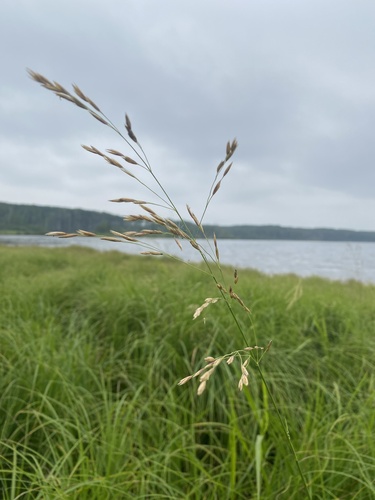
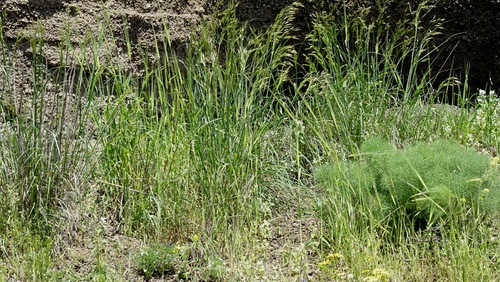
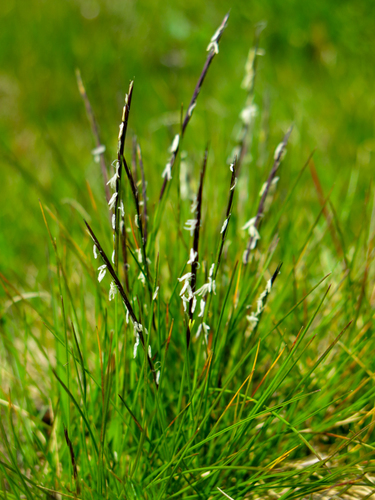
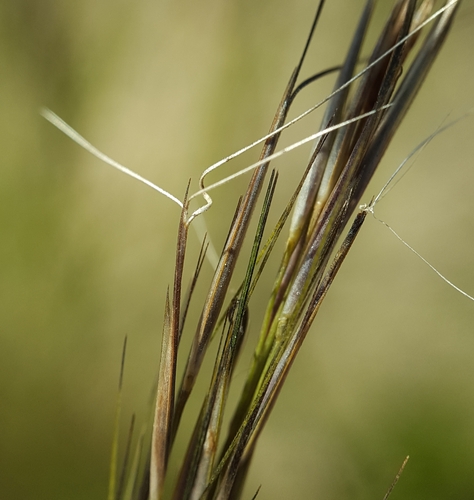
Aristida basiramea Vasey, commonly known as fork-tailed three-awn, is an annual grass. It branches freely from its base, and reaches a height between 2 and 6 decimeters (7.9 to 23.6 inches). Its wiry culms are only sparingly branched. The grass has narrow, flat leaves that become involute toward their tips. Its panicles grow from the basal sheathes. The glabrous glumes at the base of each spikelet taper gradually to a point, and average 1 to 1.5 centimeters (0.39 to 0.59 inches) in length. Each glume has a single vein and the two glumes on a spikelet are unequal in length. The lemma, not including its awns, measures approximately 1 centimeter (0.39 inches) long. The delicate lateral awns are 5 to 10 millimeters (0.20 to 0.39 inches) long, and they can be either erect or spreading. The middle awn is much longer and stouter, measuring 1 to 1.5 centimeters (0.39 to 0.59 inches) long, and forms a loose spiral when dry. Mature spikelets are light brown. The seeds are chestnut brown, and 6 to 7 millimeters (0.24 to 0.28 inches) long. This grass flowers from August to October. Aristida basiramea is endemic to North America, where it occurs most commonly in the continent’s midwest. Outlier populations exist as far south as Texas and as far east as Maine. It is rare in Canada, where it is only found in southern Ontario and Quebec. It does not grow any farther north than the upper peninsula of Michigan. This species grows in weedy habitats like roadsides or pastures, and it often grows in pine barrens. In Canada, it is occasionally found on open, dry sand ridges or dunes. It prefers dry or sandy soil and warm climates, despite being the hardiest member of its genus. Aristida basiramea is generally considered a poor forage grass, and it can be harmful to grazing animals due to its calli. However, it is an important source of forage in springtime, especially across its western distribution. Small mammals and quail feed on its hardy seeds.