About Arion vulgaris Moquin-Tandon, 1855
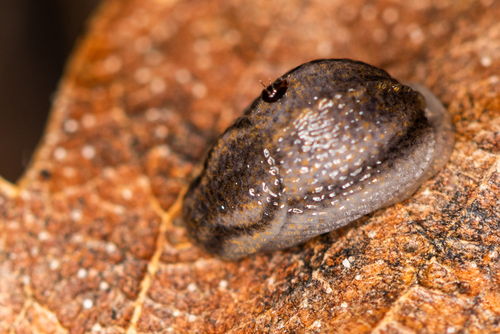
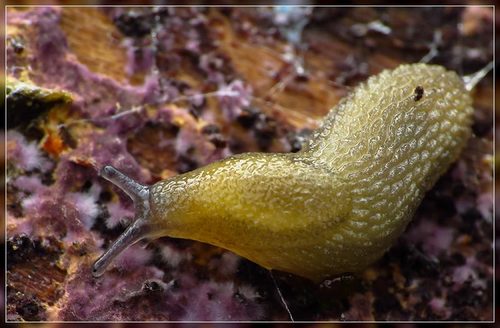
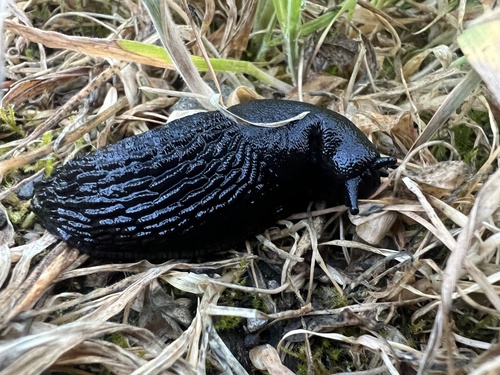
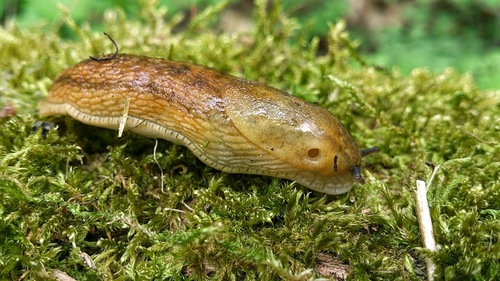
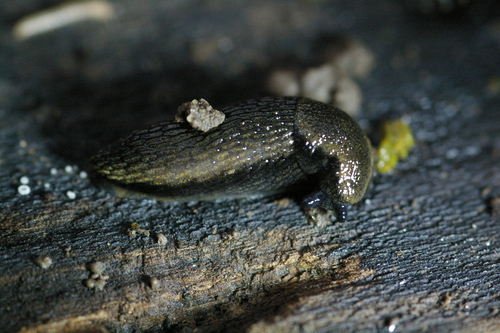
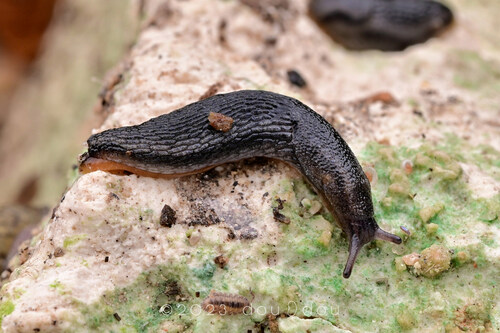
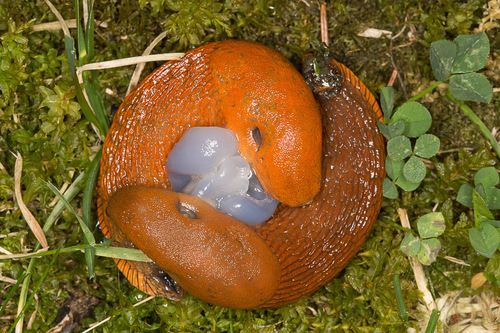
Adult Arion vulgaris slugs measure 60–140 mm in length. Their body color ranges from yellow to black, and is most often brick-red, dirty orange, or brown, with darker tentacles. Externally, adult A. vulgaris cannot reliably be distinguished from Arion rufus, so accurate identification requires dissection to examine genitalia. Juveniles of these two species can be told apart, as only A. vulgaris juveniles have longitudinal bands. Juveniles of other large Arion species, such as Arion flagellus, also have these longitudinal bands.
In A. vulgaris's reproductive system, the atrium is small. The adjacent section of the oviduct is dilated and muscular, matching the atrium's diameter, and contains a longitudinal ligula. This feature separates A. vulgaris from Arion ater s.l., which has a thinner oviduct and a larger atrium that holds the ligula. Arion flagellus also has a ligula in the dilated section of its oviduct, but its ligula does not extend as close to the atrium as the ligula of A. vulgaris. The spermatheca of A. vulgaris is spherical, with a diameter twice that of the oviduct.
The exact native range of Arion vulgaris is not confirmed. Genetic evidence showing a higher incidence of rare alleles suggests the species originated in France or Spain, which contradicts earlier genetic analyses that did not adequately sample these regions. The first recorded observation of A. vulgaris in Britain was in 1954, and this does not indicate the species is native there. It is presumed that the specimen used in Moquin-Tandon's original 1855 description was collected from France.
The non-native distribution of A. vulgaris covers almost all of Western and Central Europe, and extends into parts of Southern, Northern, and Eastern Europe. The first confirmed Asian records came in 2022, from Armenia and the Pacific coast of Russia. A 2017 report of A. vulgaris from Asian Turkey was not confirmed via dissection, and is likely a misidentification of A. ater s.l. A. vulgaris has also been recorded in Canada (2009) and Mexico. Historical reports of "A. lusitanicus" (likely referring to this species) from Madeira may be copied from an 1895 publication and require confirmation, while a 1975 report from the Azores may instead be true A. lusitanicus. Claims of A. vulgaris presence in Algeria also lack supporting evidence.
The documented timeline of A. vulgaris expansion across Europe is as follows: Great Britain has had the species since 1954, and it spread to Lincolnshire and Norfolk in 2012; France has seen expansion from the native range since 1955; Switzerland has had the species since at least 1956; Italy since 1965; Bulgaria since 1966; Germany since 1969; Austria since 1971; Belgium since 1973; Sweden since 1975; Slovenia and Croatia since 1982–83; Ireland since 1984; Hungary since 1985; Poland likely had the species since 1987, and was confirmed to have it by 1993; Norway since 1988; Netherlands since 1989; Spain (where it may be native, only confirmed in the north-east) since 1990; Finland since 1990, and it is abundant in southern Finland; Czech Republic since 1991; Denmark since 1991; Slovakia since 1992; Faroe Islands since 1996; Serbia and Montenegro since 2002; Iceland since 2003; Macedonia since at least 2003; Ukraine since 2007, and it has since spread across almost the entire country; Lithuania since 2008; Estonia since 2008; Latvia since 2009; Russia had records in greenhouses starting 2009, and outdoor populations starting 2019, with unconfirmed outdoor reports from 2015; Romania since 2012; Belarus confirmed the species in 2020, after an unconfirmed 2018 record.
A. vulgaris has not yet become established in the United States, but it is considered a potentially serious invasive pest that could harm agriculture, natural ecosystems, human health, and commerce. For this reason, experts have suggested that the species be given top national quarantine significance in the USA. As of 2014, British authorities also expressed concern that it could become a major pest.
Arion vulgaris inhabits all agricultural ecosystems, as well as natural habitats including river and lake margins, forest edges, valley forests, and meadows. In Switzerland, it has been found at altitudes up to 1700 m. Across much of Europe, it is a serious pest of agriculture and horticulture. It feeds on a wide cosmopolitan range of growing plant parts, plus decaying vegetation. It opportunistically feeds on carrion, including squashed members of its own species. It is most active at night, and during wet weather during the day. Population densities can reach 50 individuals per square meter, and can be even higher in some local areas. While individual slugs can crawl several meters in a single night, long-distance dispersal is thought to occur via vegetables, horticultural seedlings, and plant debris disposed of as waste.
This species has an annual life cycle. Mating begins in July, and eggs are first laid several weeks later in late summer. Clutches are laid either on the soil surface or in underground crevices up to 10 cm deep. The average clutch size is around 70 eggs, and a single adult typically lays approximately 400 eggs over its lifetime. Eggs hatch between autumn and spring. Neither eggs nor adult slugs can survive temperatures below -3 °C, so overwinter survival depends on sheltered hiding spots. Adults normally die off in autumn before winter frosts occur.