About Arion distinctus Mabille, 1868
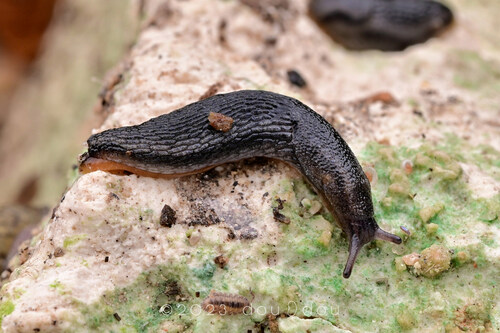
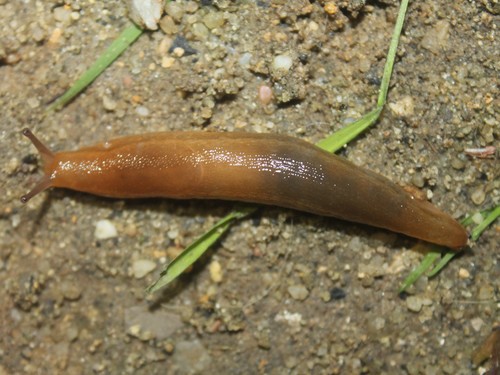
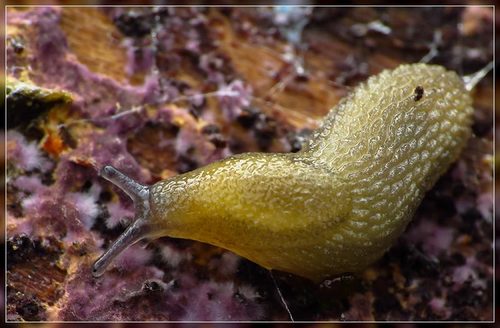
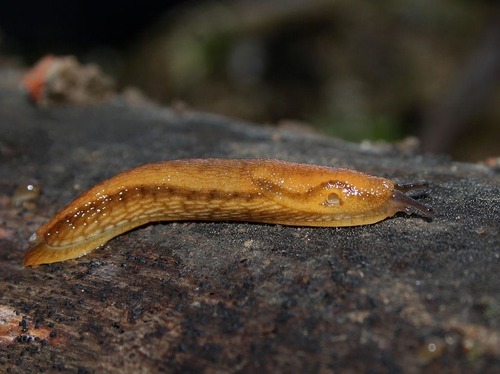
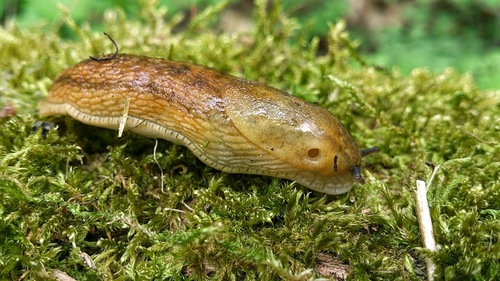
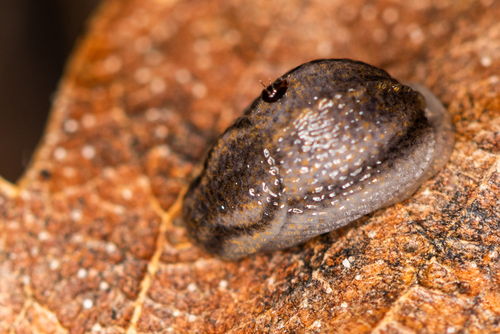
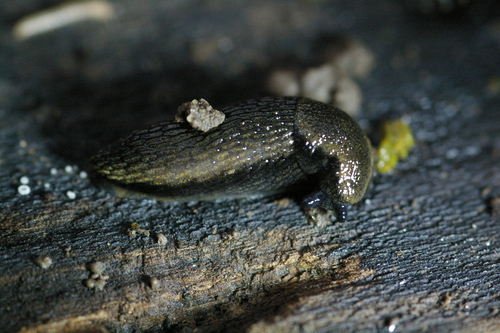
Like all other members of the genus Arion, the pneumostome of Arion distinctus is located in the anterior half of the mantle. When fully extended, this slug never grows larger than about 4 cm. Unlike members of the subgenus Carinarion (such as Arion circumscriptus), it has no dorsal line of pale tubercles that would suggest a keel, and its body shape in cross-section is a circular segment rather than a bell shape. It does not have the prickly tubercles found in A. intermedius, and it is larger and darker than this species, with prominent lateral bands. Preserved specimens of A. subfuscus and A. fuscus can look very similar to A. distinctus, but living individuals of these two species have bright orange body mucus and a pale sole, while A. distinctus has a sole that appears yellow or orange from its sole mucus, with no colored body mucus. Even so, reliably distinguishing A. distinctus from other members of the subgenus Kobeltia based on external features alone is not always straightforward. Across most of Western Europe, the Kobeltia species most commonly confused with A. distinctus is A. hortensis, and mixed populations of the two species often occur. Scientific authorities do not agree on how reliably the two species can be separated using external characters from living specimens. Useful identifying differences are that A. distinctus has dark tentacles without the red or violet tinge that is typical of A. hortensis; the overall color of its back is yellower or browner than A. hortensis; the row of tubercles directly above the sole is not as white as is typical for A. hortensis; and (least reliably) its lateral bands tend to run lower, passing through the pneumostome rather than above it. Dissection showing a two-partite oviduct confirms a specimen is A. distinctus, but a large proportion of individuals in most regions have a three-partite oviduct that matches that of A. hortensis. The definitive trait that distinguishes A. distinctus from all other Kobeltia species is a conical structure inside the atrium that covers the entrance to the epiphallus, although this structure does not develop in juveniles. This structure is involved in receiving the partner's spermatophore during mating.
Arion distinctus lives in a wide range of moist habitats, including gardens, waste ground, and woodland, but it may be absent from harsh upland environments. In Switzerland, it can be found at elevations up to 2000 m. It is typically found among ground litter, or sheltering under wood, stones, and soil clods. Most studies in agriculture and horticulture have not separated A. distinctus from A. hortensis, but both species are recognized as economically significant pests.
This species is thought to be native to Western, Northern, and Central Europe, but it has spread eastwards, especially into human-associated synanthropic habitats. Confirmed records from Andorra are the only verified occurrences of this species on the Iberian Peninsula. A. distinctus has also been introduced to regions outside of Europe. The list below only includes records where A. distinctus was explicitly distinguished from A. hortensis: Azores, Madeira, South Africa (identification considered probable), Canada (British Columbia, Ontario, Nova Scotia), USA (California, Pennsylvania, Hawaiʻi), Taiwan, New Zealand.
For most existing studies on the life cycle and reproduction of A. distinctus, it is unclear whether authors studied pure A. hortensis populations, pure A. distinctus populations, or mixed populations. However, a more recent study of a pure A. distinctus population in southern England reported results that match most earlier work (it does not match results from Hunter 1968, which suggests that 1968 study likely focused on A. hortensis). In this pure population, the majority of individuals reached maturity in early winter, and adults survived until summer. Eggs laid at the start of this period grew to adult size by the beginning of summer, but these individuals moved underground for the summer and did not become reproductively mature until the end of the year. This follows an annual life cycle. Development of slugs hatching from eggs laid later in spring was delayed by dry summer conditions, creating a bimodal size distribution in autumn. These slower-developing slugs only reached maturity in spring, and some may delay maturity even further. Because of this variation in development timing, most studies report that A. distinctus can be found at every size throughout the year, though reproducing adults are mostly absent during summer and autumn. A. distinctus matures several weeks or more later than its close relative A. hortensis. When kept in captivity at 12–15 °C, eggs took approximately 27 days to hatch. Genetic evidence indicates that A. distinctus is at least predominantly an outbreeding species, and captive individuals only produce offspring when kept with another member of the same species. The two oviduct morphs of A. distinctus mate freely with each other, even though only the tripartite form can evert its oviduct over the back of a mating partner. Copulation lasts 20–30 minutes, which is considerably shorter than copulation in A. hortensis. A. distinctus has been observed mating with A. hortensis in the wild, but no hybrids between the two species have ever been recorded.