About Arion ater (Linnaeus, 1758)
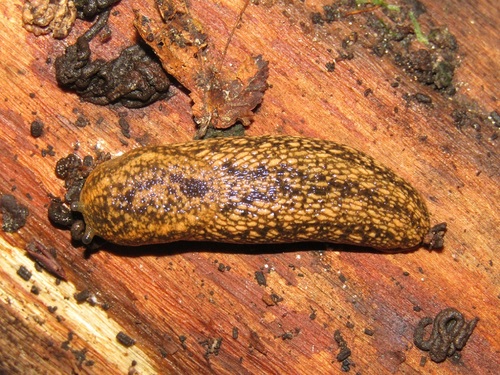
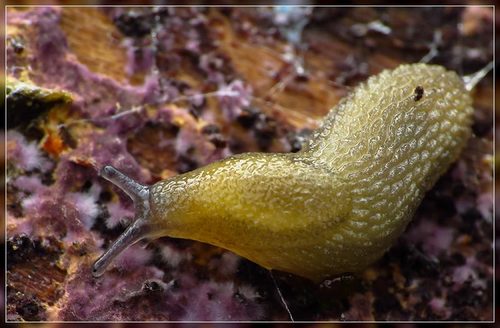
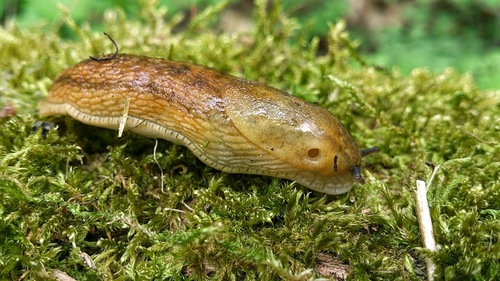
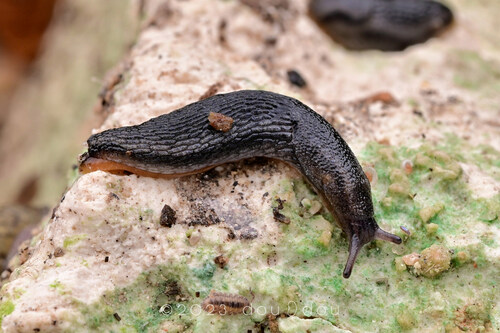
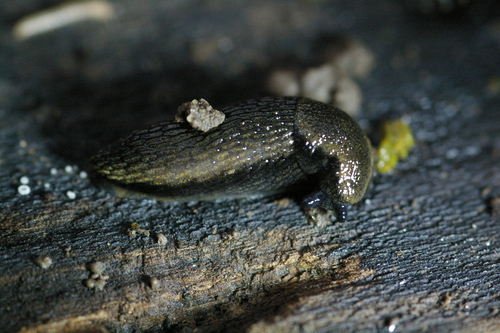
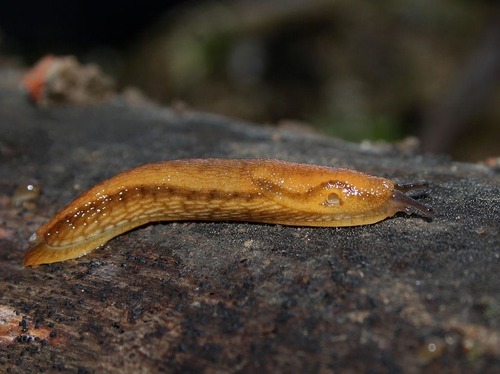
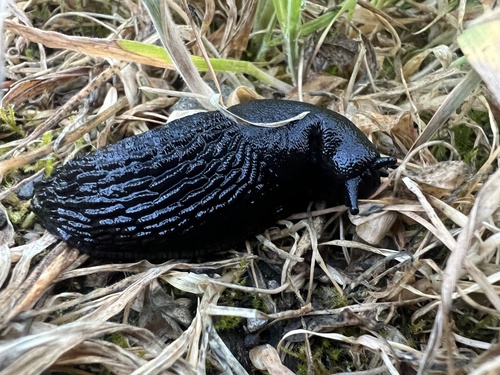
Arion ater (Linnaeus, 1758), commonly called the black slug, has an adult body length that ranges from 10–15 cm (3.9–5.9 in), reaches sexual maturity at around 2.5 cm (0.98 in), and can move at speeds up to 4.5 cm/min (1.8 in/min). It is generally deep black in color, though some adults may be brown or even white. Pigmentation typically darkens with increasing latitude. Young specimens are usually brown or ivory whitish, turning grey before developing their characteristic mature black color. Rust-brown individuals are sometimes classified as the separate subspecies Arion ater rufus or the separate species Arion rufus (red slug), and the two can only be distinguished by dissecting reproductive anatomy. The slug has a black foot-fringe, large and elongate tubercles, and a blackish grey sole. In its genitalia, the atrium and vagina are considerably narrower than the spermatheca, the sperm-storing organ; the oviduct is narrow, while the spermatheca is spherical. The black slug is omnivorous, with a diet that includes fungi, carrion, earthworms, leaves, stems, dead plant material, and dung. It shreds food into tiny pieces with its radula, then digests the food via enzymes. Like other terrestrial slugs, the black slug is a hermaphrodite. It prefers to find a mate, often multiple mates, but is capable of self-fertilization. After mating, it seeks a dark, moist environment such as beneath mosses, and occasionally within topsoil, to lay its eggs, which are about 5 mm (0.20 in) in diameter. Between August and October, an individual slug lays up to 150 eggs every one to three weeks, with clutch sizes shrinking to 20 eggs late in the season. Juveniles hatch after at least twenty-seven days, and hatching is later when temperatures are cold. Maturation takes up to nine months, allowing mating in early summer. Black slugs die shortly after laying their last clutch, and rarely survive into a second year. Details of its reproductive anatomy: the ovotestis, the hermaphrodite gonad, produces gametes at the proximal end of the reproductive system. The hermaphrodite duct runs forward, connecting to the albumen gland and the common spermoviduct. Male and female gametes separate before entering the common duct. The male portion of the reproductive tract contains the vas deferens and the epiphallus; Arion slugs lack a penis. The vas deferens connects the spermoviduct to the epiphallus, which then opens into the genital atrium. The spermathecal duct, a sac for storing spermatozoa, also enters the atrium. The female portion contains the oviduct, which transfers eggs from the common duct to the atrium. The atrium is further divided into an upper and lower atrium, and contains a stimulating organ called a ligula. Finally, the atrium opens through the genital pore, which is located slightly behind and below the right upper tentacle on the head. Like other members of the family Arionidae, the black slug has a pneumostome, a breathing hole, on the right side of its mantle, which it uses for respiration. In snails, the mantle secretes a shell; in the black slug, the mantle holds a resilient protective structure made of calcareous granules. Arion ater produces three forms of mucus. The first two aid in locomotion: a thinner mucus coats the slug's lateral surface, and a thicker, more viscous mucus is secreted along the slug's length. This combination enables wave-like contractions of the foot that propel the slug forward. The third type of mucus is a vile-tasting substance that deters predation. All three forms of mucus help protect the slug from dehydration, and also allow it to locate and identify other slugs for mating, or to locate prey. The species is native to northern Europe (including Great Britain and Ireland), and has been introduced to Canada, the Pacific Northwest of the United States, Australia, and some Caribbean countries. Its specific documented populations include: in Great Britain, it is often found in more wooded, less human-dense habitats than A. ater rufus; it occurs in the Maladeta Mountains of Spain, Ireland, Italy, Germany, Scandinavia, and Gerês, Portugal; in Canada, it is an invasive species first documented in 1941, and became an established pest by 1960, with populations recorded in British Columbia, Newfoundland, and Quebec (specifically on Mont Bellevue in Sherbrooke); in the United States, it is an invasive species well-established in Washington and Oregon, and is considered a potentially serious invasive pest that could negatively affect agriculture, natural ecosystems, human health, or commerce, so it has been suggested that the species receive top national quarantine significance in the USA; in Australia, it is an invasive species first documented in 2001, with multiple reports from cultivated gardens and farms since that time, but as of 2009, it was still not considered an established species in Australia. Within its native range, this species acts as a decomposer and consumer, and often becomes an agricultural pest. Ecologically, the black slug is mainly nocturnal and avoids sunlight, though it has been observed to be active throughout the day and night in introduced areas. It is omnivorous, feeding on carrion, fungi, animal feces, algae, lichen, and both living and decaying vegetation. These slugs prefer to feed on cloudy days or at night when temperatures are above 10 degrees Celsius. Mucus production requires moist habitats, such as leaf litter, among mosses, or under fallen trees, so the black slug is most active after rainfall. A 1976 UK study compared the assimilation rates of the black slug to those of similar slug species, finding it feeds at similar rates to other European slugs when measured by biomass, meaning it is an equally important decomposer and consumer in forest systems. The study theorized that these high assimilation rates may come from abundant digestive enzymes in the slug's digestive system: amylase, invertase, cellulase, xylanase, and chitinase. The presence of chitinase may explain how these slugs can consume large quantities of fungi such as Armillaria mellea. Microbiota within the black slug's digestive system produce these enzymes; for example, bacteria produce cellulase, which allows the slug to break down lignocellulose. A more recent study of Arion ater's gut microbiome found that black slugs have far more gut bacteria than neighboring northern European insects from the orders Coleoptera, Isoptera, Orthoptera, and Diptera. This study also found that the black slug's gut microbiome functions across a wide range of temperatures and pH levels, results suggest mycobacterial culture may be uniform throughout the gut, and that Gammaproteobacteria makes up most of this culture. The study contrasted its findings with studies of North American black slugs that have higher levels of cellulolytic activity over a narrower pH range. Overall, Arion ater can digest diverse food materials including cellulose because gut bacteria produce the necessary digestive enzymes. As decomposers and consumers, slugs fill an important ecological niche that contributes to ecosystem health. A 2005 study of another Arion slug species concluded that slugs may promote plant biodiversity, particularly for forb species, support the fitness of annual plant species, and reduce rates of successional change. Slugs also help disperse seeds and spores through their waste, and facilitate nutrient cycling both as omnivorous consumers and decomposers, and through their leftover mucus that also aids decomposition. At the same time, black slugs are common agricultural and horticultural pests. They consume large amounts of vegetative matter, especially seedlings, and many people consider them unsightly. Most animals avoid preying on black slugs due to the bad taste of their mucus, and the mucus also makes the slugs slippery and hard to capture. However, the black slug does have natural predators, including hedgehogs, badgers, shrews, moles, mice, frogs, toads, snakes, carnivorous beetles, and some birds. When picked up or touched, the black slug contracts into a hemispherical shape and begins to rock from side to side. This defensive behavior confuses predators, and is unique to the family Arionidae. For human use, Arion ater was used as grease to lubricate wooden axles or carts in Sweden, a use documented since at least the 18th century. Black slugs are edible but are rarely consumed by humans; they taste unpleasant, may bioaccumulate pesticides, and can potentially carry French heartworm (Angiostrongylus vasorum) that can infect carnivores including dogs. Research on the black slug has provided human and ecological value. A 1996 study investigated mercury bioaccumulation in black slugs and found the slugs can be used to monitor heavy metal levels in terrestrial systems, similar to how ecologists use aquatic mollusks. A 2014 study researched the gut microbiology of the black slug, with the goal of informing other studies of cellulolytic activity that could improve biofuel technology.