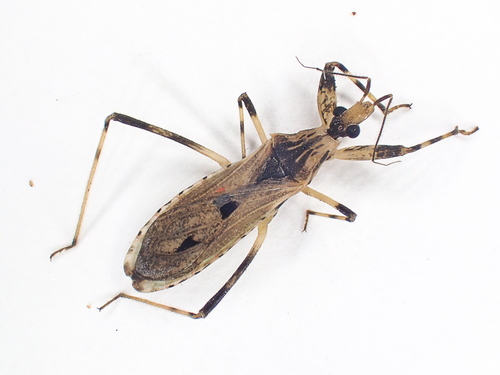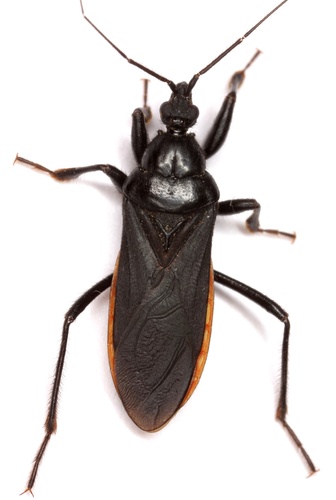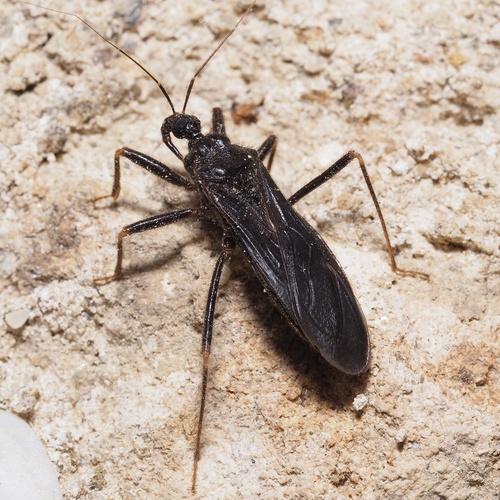
About Arilus cristatus (Linnaeus, 1763)
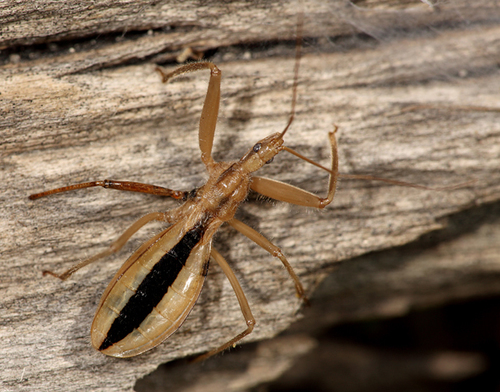
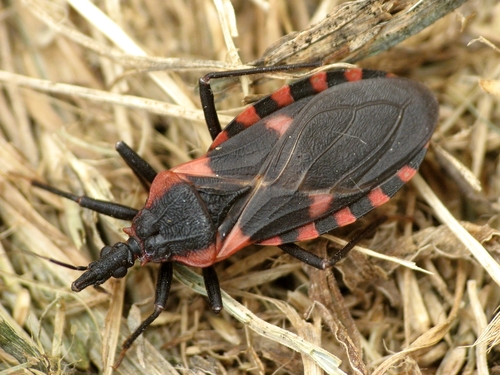
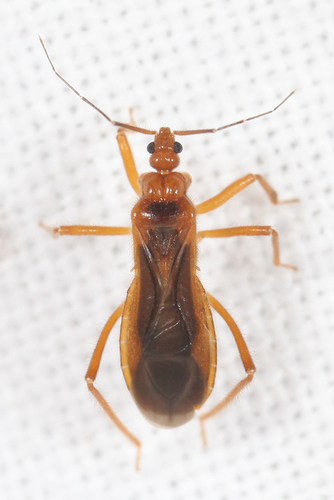
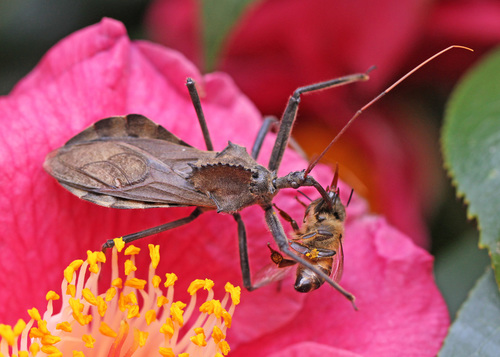
Description: Adult Arilus cristatus are gray to brownish gray, and are black shortly after molting. Nymphs, which do not yet have the species' characteristic wheel-shaped structure, have bright red or orange abdomens. Like other wheel bug species, A. cristatus has a distinct dorsal crest shaped like a wheel or cog. These bugs move and fly slowly, and produce a noisy buzzing sound when flying. As with other assassin bugs, their proboscis grows from the anterior end of their long, tubular head, and unfolds forward when feeding. A. cristatus has two red-orange scent glands that can be ejected from the abdomen, each with a different chemical function: one gland is used for defense, and the other is used in breeding behaviors. The scent these glands produce is less strong than the scent produced by stink bugs, but is still strong enough to be detected by humans. North American wheel bugs have armored forewings and membranous hind wings, which enable the species to fly. Because A. cristatus cannot move quickly, it relies heavily on camouflage, the effect of its bite, or producing unpleasant odors to avoid predation. Distribution: North American wheel bugs are most common in eastern Canada and the United States, and their range extends into Mexico and Guatemala. Arilus is a western hemisphere genus with five currently living species, and only A. cristatus is found in the United States. Reproduction: The reproductive cycle of A. cristatus begins in autumn. After mating, females lay 40 to 200 small, brown, cylindrical eggs, then eventually die. Females lay eggs on trees, bushes, twigs, and other objects. Glue secreted by the female acts as an adhesive to keep the egg cluster intact. Eggs hatch the following spring into 8-millimeter-long red nymphs. Nymphs undergo five molts before reaching the adult stage the following summer. After nymphs hatch, the average length between each molt is roughly 18.8 days; the interval of the fifth and final molt before adulthood is the longest. Eggs generally hatch in early May, and nymphs fully mature into adults by July. In total, nymphs take roughly 94 days to reach maturity. The timing of this life cycle changes based on the climate of the population's location; for example, populations in warm climates may not overwinter as eggs. In a laboratory study carried out at Southern Illinois University in 1997 and 1998, researchers found that A. cristatus eggs can be attacked by parasitic wasps such as Ooencyrtus johnsoni. Of the 12 monitored egg clusters in the test, 10 were severely damaged by parasites that prevented the eggs from hatching normally. A. cristatus is predatory immediately after hatching, but the distinctive wheel unique to this species only develops after the final molt when the bug reaches adulthood.