About Arignota stercorata (Lucas, 1894)
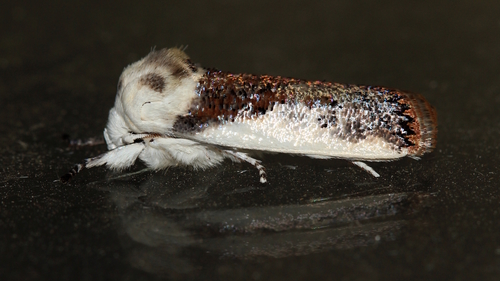
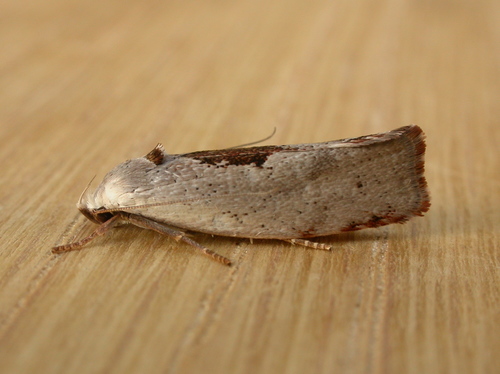
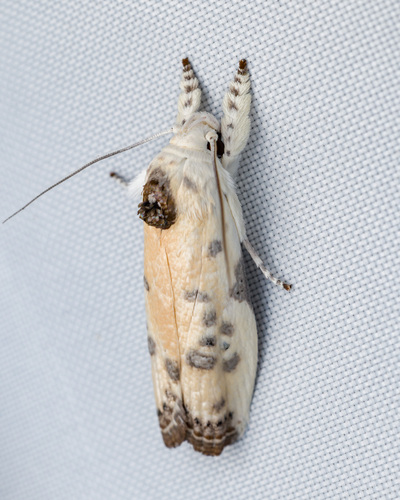
Arignota stercorata is a species of moth belonging to the family Xyloryctidae. It was first described by Thomas Pennington Lucas in 1894. This moth is found in Australia, where it has been recorded from the regions of New South Wales and Queensland; it also occurs in Papua New Guinea. The wingspan of Arignota stercorata ranges from 28 to 35 mm. Its forewings are white, marked with a number of pale leaden-coloured spots that resemble bird droppings. An acute-shaped spot sits in the centre of the forewing, and a splash of colour tinted with ferrous is located in the inner angle of the wing base. A triangular blotch occurs at three-fifths along the costa, and there are five distinct round spots: the first lies near the costa at one-eighths of the wing, the second is positioned obliquely posterior to the first, the third sits before the middle of the wing at its centre, the fourth is at three-fourths of the wing, and the fifth is aligned with the fourth but closer to the costa. Two sharp dots are arranged diagonally relative to the first and second spots. Four dots form a rhomboid figure at three-fifths of the wing, with the two rear dots tinted purplish black. There is also an obscure dot on the hindmargin at five-sixths of the wing, and a second obscure dot located halfway between this spot and the wing apex. The forewing has three rows of fine hindmarginal spots. The hindwings of Arignota stercorata are white. The larvae of this moth feed on Elaeocarpus obovatus. They bore into the host plant's stem, and feed on leaves that they cut off and attach to the entrance of their tunnel.