About Aricia artaxerxes (Fabricius, 1793)
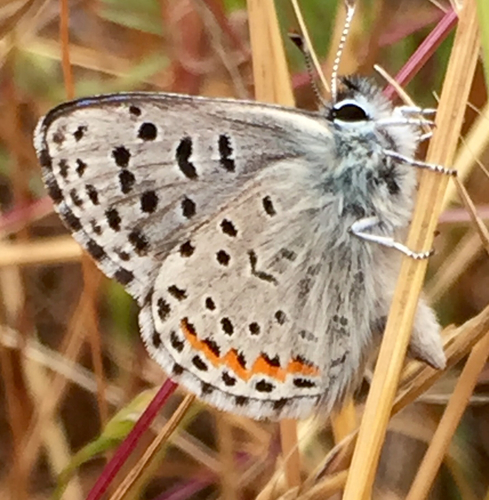
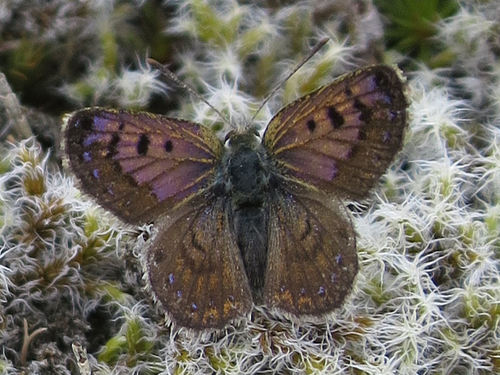
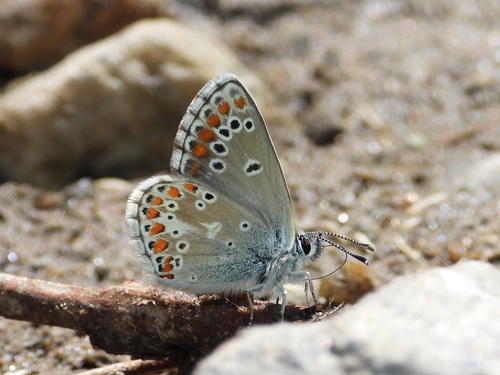
The northern brown argus, with the scientific name Aricia artaxerxes (Fabricius, 1793), is a butterfly belonging to the family Lycaenidae. It is distributed across much of the Palearctic realm. This species has confused British entomologists for many years. After it was first discovered in Britain, experts have alternately classified it as either a form or subspecies of the brown argus (Aricia agestis), or as a separate species. Since 1967, all brown argus butterflies found in northern England and Scotland have been classified as A. artaxerxes. Recent genetic studies have revealed that some colonies along the border of the two species’ ranges are still misclassified, and some colonies in northern England are now thought to be A. agestis. As far as current knowledge goes, the ranges of these two species do not overlap in the United Kingdom. The Scottish form of A. artaxerxes is quite visually distinct from the brown argus. It usually has a small white dot in the center of the upperside of its forewing; the black spots on its underside are absent, leaving larger white spots against a light brown background. Populations in northern England belong to the form salmacis, called the Durham argus in English. These individuals are very similar to the brown argus, including having black spots on the underside of their wings — which explains the historical classification confusion. Across Europe, this species is known as the mountain argus, and it is widespread in Scandinavia as well as the mountainous regions of central, southern and eastern Europe. In Britain, the species is considered locally rare, and the UK has created a detailed Biodiversity Action Plan to conserve this species along with a small number of other butterfly species. All information in this section about the species’ life cycle and food plants applies specifically to populations in Great Britain, and some details may not match populations in other parts of the species’ range. Females lay eggs singly on the upperside of food plant leaves. As far as is known, common rock-rose (Helianthemum nummularium) is the sole food plant for this species in Britain. Larvae hibernate when they are still quite small, and resume feeding and growing the following spring. Like the brown argus, A. artaxerxes is attractive to ants, and is often attended by them. Pupation occurs at ground level in late May, and adult butterflies are active in flight from mid-June to mid-July.