About Arianta arbustorum (Linnaeus, 1758)
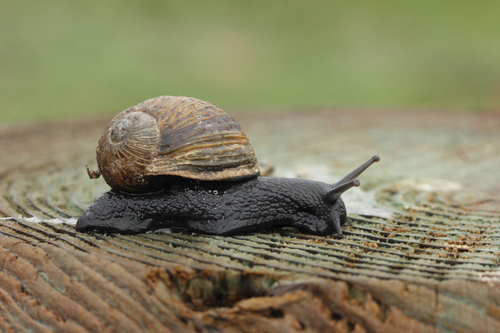
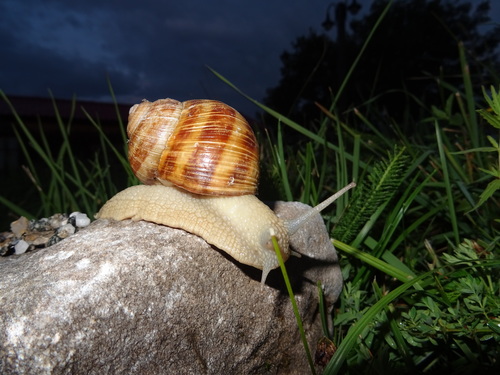
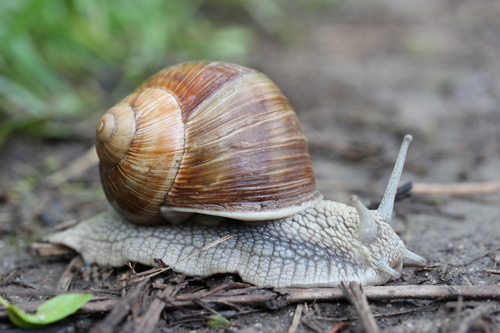
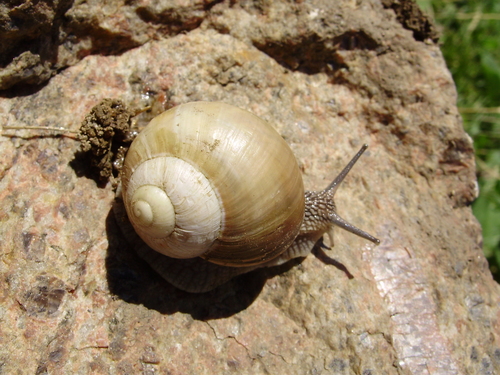
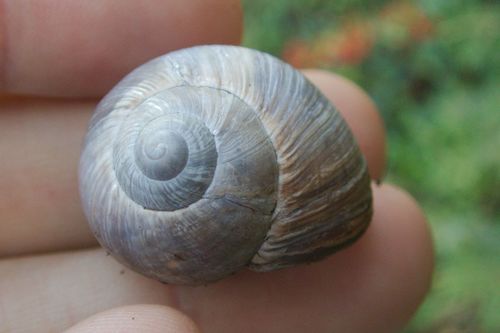
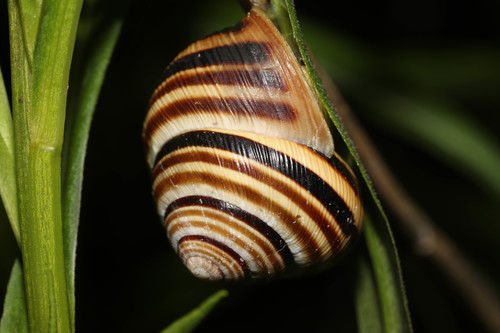
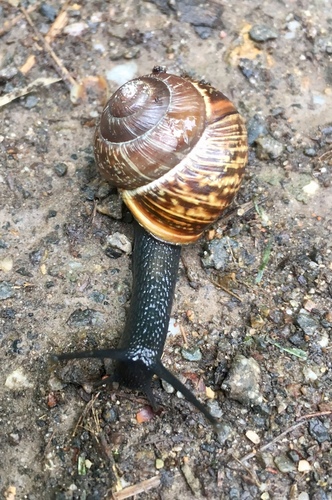
Description: The shell of Arianta arbustorum is most often brown, marked with multiple pale yellowish rows of spots, and usually bears a brown band above the periphery. It may occasionally be yellowish, reddish, or carry a greenish hue. The upper side of the shell is weakly striated and marked with fine spiral lines. The shell has 5 to 5.5 convex whorls with a deep suture. The final whorl descends slightly near the aperture. A prominent white lip appears inside the aperture, and the apertural margin is reflected. The umbilicus is fully covered by the reflected columellar margin. The shell measures 18 to 25 mm in width and 12 to 22 mm in height, and dimensions vary between local populations. Most modern populations have a globular shell shape; it is believed that Pleistocene populations originally had depressed shells. Shells became globular after the species invaded lowlands, and the species has since re-invaded mountain regions, leaving only a few isolated spots among glaciers with the original depressed shell form. The soft body of the snail is usually black. Distribution: This species is native to Europe, where it occurs in north-western and central Europe, including the Alps, Carpathians, Netherlands, Austria, Czech Republic, Slovakia, Poland, and Switzerland. It is one of the most common land snail species in Switzerland, and can reach very high population densities of up to 20 adults per square meter. It is also found in the eastern Pyrenees (Spain), Norway, Iceland, the Faroe Islands, and the British Isles (Great Britain and Ireland). In Britain, the species has declined slightly due to intensive farming and ongoing destruction of suitable uncultivated refuge habitats. It is rare in Ireland. Additional native locations include Kaliningrad, Finland, Estonia, Latvia, with scattered occurrences reaching Serbia and Bulgaria. It is rare in Bulgaria, and also occurs in western Ukraine. In Finland, the species has become so common in the Porvoo region east of Helsinki that it is locally known as the "Porvoo snail". Arianta arbustorum has been introduced to North America, where established populations are only known from Canada, specifically Newfoundland, New Brunswick, Ontario, and Prince Edward Island. It has not yet become established in the United States, but it is considered a potentially serious threat as a pest and invasive species that could negatively impact agriculture, natural ecosystems, human health, or commerce. For this reason, it has been suggested that the species should be given top national quarantine significance in the USA. Life cycle and habitat: Arianta arbustorum inhabits forests and all types of open habitats, and requires humid conditions. It also lives in disturbed habitats, with the exception of Ireland, where it is restricted to old native woodland. It can tolerate non-calcareous substrate in some local areas, and is found on sandhills in northern Scotland. Its elevation range reaches up to 2700 m in the Alps, 1200 m in Britain, and 1500 m in Bulgaria. It feeds on green herbs, dead animals, and faeces. Snail individuals hatching more than 50 m apart from each other are considered reproductively isolated, because the species does not move more than 25 m over its lifetime; its typical neighbourhood range is 32 to 50 m. Individuals usually move 7 to 12 m per year, mostly along water currents. During mating, this snail species produces and uses calcareous love darts. Reproduction most often occurs after copulation, but self-fertilization is also possible. Eggs measure 3.2 mm across. Individuals reach maturity after 2 to 4 years, and can live up to a maximum of 14 years. This snail species can be successfully experimentally infected with Angiostrongylus vasorum.