About Arhopala atrax (Hewitson, 1862)
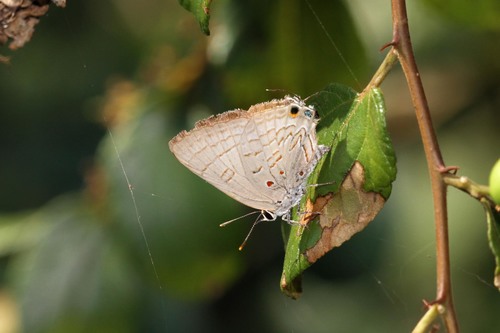
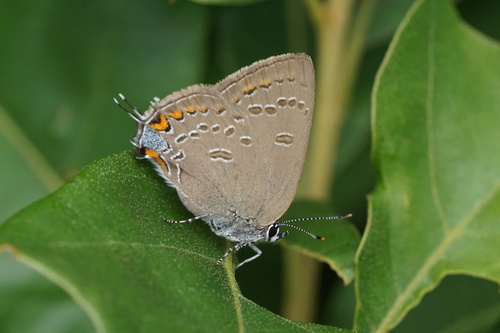
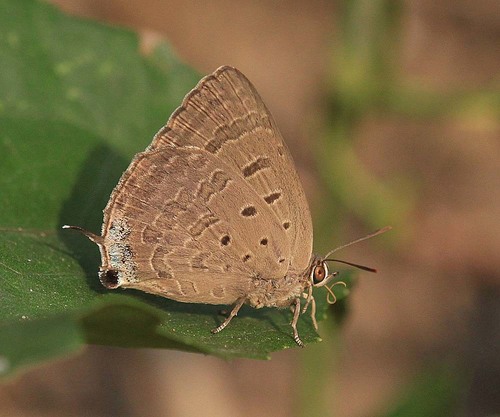
This description covers male and female specimens of Arhopala atrax. For males: The upperside is purplish-blue, and shines in certain lighting. The forewing has a narrow black costal band, and an outer marginal black band that is roughly twice as broad. The hindwing has a black costal space and black outer marginal line; the tail is black with a white tip, with faint indications of a blackish spot on the margin on each side of the tail, and the abdominal fold is grey. The cilia are black with white tips. The underside is pale brown with a lilac tint; markings are darker brown and edged with white. The forewing has three oval cell spots that increase in size towards the outer edge, with an outwardly oblique spot below the outermost cell spot, and another similar outwardly oblique spot in the next lower interspace just below the middle cell spot; all these spots are well separated from each other. There is a discal band of seven spots: the first four are conjoined and outwardly oblique, with the second and fourth positioned a little further outwards; the fifth spot is angled inwards, with its upper outer end almost touching the lower inner end of the fourth spot, and connected to the sixth spot which is oriented outwardly obliquely; the seventh spot is angled inwards with the same oblique orientation, and has a small mark attached to its lower end; the hinder marginal space below and between these spots is pale. The hindwing has four sub-basal spots that are almost in a straight line, with the fourth positioned slightly inwards; this is followed by three slightly larger oval spots in a line, the third of which has an irregular shape; there is an outwardly curved bar at the end of the cell, with a small spot attached to its lower end; there is a discal series of eight spots: the first two sit below the costa, the lower ends of the second spot touch the upper ends of the discoidal bar and the third spot, the third spot is conjoined with the other four spots that form an outward curve, the fourth and sixth spots are shifted outwards, and the seventh is angular as is typical for this species. Both wings have a brown marginal line, a somewhat lunular submarginal band, and a series of smaller lunular marks between these two lines. For females: The upperside is brighter blue and paler than the male. The forewing has a black spot at the end of the cell that runs into the broad black costal band; this band widens gradually from the base, is very broad at the apex, and continues broadly and evenly down the outer margin. The hindwing has very broad black areas along the costa and outer margin. The underside matches that of the male.