About Argyrophenga antipodum Doubleday, 1845
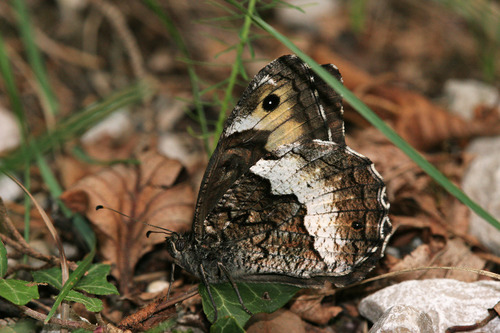
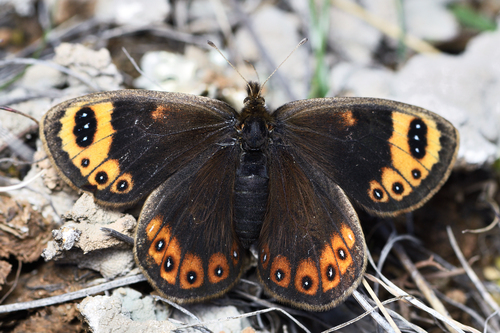
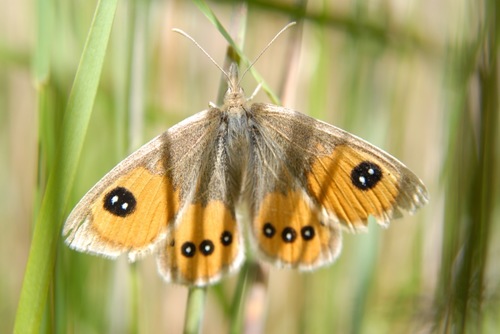
Argyrophenga antipodum, commonly known as the common tussock butterfly, has a body length of approximately 12–17 mm and a wingspan of about 35–45 mm. Males and females differ in body shape: females are shorter with more rounded bodies than males. Common tussock butterflies have very distinct silver streak markings on the underside of their wings, which helps them camouflage. The butterflies themselves are brown and red, with distinctive eyespots thought to be an evolutionary adaptation to deter attacks from predators. The two sexes also have different coloration: males are darker with more red and brown tones, while females are more yellow. Despite this color difference, males and females have very similar patterns on both the top and underside of their wings. This butterfly species is endemic to New Zealand, and is found only in the eastern, southern, and central regions of New Zealand's South Island. It is most abundant in lowland Canterbury, Otago, and Southland. Studies note that A. antipodum is not found in other areas of New Zealand, even where suitable habitat is available. Common tussock butterflies occupy a variety of habitats, ranging from sea-level saltmarshes and grasslands up to the alpine zone at 1950 metres elevation. A. antipodum can be abundant in both native and introduced grasslands, whether tall or short, as well as in various open-country, semi-natural landscapes across the South Island. It is commonly seen along roadsides near old forest sites and within ungrazed grassland habitats. At sea level along the Southland coast, A. antipodum has been found in mosaic habitats that include salt marsh, swamp, and tussock grassland. A new generation of common tussock butterflies hatches every year, and adult butterflies can be found from late October to late March. In the larval stage, caterpillars camouflage themselves among various tall and short grasses that act as their host plants. This camouflage ability continues when the species develops into pupae, the chrysalis stage of development. Adult A. antipodum are sexually dimorphic and have distinct behavioural differences between the sexes. Males fly faster and more frequently, while smaller females spend more time among flowers and grass to lay their eggs. A study of Argyrophenga in central Otago recorded the flight period from November to March, finding A. antipodum abundant in grassland host plants from late November to late February. The species is capable of covering relatively large flight distances: one marked male was recaptured one week later roughly 1 kilometre from its original capture location. New Zealand has relatively few native butterfly species, so existing endemic species are considered culturally important for biodiversity conservation, including the endemic common tussock. Native Māori never used these butterflies for any specific cultural purposes, but butterflies are called pūrerehua in te reo Māori, and pupae are commonly referred to with a term that translates to 'nod'. This name comes from the nodding-like motion the pupa's abdomen makes as it bends back and forth. Pupae were sometimes used in a traditional children's game: children would ask their grandparents for permission to hold a pupa between their thumb and forefinger, then ask it a yes-no question such as 'am I a good girl?'. A upward bend of the pupa's abdomen meant the answer was 'yes', while a downward bend meant the answer was 'no'.