About Argyrochosma microphylla (Mett.) Windham
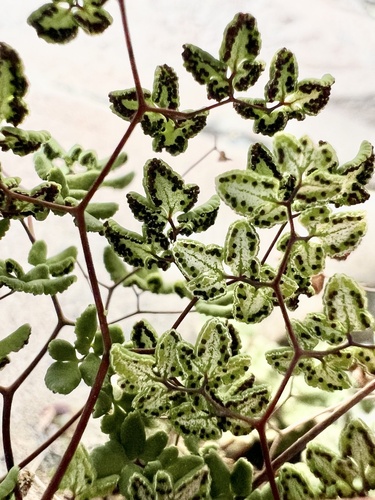
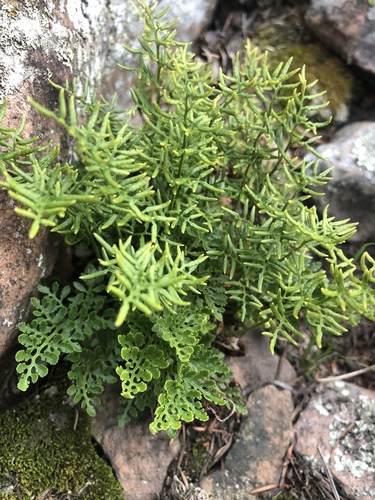
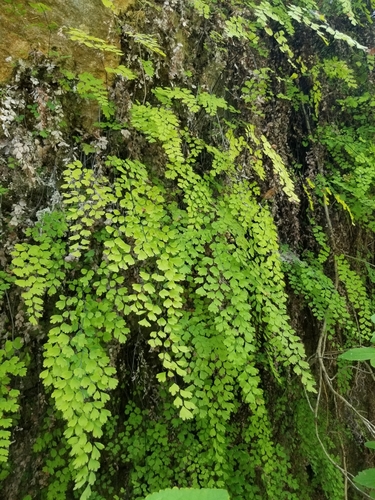
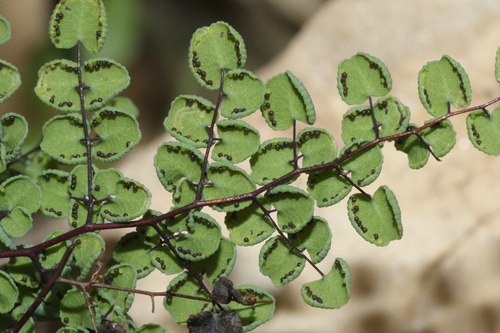
Argyrochosma microphylla (Mett.) Windham has a short horizontal rhizome with closely spaced leaves. The rhizome carries thin, uniformly colored brown to dark orange, chestnut-brown, or reddish-brown scales, which are narrowly lanceolate or linear, 4 to 7 millimeters (0.2 to 0.3 in) long, with entire toothless margins. Leaves grow in clumps and are 7 to 25 centimeters (2.8 to 9.8 in) long. The stipe, the leaf stalk below the blade, is 3 to 12 centimeters (1.2 to 4.7 in) long and 0.75 to 1.5 millimeters (0.030 to 0.059 in) in diameter, making up one-third to one-half of the total leaf length. Its upper surface is rounded, somewhat flattened, or grooved; it is colored reddish-brown to dark brown or chestnut brown, usually darker at the base, and lacks hairs or scales except for a small number of rhizome-like scales at its very base. Leaf blades measure 5 to 14 centimeters (2.0 to 5.5 in) long and 2 to 7 centimeters (0.8 to 3 in) wide. They range in shape from deltate triangular to ovate. They are most divided at the base, where they are tripinnate cut into pinnae, pinnules and pinnulets to quadripinnate, becoming only bipinnate near the tip. The blade is abruptly truncate at the base, and acute pointed to acuminate at the tip. The rachis, the central leaf axis, is flattened or shallowly grooved on its upper surface, and may be straight or somewhat zig-zagging. It is dark in color, though lighter than the stipe, and this dark coloration also extends to the axes of leaf segments. The dark color ends abruptly at a joint located at the base of each leaf segment. There are 5 to 9 pairs of pinnae, which alternate along the rachis or are nearly opposite, and narrow abruptly near the tip. Costae, the axes of individual pinnae, are straight to somewhat zig-zagging; when they zig-zag, they typically do not branch at the angles. Leaf segments are orbicular circular to cordate heart-shaped. When dry, they curl and appear narrow or triangular, and each is borne on a small stalk. The leaf tissue is gray-green and leathery, hides veins from the upper surface, and bears no hairs or scales on either surface. Unlike many species in this genus, no powdery farina is present on either leaf surface, although both leaf surfaces are glaucous. On fertile leaf segments, sporangia sit close to the margin, growing along the outermost third of secondary veins branching from the segment midrib. They form a band around 1 millimeter (0.04 in) wide along the edge of each segment. Each sporangium holds 64 spores. Leaf segments bend or curl under, and often hide the sporangia. The curled tissue has the same texture as the rest of the leaf, and is not modified into a false indusium. Fertile segments often fold along their long axis. This species is a sexual diploid, with a chromosome count of 2n = 54. Small leaf segments and the shallow groove on the rachis distinguish A. microphylla from other species in the genus. While the zig-zagging rachis seen in some specimens resembles Argyrochosma fendleri, A. fendleri produces farina, and its smaller leaf axes also zig-zag. Among other farina-lacking North American Argyrochosma taxa, Argyrochosma formosa has somewhat larger leaf segments and a dark, straight rachis that does not have a groove. Argyrochosma jonesii and Argyrochosma lumholtzii lack the distinct joint at the base of the leaf segment, and do not form dramatically folded leaf segments when dry. In the United States, Argyrochosma microphylla is found in southeastern New Mexico and Trans-Pecos Texas, with isolated outlying occurrences as far as Brazos County, Texas and Bernalillo County, New Mexico. In Mexico, it ranges across northern states from Sonora to Nuevo León, extending south into Zacatecas. It grows on rocky limestone hillsides, cliffs, and talus slopes, at altitudes between 300 and 2,100 meters (980 to 6,900 ft). For cultivation, it prefers high light, and moist-dry, well-drained garden soil mixed with sand, which may have a high pH.