About Argyrochosma limitanea (Maxon) Windham
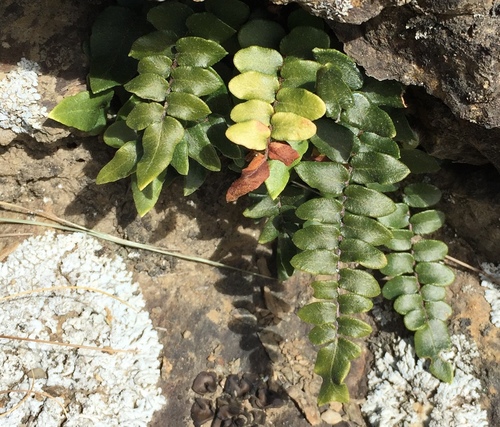
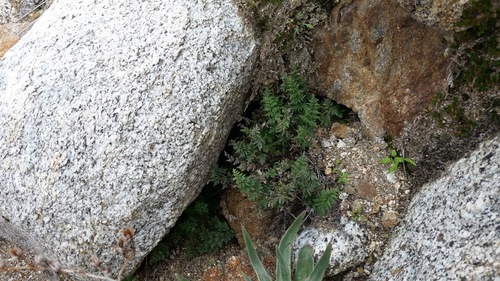
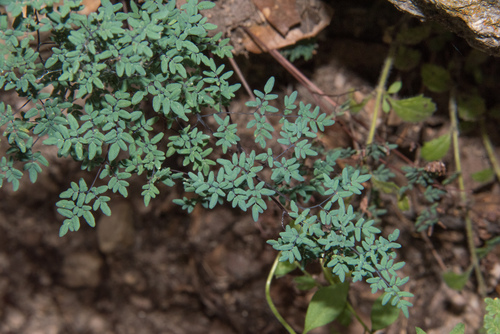
Argyrochosma limitanea (Maxon) Windham has a short, horizontal rhizome with closely spaced leaves. The rhizome is covered in thin, uniform-colored linear to lanceolate brown to reddish-brown or chestnut-brown scales with entire, toothless margins. Total leaf length ranges from 5 to 30 centimeters (2.0 to 12 inches). The stipe, the leaf stalk below the blade, is reddish-brown to black, rounded, and lacks hairs or scales except for a few rhizome-like scales at its very base. It measures 3 to 12 centimeters (1.2 to 4.7 in) long and 0.75 to 2 millimeters (0.030 to 0.079 in) in diameter, making up one-half to one-third of the total leaf length. Leaf blades are 2.5 to 11 centimeters (0.98 to 4.3 in) long, ranging in shape from narrowly to broadly deltate (triangular). They are divided from tripinnate (cut into pinnae, pinnules and pinnulets) to pentapinnate at the base, their most divided region. The rachis, the main leaf axis, is rounded or slightly flattened, hairless on its upper surface, straight or slightly zig-zagging, and dark in color, matching the color of leaf segment axes. This dark color extends into the base of leaf segments, with no distinct joint present. The blade bears 6 to 12 pairs of pinnae, which gradually narrow toward their tips and are widest at their bases. Leaf segments are numerous, closely spaced, small, and shaped elliptic to ovate, or roundish to oblong. Leaf tissue is leathery in texture, which obscures veins from view on the upper surface, and bears no hairs or scales on either surface. The underside of the leaf has a thick covering of white farina, a powdery coating. Leaves and their axes curl upward when dry. On fertile leaf segments, sporangia lie close to the segment margin, borne along the distal half of secondary veins that branch from the segment midrib. Each sporangium contains 32 spores, and leaf segments curl under their edges, often concealing the sporangia. A. limitanea is an apogamous triploid with a chromosome count of n = 2n = 81. Two subspecies are recognized: the nominate Argyrochosma limitanea subsp. limitanea, and Argyrochosma limitanea subsp. mexicana. Argyrochosma limitanea subsp. limitanea has broader blades, 2 to 6 centimeters wide, shaped broadly deltate-ovate, and is more highly divided, 4 to 5 times, at the base, with the lowest pinnae measuring at least half the length of the entire leaf blade. Argyrochosma limitanea subsp. mexicana has narrower blades, 1 to 2.5 centimeters wide, shaped lanceolate to oblong, and is less highly divided, 3 to 4 times, at the base, with the lowest pinnae measuring one-third to one-quarter the length of the entire leaf blade. Argyrochosma limitanea is found in the United States from San Bernardino County, California, east through Arizona, New Mexico, southern Utah and Colorado, and Trans-Pecos Texas, ranging south into northern Mexico and extending as far southeast as Hidalgo. Argyrochosma limitanea subsp. limitanea occurs from California through Utah and Colorado into Mexico, where it is only found in Sonora and Chihuahua. Argyrochosma limitanea subsp. mexicana has a more easterly distribution, ranging from Arizona through Texas, and in Mexico from Chihuahua and Sinaloa eastward. Both subspecies grow on rocky slopes and cliffs formed from either calcareous or volcanic rocks, though A. limitanea subsp. mexicana shows a stronger preference for calcareous substrates in Mexico. Argyrochosma limitanea subsp. limitanea occurs at altitudes from 800 to 2,300 meters (2,600 to 7,500 ft), while A. limitanea subsp. mexicana, which grows in mountains, occurs from 1,500 to 2,500 meters (4,900 to 8,200 ft).