About Argyrochosma fendleri (Kunze) Windham
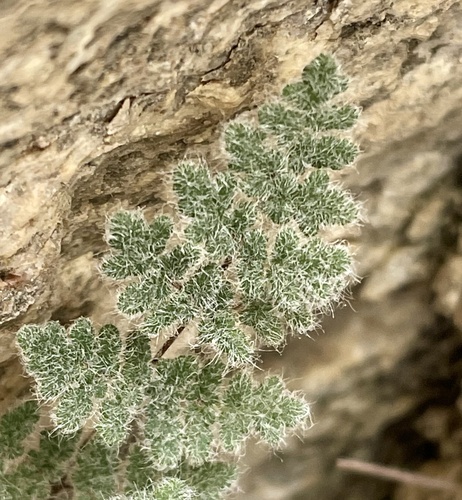
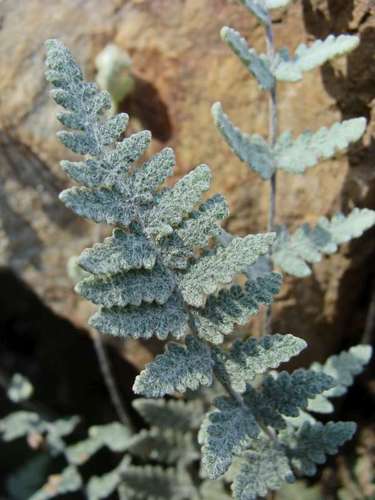
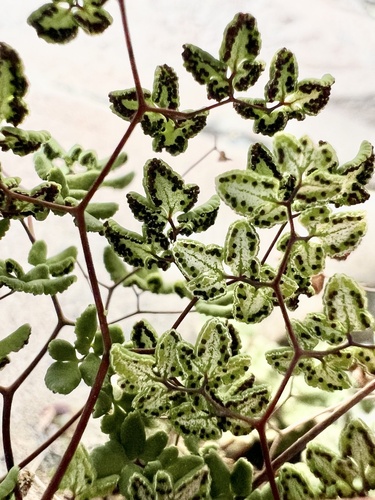
Argyrochosma fendleri is a medium-sized epipetric fern. Its rhizome is compact, 2 to 3 millimeters (0.08 to 0.1 inches) wide, and can grow either horizontally or upright. The rhizome carries linear to lanceolate scales 7 to 10 millimeters (0.3 to 0.4 inches) long; these scales are thin in texture, uniformly orange-brown or chestnut-brown, and have entire, toothless margins. Numerous fronds grow in dense clumps from the rhizome. Fronds measure 5 to 25 centimeters (2.0 to 9.8 inches) long from base to tip, and 5 to 12 centimeters (2.0 to 4.7 inches) wide. Around half of this length is made up by the stipe, the stalk of the leaf below the blade, which is round, hairless, chestnut-brown, typically 0.75 to 1.5 millimeters (0.030 to 0.059 inches) in diameter and 3 to 16 centimeters (1.2 to 6.3 inches) in length. The leaf blades are deltate, triangular, in shape, and highly divided, with four to six successive subdivisions, at the base; they are sometimes broader than they are long, and curl slightly upwards when dried. The rachis, the leaf axis, is round rather than flattened, hairless, and grows in a zig-zag rather than a straight shape. Each blade carries 4 to 6 pairs of pinnae, whose costae are also zig-zag, with subdivisions branching off at the angles. The ultimate segments are ovate to lanceolate or oblong, obtuse at the tip and broadly cuneate, wedge-shaped, at the base, and sometimes have crenate, round-toothed, margins. The dark color of the axes extends into the segment base without a distinct joint, and pinnae and subsequent subdivisions grow on long stalks. The underside of the leaf is coated in pale white farina, powder, and a scattering of glands and farina is sometimes present on the upper surface. Leaf tissue texture ranges from leathery to somewhat leafy. Sori are located along the veins, on the final quarter of the vein length closest to the leaf edge. The veins themselves tend to blend into the leaf tissue. Leaf edges are not modified into false indusia, and may be flat or curled under to cover the sori. Each sporangium holds 64 spores. Plants of this species are diploid, with a chromosome number of 2n = 54. The zig-zag shape of the rachis and axes generally distinguishes this species from other members of its genus. Argyrochosma limitanea may have slightly zig-zag axes, but its subdivisions do not spread as strongly. In addition, A. limitanea is apogamous and only has 32 spores per sporangium, rather than 64. Argyrochosma fendleri is found in the United States in New Mexico, Colorado, and the southeastern corner of Wyoming, and in Mexico in Sonora. It grows on rocky cliffs and slopes, particularly on granitic and igneous rocks, and is the only member of its genus to prefer this substrate. It occurs at altitudes between 1,700 and 3,000 meters (5,600 to 9,800 feet). Horticulturist George Schneider considered the species suitable for conservation, noting that it "thrives well under cool treatment", likely in contrast to tropical ferns. The Tewa people grind this fern into powder and apply it as a remedy for cold sores on the lips.