About Argynnis paphia (Linnaeus, 1758)
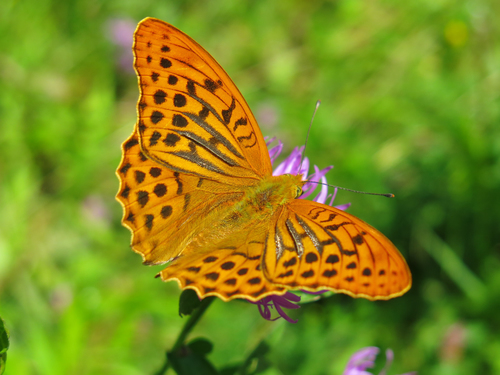
The silver-washed fritillary (Argynnis paphia, Linnaeus 1758) is a butterfly with distinct physical traits across its life stages. The upperside of its wings is deep orange marked with black spots, and it has a total wingspan of 54–70 mm. Males are smaller and paler than females; males also have rather pointed forewings, while female forewings are more rounded. The underside of the wings is verdigris green with a metallic sheen and broad, partially curved silver bands, which gives the species its common name. A minority of females belong to the valesina form, which recurs in most European populations; these individuals have a grey ground color with greenish reflections instead of the typical fawn base color. The species' caterpillar is black-brown, with two yellow lines running along its back and long reddish-brown spines. Males have three distinct scent streaks made of scent scales along veins 1 to 4 on the upperside of the forewing; the scent from these scales attracts females and helps distinguish this species from others. Seitz's account adds more detail to early life stages: the eggs are conical, ribbed, and yellowish-grey. Females lay eggs on tree trunks, most often pine trunks, starting around 4 or 5 feet above ground. They fly higher in a spiral around the tree, laying one egg at intervals of 1/2 to 1 meter, and move to a new tree once they reach about 4 meters in height to repeat the process. Unlike most butterflies, female silver-washed fritillaries do not lay eggs directly on the violet caterpillar food source. Instead, they place eggs one to two meters above the woodland floor in bark crevices near clumps of violets. When eggs hatch in August, the newly emerged caterpillars immediately enter hibernation until spring. When they awaken in spring, they drop to the ground and feed on violets near the base of the host tree. Caterpillars usually feed at night and hide away from their food source during the day, but will bask in sunny spots on dry dead leaves on the forest floor during cool weather. According to Gillmer's observations, larvae live on Violaceae from August to the end of May, hibernating while very small and begin feeding as early as March. Full grown larvae are blackish brown, with a broad yellow dorsal stripe divided by a thin black line, plus numerous yellow dots, spots and streaks on the sides; their spines are long, yellow at the base, and the two anterior spines are curved and extended to look similar to antennae. Caterpillars pupate among ground vegetation; Seitz notes pupae are usually fastened low on pine trunks. The pupa is greyish brown, with pointed processes on the head and sharp angles, and bears conical pointed tubercles that are silvery when young and turn golden just before the adult butterfly emerges. Adults emerge in June. In Europe, adults are in flight from July to September, while in Eastern Asia they fly until October. The species is very common across its range, and is most often found flying along wide forest roads and woodland edges. Adult butterflies frequently visit bramble, scabious and thistle flowers, where they are easy to catch. When seeking to mate, males circle around the female while the female flies with steady wing beats straight toward a bush or protruding branch; mating occurs at this spot, and the two sexes often remain joined tightly for some time, with one individual sometimes carrying the other around. Adult silver-washed fritillaries feed on nectar from brambles, thistles, and knapweeds, and also feed on aphid honeydew. This species is a strong flier, more mobile than other fritillary species, and can be seen gliding at high speed above the tree canopy. Its preferred habitat is thin, sunny deciduous woodland, especially oak woodland, but it has also been recorded living in coniferous woodland. The main larval food plant for this species is common dog violet, Viola riviniana.