About Argonauta hians (Lightfoot), 1786
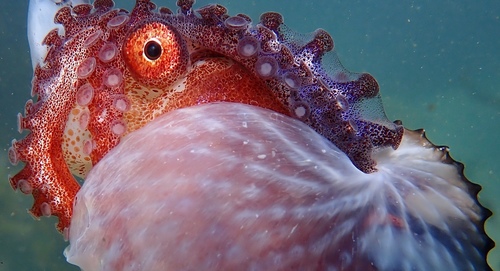
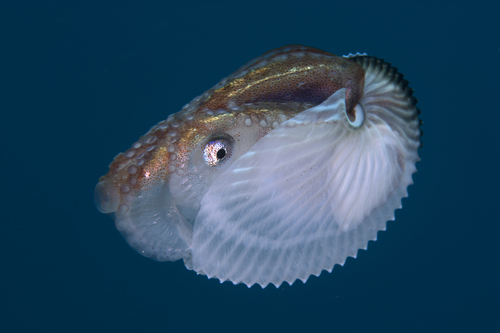
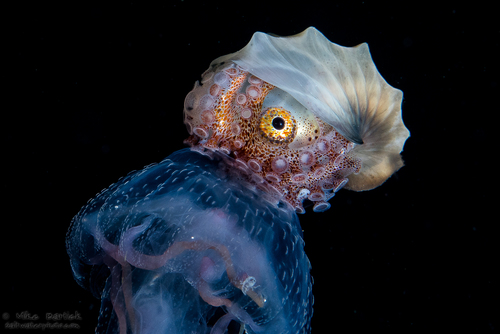
Argonauta hians, first described by Lightfoot in 1786, is a species of pelagic octopus, commonly known as the winged argonaut, muddy argonaut, or brown paper nautilus. Its common names come from its characteristic grey to brown coloured shell, and its Chinese name translates directly to "grey sea-horse's nest". Like all argonauts, only female A. hians create a thin, paper-like eggcase that wraps around their body in a structure similar to the shell a nautilus occupies, which gives the species the "paper nautilus" common name. The eggcase of A. hians has a distinct wide keel that gives it a square overall shape, with a small number of rounded tubercles along the keel, and fewer than 40 smooth ribs running across the sides of the shell. Most eggcases reach around 80 mm in length, but exceptional specimens can exceed 120 mm; the world record size for an A. hians eggcase is 121.5 mm. A. hians is a cosmopolitan species found in tropical and subtropical waters across the globe. It is an extremely variable species, with at least two distinct recognised forms: a "southern" form and a "northern" form. The southern form is most abundant in the Philippines and the South China Sea. It is smaller overall, with an eggcase that rarely grows larger than 80 mm, and lacks the distinctive winged protrusions that give the species its common name. The northern form, found in waters around Taiwan, Hong Kong, and Japan, produces a much larger, darker, more robust eggcase that can reach 120 mm, and has the species' characteristic winged protrusions. Its eggcase is typically less elongated than that of the southern form, and lacks the southern form's porcelain-like shine. Additional research is required to confirm whether these two forms are actually separate species. A. hians feeds primarily on pelagic molluscs, and heteropod remains have been documented in the stomachs of this species. Numerous predators hunt A. hians, and the species has been found in the stomach contents of Alepisaurus ferox caught in the south-western Pacific. Male A. hians reach sexual maturity at a mantle length of around 7 mm, which is thought to be their maximum attained body size. Females mature at about half the size of mature female Argonauta argo, and begin secreting their eggcase when their mantle is between 6.5 and 7 mm in length. Egg laying typically begins when females reach a mantle length of 14 to 15 mm, and females have finished laying their eggs by the time they reach 18 to 20 mm mantle length. The mantle length at which these life stages occur varies across the species' range. Mature female A. hians grow to a mantle length of 50 mm, while males never exceed a 20 mm mantle length. A. hians is known to cling to floating objects on the sea surface, including other argonauts. Chains of up to 20 to 30 similarly sized argonauts have been observed, where the first female in the chain clings to an inanimate object, and every subsequent female clings to the ventral part of the preceding individual's shell. Gilbert L. Voss and Gordon Williamson observed a string of six freshly mated female A. hians swimming together off the coast of Hong Kong. In the open ocean, A. hians is often found attached to jellyfish. It has been photographed resting atop the jellyfish Phyllorhiza punctata in the Philippines. This behaviour has been recorded for a long time, but little was understood about the relationship between A. hians and the jellyfish it attaches to before the 1992 work of Heeger et al. Underwater photographer Mark Strickland observed and photographed a female A. hians clinging to a jellyfish in the Mergui Archipelago, Andaman Sea, Myanmar. He observed the argonaut using the jellyfish as cover, rotating the jellyfish to hide itself from potential predators (in this case, Strickland himself). The argonaut was also seen using the jellyfish as a hunting platform: it maneuvered its host close to a smaller comb jelly, then quickly grasped the comb jelly with another pair of tentacles and devoured it. A. hians is considered to be closely related to the smaller A. bottgeri from the Indian Ocean and A. cornuta from the north-east Pacific. The oldest known fossil remains of A. hians come from the middle Pliocene Sadowara Formation of southwestern Japan. In terms of eggcase shape, A. hians is similar to the extinct species A. sismondai. The type locality and type repository of A. hians are currently unknown.