About Argiope pulchella Thorell, 1881
Argiope pulchella Thorell, 1881 shows clear sexual size dimorphism: females are larger than males, measuring 8 to 10 mm (0.3 to 0.4 in) while males reach 4 to 6 mm (0.16 to 0.24 in).
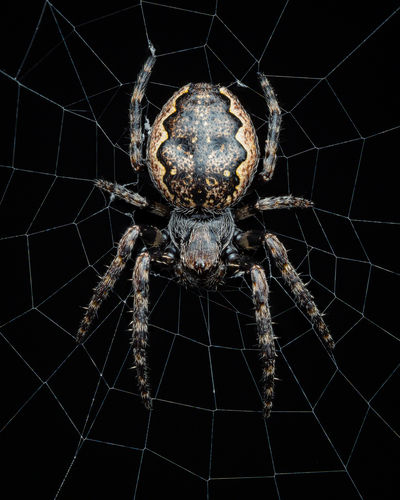
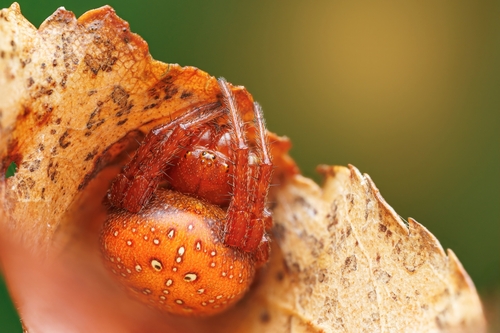
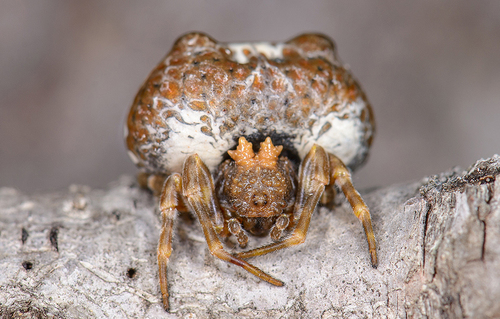
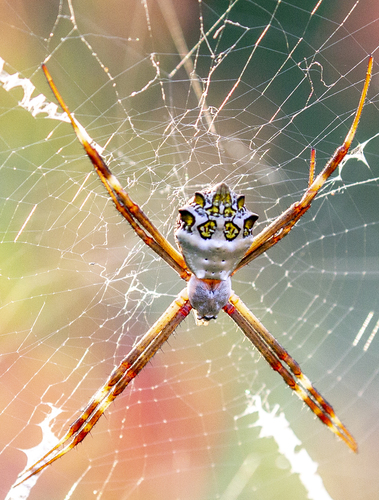
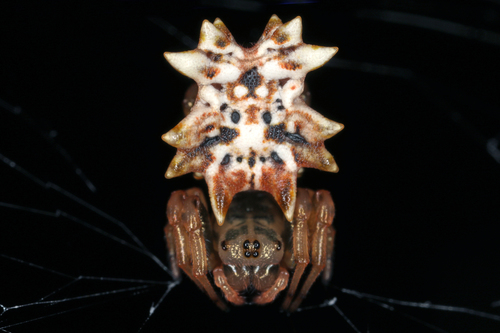
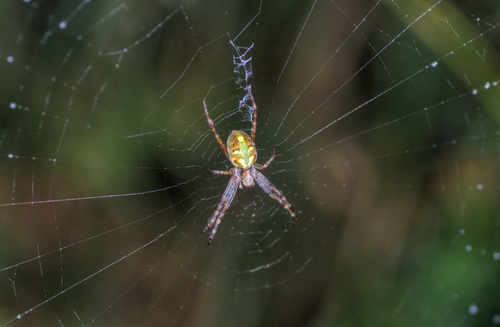
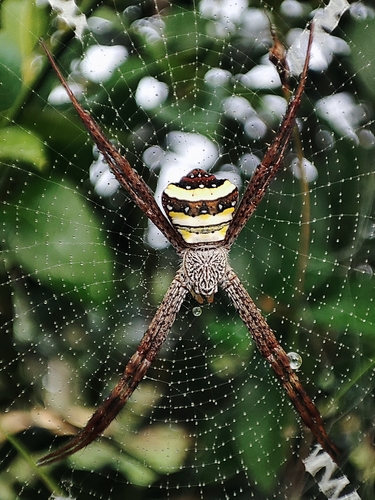
In females, the cephalothorax is slightly longer than wide and covered in white, silky pubescence. The two central eyes sit on a prominent tubercle and are surrounded by black rings. Chelicerae are brown and rather small. The legs are long and robust, covered with spines and hairs, and marked with brown and yellow bands. The abdomen is pentagonal, slightly overlaps the cephalothorax, and is a little longer than it is wide. Its dorsal surface is pubescent, bright yellow, and marked with three horizontal black bands; the ventral surface is brown with two longitudinal white patches. Males have a more drab appearance overall, with a dark brown cephalothorax and none of the stripes present on females.
Females of this species spin an orb-shaped silk web that includes a zig-zag stabilimentum, and rest head-down at the center of the web. If disturbed, the female drops to the ground, returning to the center once the disturbance ends. Males do not spin their own webs, and instead occupy the edge of a female's web. This species is an entomophagous predator that preys on a wide variety of insects.
Natural habitats for Argiope pulchella include forests, woodland glades, and gardens. It is also abundant in disturbed habitats such as rubbish dumps, drains, and sewage works. Juveniles occupy a wider range of habitats, while sub-adults and adults live primarily in garden areas, roadside drains, and domestic sewage sites. When a male wishes to mate, he performs specific courtship behaviors that include vibrating the female's web. Research has found females are more receptive to males that produce high-frequency web shuddering for long periods, and this behavior may also reduce the chance that the male will be cannibalized after mating.