About Argiope protensa L.Koch, 1872
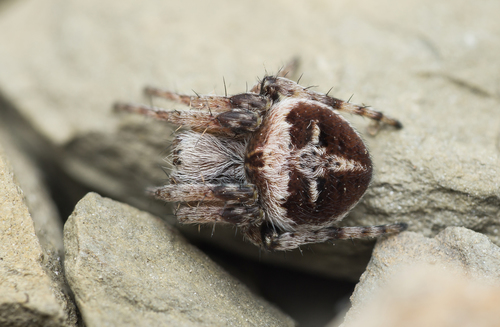
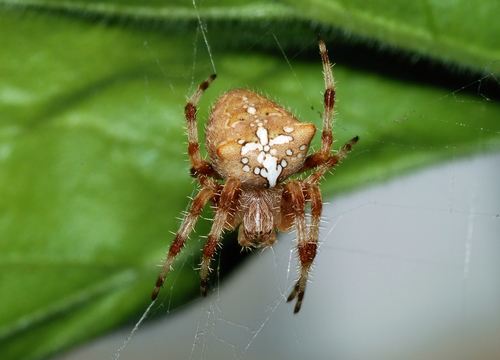
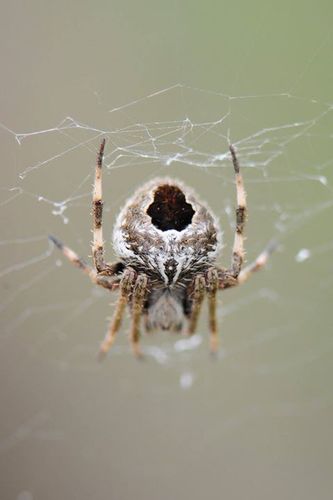
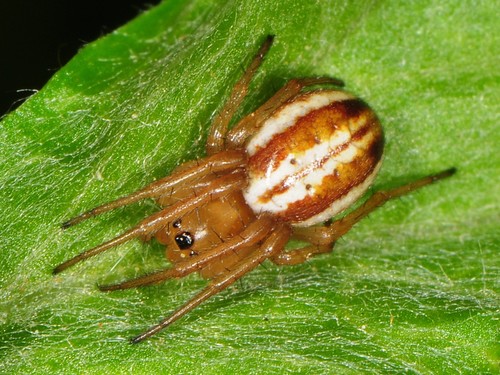
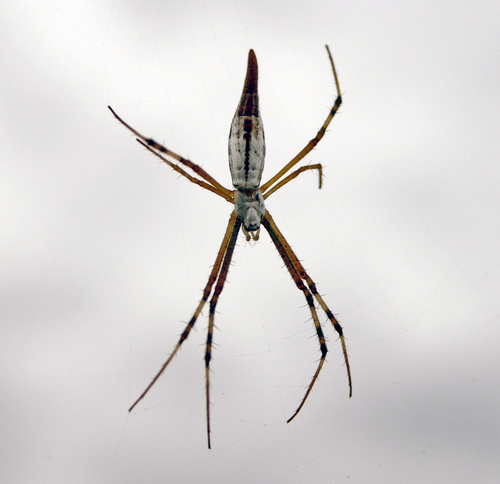
Argiope protensa, the tailed grass spider, is a slender, medium-sized spider with a body length ranging from 13 to 25 mm. Its abdomen is distinctively elongated, tapering to a long “tail” that extends beyond the ventrally positioned spinnerets, though immature individuals and males may not show this trait clearly. On each side of the dorsal abdomen, there is a finely pubescent strip of short silvery hairs, which grows sparser closer to the abdomen’s apex. Four to six pairs of weakly indented spots border a variably coloured, hairless medial line, and similar hairless dark strips run along the sides of the abdomen. The ventral surface of the abdomen is dark and sparsely haired, with two pale longitudinal stripes that run down its full length to the apex. The cephalothorax accounts for around one quarter of the spider’s total body length, and its dorsal surface is covered in silvery-grey hairs. Leg colouration varies between individuals: some individuals are almost uniformly grey-brown, while others have strong contrasting dark and light bands along their leg lengths. Relative leg lengths, from longest to shortest, are 1, 2, 4, 3. In Australia, Argiope protensa can be told apart from A. probata, the only other Argiope species with a similarly shaped abdomen, by examining morphological features of the epigyne. The web of the tailed grass spider is variable in structure, and is usually quite small, especially when compared to the webs built by other Argiope species. Webs may be constructed close to the ground, and oriented on a plane anywhere between vertical and horizontal. A 2022 analysis of 262 photographs of 124 different tailed grass spider webs across Australia and New Zealand found that 38.9% of webs contained a structure called a stabilimentum, whose purpose remains undetermined. Argiope protensa has been recorded from Australia, New Zealand, New Caledonia and New Guinea. It is considered native to New Zealand, and is thought to have naturally dispersed to New Zealand from Australia. Confirming this status and estimating the time of its first arrival to New Zealand would require further review of early collection records, or comparative genetic analysis, or both. A 2014 study that analysed changes in spider assemblage composition across a 900 km environmental gradient in Australian grasslands found a strong positive association between A. protensa occurrence and taller vegetation with high intra-tussock density. The total length of the tailed grass spider’s life cycle is unknown, but like similar species, it is unlikely to exceed two years. Females reach maturity in midsummer, and produce cup-shaped egg masses in late summer. It remains unknown when spiderlings hatch from the eggs. Ballooning is probably an important dispersal mechanism for young spiders to reach new habitats, and this process is also likely how the species first reached New Zealand from Australia.