About Argiope minuta Karsch, 1879
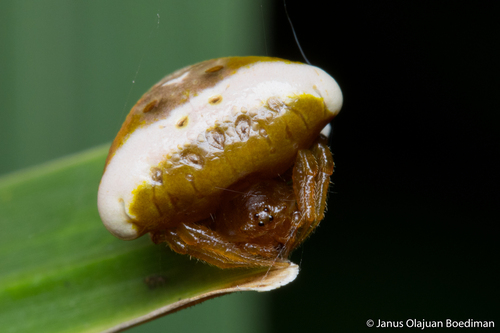
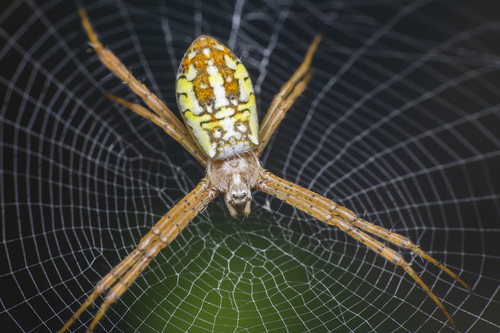
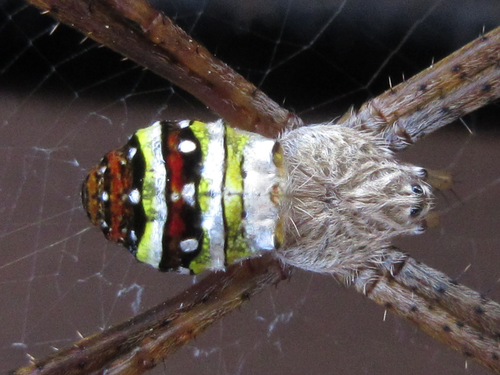
Argiope minuta Karsch, 1879 shows clear sexual dimorphism: females reach a total length of 6-12 mm, which is significantly larger than males at just 4 mm. Living specimens of this spider are very colorful, with light brown extremities. The entire body surface has a fine granulated texture that is only visible under strong magnification. The brown cephalothorax is covered in silky, long forward-directed hairs that curve in an arc over the eye region. The sternum is black, marked with a broad yellow median stripe and bears a small number of black hairs. Three pairs of hill-like colored abdominal segments are a notable feature; the last pair is yellow, and forms a cross shape with the yellow median stripe. The lip region is entirely yellow, and the maxillae are yellowish along their margins. The legs bear characteristic dark rings and abundant black spines. The pedipalp claw is fairly slender and has nine side teeth. The bald opisthosoma is covered in patches of dense, upright white silk hairs that form distinct silver spots. Yellow and brown stripes on the opisthosoma are formed by small, dense, upright translucent pigment spots, which can be seen with the naked eye. The underlying body surface matches the color of any black spots present on the opisthosoma. The anterior abdominal covering is white, with an orange-red upper margin. In front of the pointed extended corners runs a black transverse line; behind this line sits a white transverse band, then a yellow transverse band bordered by a black line. This yellow band is followed by a white band, with three yellow spots positioned directly behind the white band. Like other species in the Argiope genus, A. minuta builds orb webs, with a hanging central structure that forms a cross out of four zigzag bands. This species has been recorded in India, Bangladesh, China, Taiwan, Korea, and Japan. Per records from Bösenberg and Strand, specimens have been collected at Saga, Kompira, and Nagasaki.