About Argiope keyserlingi Karsch, 1878
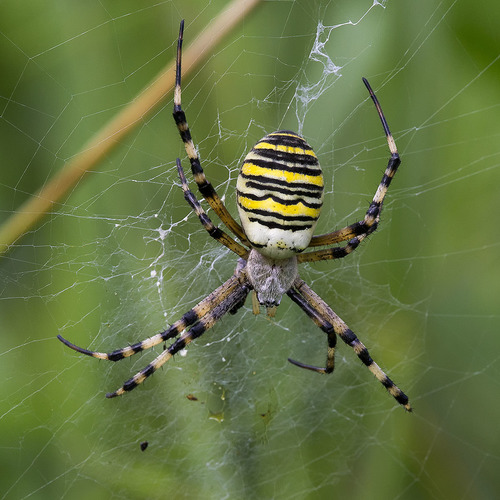
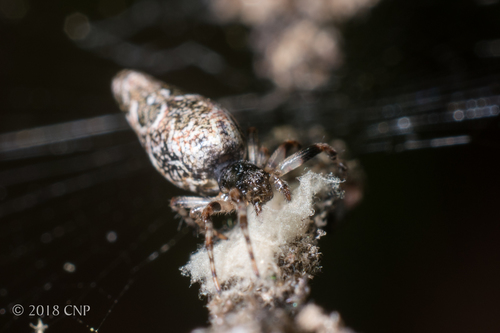
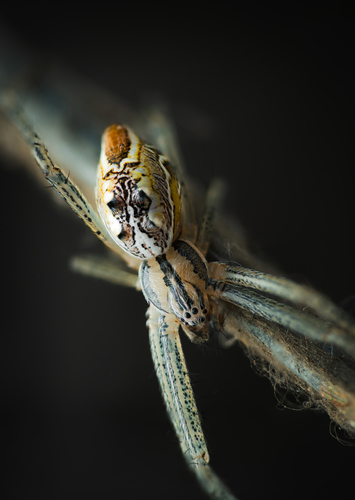
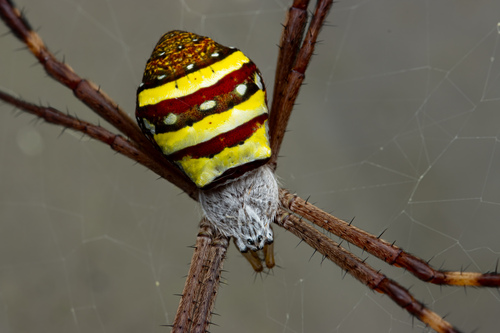
Argiope keyserlingi, commonly called St. Andrew's cross spider, has distinct size and color differences between females and males. Females of this species range from 10 to 16 mm in body size. Their glossy carapaces have silver, yellow, red, and black bands on the upper segment, and two horizontal yellow bands on the lower segment. Males generally range from 3 to 4 mm in body size, and are brown and pearly in color. Like other St. Andrew's cross spiders, this species rests with its legs positioned in pairs. This spider occurs mostly in rainforest margins, open forests, and heathlands of eastern Australia. It can also be found in northern Northern Territory, northern Tasmania, western Western Australia, near the Tedi River in Papua New Guinea, on Malakula Island in Vanuatu, and on Lord Howe Island. The species builds medium-sized webs on low, shrubby vegetation. Individual spiders tend to prefer closed habitats, and their habitat preferences are shaped by foliage density and predator density. They avoid placing webs within or between trees when birds are present. Juveniles are only found in closed habitats, most likely to avoid insectivores such as birds and lizards, and to find more suitable vegetation for web construction. A. keyserlingi may move into open habitats once it reaches the subadult or adult stage, possibly because it needs larger prey to support continued growth.