About Argiope australis (Walckenaer, 1805)
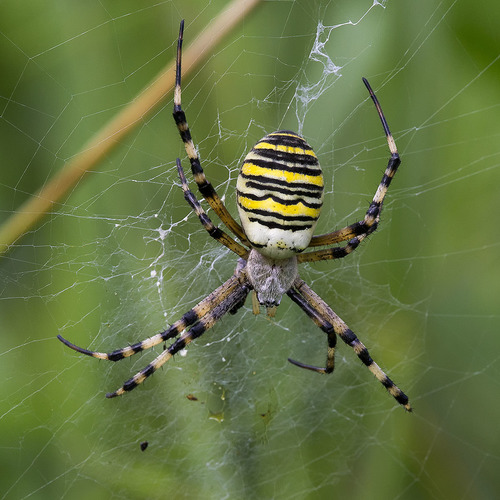
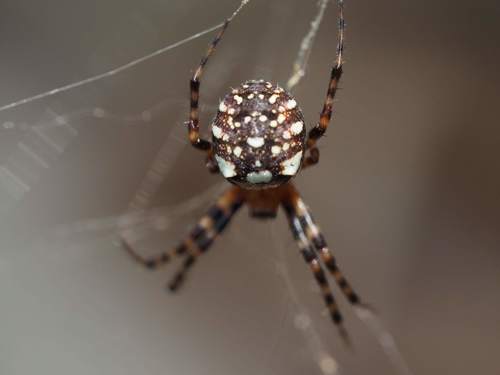
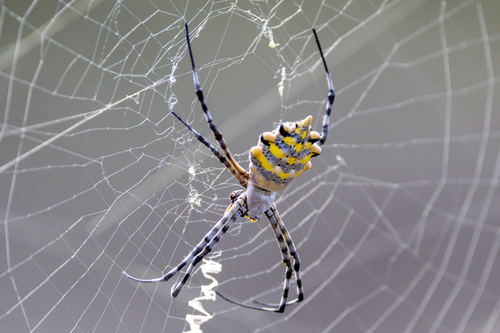
Like most orb-web spiders, Argiope australis shows considerable sexual size dimorphism; females are around 25 mm long, considerably larger than males which reach approximately 6 mm. When viewed from above, the abdomen is bright yellow with black cross-wise stripes and has a clear knobby outline. When viewed from below, the body has finer detail, appearing mostly black with symmetrically arranged yellowish spots and lines along its longitudinal axis. The legs have alternating bands of light colors such as white, orange, yellow, and dark colors such as brown and black. Argiope australis is found throughout eastern sub-Saharan Africa, with records from Cape Verde, Senegal, and Central, Eastern and Southern Africa. Its range extends as far west as the eastern Democratic Republic of the Congo, Angola, and Namibia, and it also occurs in some areas of South Asia in Sindh, Pakistan. This species is widespread across the whole of Africa. In South Africa, it has been recorded from all nine provinces, at elevations ranging from 7 to 2,066 m above sea level. A. australis constructs orb webs in open grassland areas and gardens. The webs are usually positioned low in shrubby vegetation that is sturdy enough to support their weight. The spider hangs head-down at the center of the web throughout the day, and webs are frequently decorated with a stabilimentum. The species has been recorded in all floral biomes, and has also been collected from agricultural sites including avocado, peach and pistachio orchards, pine plantations, and pumpkin fields. After rain in Clocolan, Free State, an "Argiope city" was discovered, where 50 to 60 spider webs were found in bushes. This grouping was likely attracted by a large population of grasshoppers. Most of the webs were large, at least 500 mm in diameter, and some had stabilimenta while others did not.