About Argiope aemula (Walckenaer, 1841)
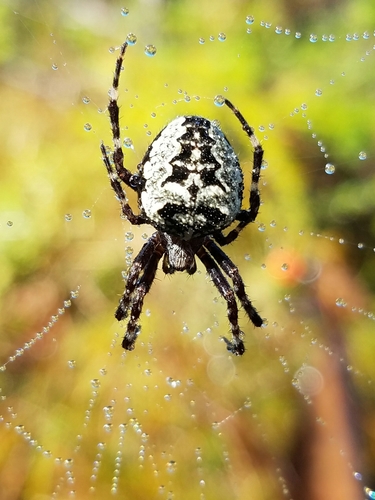
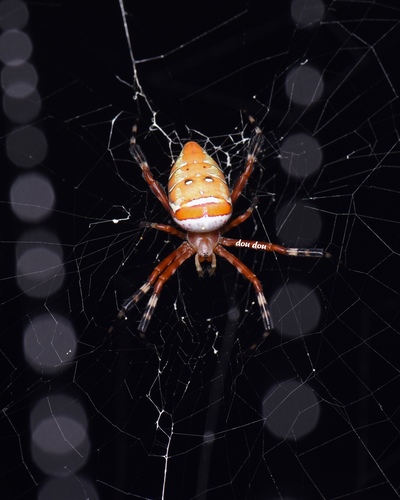
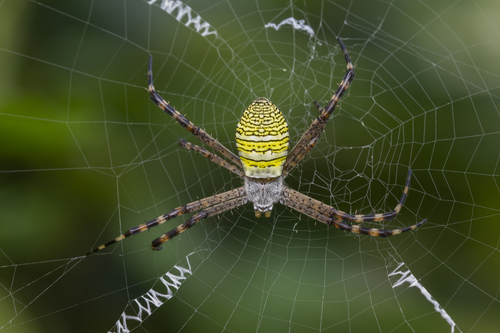
Argiope aemula (Walckenaer, 1841) displays strong sexual size dimorphism: females are much larger than males, reaching 23–30 mm in total length, while males stop growing at 5–8 mm, with males only around 10% of the size of females. The female cephalothorax is brownish with white pubescence, and has also been described as dirty white; silver hairs on its carapace give the species its common namesake. The female carapace is flat, with yellow and black horizontal lines running from the end of the carapace across the entire backside. Posterior median eyes are encircled in black, and the heart-shaped sternum has a narrow elongation at its distal end. The female abdomen is oval-shaped, anteriorly truncated, yellowish with black stripes; four yellow dots are arranged vertically on the abdomen. The abdomen ventrum is brownish with yellow parallel lines. Males have much duller coloration than females: their carapace is black, while their sternum and backside are brownish. Both sexes have oval abdomens. This species has eight long legs that are held doubled apart in an X-shape on the web; legs are gray with black rings, and end in claw-like structures. Females’ bright distinct coloration has been speculated to be associated with attracting prey. The species is easy to identify by the stabilimentum, a zigzag web structure that gives it the common name of signature spider; this stabilimentum is thought to serve a camouflage function. Extreme sexual size dimorphism often leads to sexual cannibalism of males by females. If a male survives his first copulation, he almost always dies during a second mating attempt; studies confirm that male death after second copulation is a form of programmed suicide. This spider is mostly distributed in Southeast Asian countries including the Philippines, Malaysia, Singapore, and Thailand, and can also be found in India, Sri Lanka, China, northern Australia, and southern Japan. It occurs near human settlements, and prefers open sunny woodland areas with flowers, shrubs, and plants that provide protection. Common plant species found in its habitat include big bidens and giant false sensitive plants. Webs are typically built 1–2 meters above the ground.