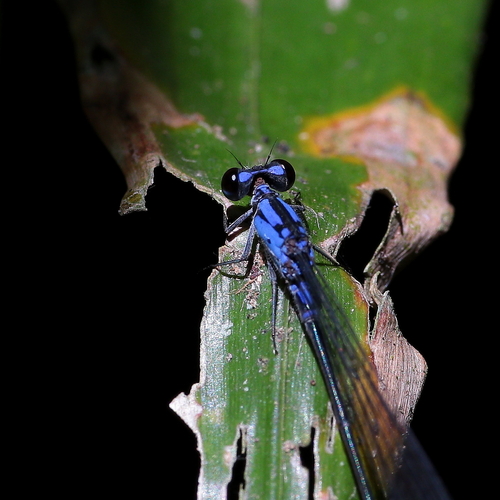
About Argia nahuana Calvert, 1902
This species is scientifically named Argia nahuana Calvert, 1902, and is commonly known as the Aztec dancer. In terms of physical description, the dark black stripe running along the side of its thorax is forked from front to back. Additional field identifying marks are blue postocular spots, pale blue legs that bear a black stripe, and a blue ring on the seventh abdominal segment. It can be distinguished from similar related taxa by the greater width of the stripe running down the mid-dorsal thorax, and the medial orientation of the cercus lobe. Its forewing contains four quadrangular cells, while its hindwing contains three. Females have a similar overall appearance to males, except females are primarily light brown in color, whereas males have bright blue coloration. Aztec dancers are most commonly found in the southwestern North America, including many regions of Mexico and the US states of California, Arizona, Texas, and Kansas. They inhabit clear, shallow streams that have high sun exposure and very little vegetation along the water’s edge.