About Argentipallium blandowskianum (Steetz ex Sond.) Paul G.Wilson
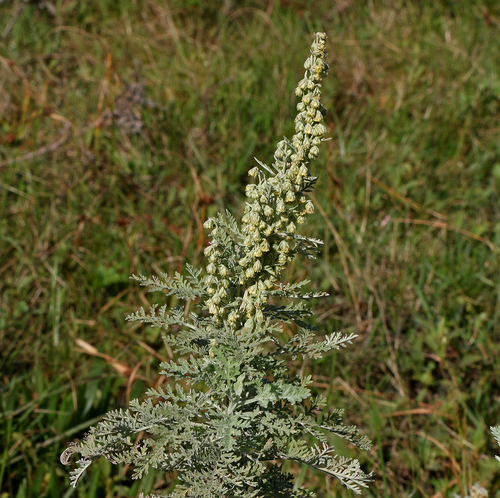
Argentipallium blandowskianum is an erect perennial herb that grows 20 to 50 centimeters tall, with a branched crown at its base. It produces several usually branched stems covered in a dense, felty layer of woolly hairs. Leaves are oblanceolate (most often narrowly oblanceolate), and sometimes narrowly elliptic; they are flat, with tips that are acute to acuminate ending in a soft dark mucro, and a cuneate sessile base. Most leaves measure 2 to 4 cm long and 5 to 8 mm wide, and are thick and felty with dense woolly hairs on both surfaces.
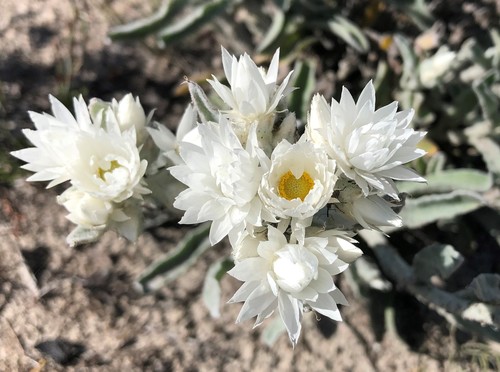
Capitula number 6 to 12, arranged in rather dense terminal leafy corymbs that are sometimes grouped into panicle-like clusters. The capitula are broadly campanulate, with the laminae of the involucral bracts angled outward to spreading at flowering. When pressed (including the laminae), capitula are 1.3 to 1.7 cm long, and eventually reach 2 to 2.5 cm in diameter. Involucral bracts are arranged in 6 to 8 series, with intermediate bracts being the longest. The outermost bracts are wrapped in and mostly hidden by long woolly-cobwebby hairs. Intermediate bracts have scarious white, or sometimes pinkish, opaque narrowly elliptic blunt laminae, and short firm subherbaceous linear cobwebby-hairy claws that make up about one fifth of the bract's total length. Total bract length is 11 to 13 mm, and the bract extends 9 to 10 mm beyond the florets. All of the numerous florets are bisexual. Style branches are unevenly capitate, longer on the abaxial side, and covered in short papillae.
Achenes are oblong, subterete with a slight four-sided cross-section, not compressed, and covered in coarse forward-pointing rough papillae; they are pale grey-brown. The pappus has 15 to 20 free bristles that are barbellate from the base, with slightly coarser barbs toward the apex, and are dull-white. This species occurs in south-eastern Australia, specifically in the states of Victoria and South Australia.