About Arethusana arethusa (Denis & Schiffermüller), 1775
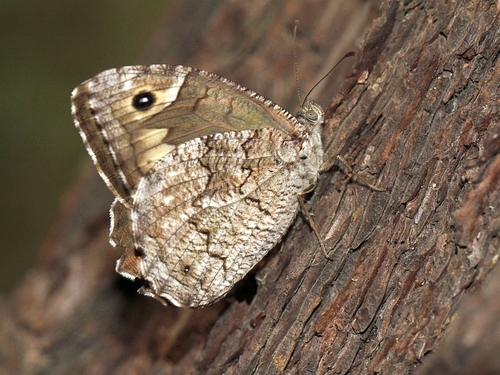
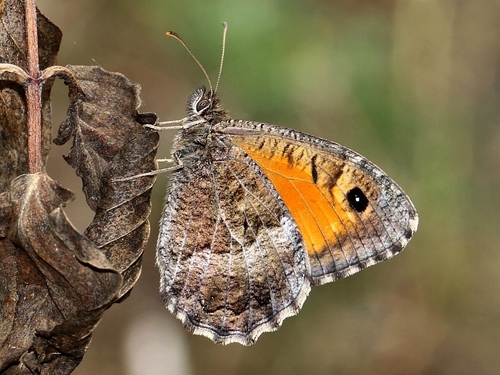
Arethusana arethusa (Denis & Schiffermüller), 1775 exhibits sexual dimorphism in wing size: males have a wingspan of 42–47 millimetres (1.7–1.9 in), while females have a larger wingspan of 50–54 millimetres (2.0–2.1 in). The forewings of this species reach a length of 21–25 mm. The upper surface of all wings is dark brown. It features a characteristic series of ocher-orange oval markings that form a V shape, plus a large blackish brown spot near the apex of the forewings. Hindwings also bear a small blackish spot near their outer border. The outer edges of the wings have a tooth-shaped pattern. The underside of the hindwings is mottled, with a transverse whitish band that divides the wing and clearly defined white veins. This species is quite similar to Pseudochazara graeca and Pseudochazara orestes. Additional description from Seitz notes: this species (listed as S. arethusa Esp. (43b, c)) is dark brown above, with a yellow distal band that is usually separated into spots in males and broader paler in females. The apical ocellus has no pupil, and the fringes are chequered grey and brown. The underside of the forewing is yellow, and the margin is marbled grey, matching the marbling of the hindwing. The hindwing has a dark sinuous median line in males, and outside this line is a pale band dusted with white-grey. The distal band on the wing upperside varies extremely: it can be broad and continuous, completely absent from the hindwing, and only vestigial on the forewing. Several named variants exist. In ab. erythia Hbn., found in South France and the East, the distal band is slightly dentate, with acuminate spots. In ab. dentata, the common form at the Riviera, the spots are evenly and more strongly acuminate, which makes the band resemble a saw. In boabdil Rbr. (43c), the upper band is so shaded with smoky color that it blends almost completely with the ground color, only the apical ocellus and very faint traces of the band remain distinct; this variant occurs in Spain. As obscura (43c), Ribbe collected specimens from Andalusia that are entirely black on the upper wing surface and very vividly marbled on the underside. Mature larvae are bone-colored, with a red-yellow dorsal stripe that contains a thin dark line, a yellow side stripe, and faint, barely visible longitudinal lines. Larvae develop until June on Festuca grasses. Adults fly from July to September. Different forms fly together in some locations, and are geographically separated in others. The species is common on limestone mountains, across the whole of South Europe from Portugal to Turkey and South Russia, present throughout the Black Sea region, and extends east to Saisan in the Altai (Rueckbeil). In Europe, it ranges north as far as Alsatia, Baden, Hungary (ab. peszerensis) and Galizia. Its flight locations are often widely separated, and are located on sterile hills and fallow fields, especially on limestone. The full distribution of this species extends west to Morocco and east to south-west Siberia and northern Tian Shan. These butterflies prefer grassy and bushy areas, steppes, and arid sparse woodlands, at elevations ranging from 0–2,500 metres (0–8,202 ft) above sea level.