About Arenicola marina (Linnaeus, 1758)
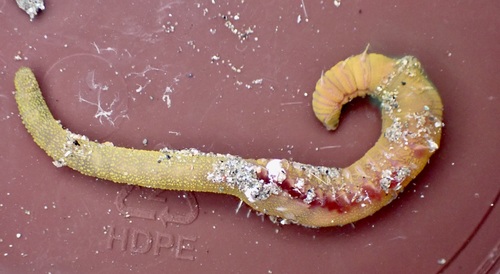
Scientific name: Arenicola marina (Linnaeus, 1758). When fully grown, blow lugworms found along European coasts reach 5.1 inches (13 cm) in length and 0.375 inches (1 cm) in diameter, and weigh 2 to 5 ounces (57 to 142 grams). Like all typical annelids, their bodies are ringed and segmented. Their blackish-red head end has no tentacles or bristles, and connects to a fatter, red middle section of the body. This middle section in turn connects to a thinner, yellowish-red tail end. The middle part bears bristles along its sides, as well as pairs of feathery gills. The species has a well-developed blood vessel system, with red blood that contains the oxygen-carrying pigment haemoglobin. External body hairs on lugworms function as external gills, and can rapidly increase the worm's oxygen uptake. The blood of this lugworm has a large oxygen-carrying capacity, which may have medical applications. A related lugworm species also found in the UK is the black lugworm, Arenicola defodiens. Black lugworms grow larger than blow lugworms, are generally much darker, and are often completely black. The two species can also be distinguished by the different wormcasts they produce: Arenicola defodiens creates spiral casts, while Arenicola marina produces jumbled casts.