About Arenga pinnata (Wurmb) Merr.
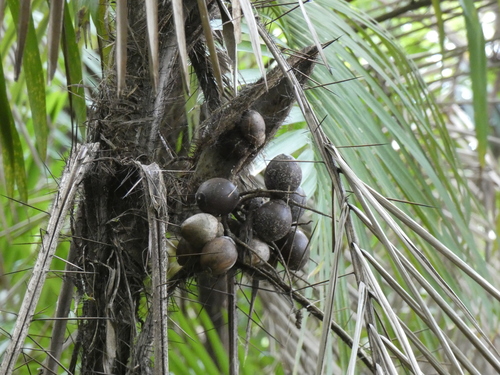
Arenga pinnata (Wurmb) Merr. is a medium-sized palm that grows up to 20 metres (66 feet) tall. Its trunk stays covered by rough, old leaf bases. The leaves are pinnate, 6–12 m (20–39 ft) long and 1.5 m (5 ft) broad. The pinnae are arranged in 1–6 rows, 40–70 centimetres (16–28 inches) long and 5 cm (2 in) broad. Its fruit is subglobose, 7 cm (3 in) in diameter, starting green and maturing to black. This palm has two notable traits. First, it grows very quickly: one individual at the New York Botanic Garden conservatory reached a height of 27 m (89 ft) in 25 years. Second, it has very long pseudo-spines that look dangerous but are not, which is possibly an example of Batesian mimicry. Ecologically, A. pinnata is affected by the red palm weevil Rhynchophorus ferrugineus, and is one of this weevil's major hosts in China. It is not classified as a threatened species, though it is locally rare in some parts of its range. It forms an important part of the diet of several endangered species, including cloud rats of the genus Phloeomys. Many products from this palm are used by people for food, construction materials, and other purposes. As a survival food, its seeds can be boiled, its stem tips can be eaten as vegetables, and its young flower stalks can be bruised to extract edible juice.