About Arenaria melanocephala (Vigors, 1829)
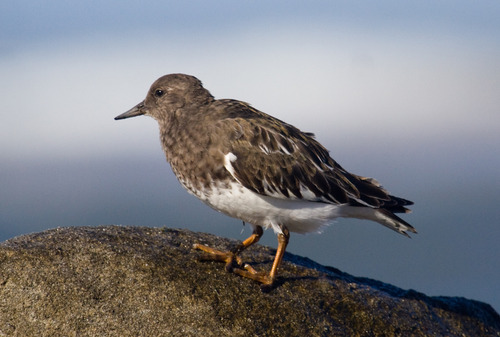
This species, scientifically named Arenaria melanocephala (Vigors, 1829), measures 22–25 centimeters (8.7–9.8 in) in length and weighs 100–170 grams (3.5–6.0 oz). It has a black, slightly upturned bill that is 20–27 millimeters (0.8–1.1 in) long, and blackish-brown legs and feet with a reddish tinge. Overall, the bird is largely black and white in appearance. For adults in breeding plumage, they have a black head and breast, except for a white spot between the eye and bill, a white stripe over the eye, and white flecks on the sides of the breast. Their upper parts are blackish-brown, with pale fringes on the wing-coverts and scapular feathers. The belly and vent are white. In flight, it shows a white wingbar, a white shoulder patch, and a white tail with a broad black band across it. There is white coloring from the lower back to the upper tail-coverts, except for a dark bar across the rump. In winter, the head and breast become largely dark brown with very little white markings. Juveniles are similar to winter adults, but are browner, with buff fringes on the wing-coverts and scapulars, and a grey-brown tip to the tail.
The similar ruddy turnstone has rufous-brown markings on the upper parts, more white on the head and breast especially in breeding plumage, narrower wings and a narrower white wingbar. It also has brighter orange legs, though there can be some overlap in leg color between the two species. The black turnstone has a variety of calls, most notably a rattling trill that can be heard year-round. This call is higher and less harsh than the equivalent call of the ruddy turnstone. Other calls include a loud screeching alarm call, and a soft purring call used when addressing young chicks. Displaying males produce a long series of staccato notes during flight, as well as chirruping trills on the ground.
For distribution, this species breeds in western Alaska, from the Alaska Peninsula in the south to Point Hope in the north. The majority of the population nests in the Yukon–Kuskokwim Delta. It usually nests near the coast, but in some areas it can be found further inland along the shores of rivers and lakes. There are a small number of records from north-east Siberia, but no evidence of breeding there has been found. The global population is estimated at 95,000 birds, with around 80,000 located in the Yukon–Kuskokwim Delta. It winters on rocky shores along the Pacific coast of North America, from southern Alaska southwards to north-west Mexico, where it occurs in Baja California and Sonora, with a single record from Nayarit. It is very rarely seen inland during spring and fall migration; there are multiple records from the Salton Sea in southern California, and scattered sightings from inland US states including Montana, Wisconsin, Nevada and Arizona. Vagrant birds have been recorded in Yukon and the Northwest Territories, and there is one record from San Cristóbal Island in the Galápagos Islands.
Regarding ecology, it feeds mainly on invertebrates: particularly crustaceans and mollusks in winter, and insects during the breeding season. It also eats seeds, eggs and carrion. At breeding grounds, it mainly feeds in wet meadows with sedges. In winter, its typical habitat is rocky coasts, but it also forages on beaches, mudflats, and man-made structures such as jetties and breakwaters. It uses its bill to turn over stones, algal mats and other objects to reach prey hidden underneath. It arrives at its breeding grounds from early May to early June, with males arriving first. The birds often return to the same territory and pair with the same mate as previous years. The nest is a scrape dug mainly by the male, and is usually located among sedges or grasses, or under willows. Typically, four eggs are laid; they are olive or pale greenish with darker spots. Both parents incubate the eggs for 21–24 days. The young are precocial, and are able to leave the nest and feed themselves soon after hatching. They become capable of strong flight 25–34 days after hatching.