About Ardeotis nigriceps (Vigors, 1831)
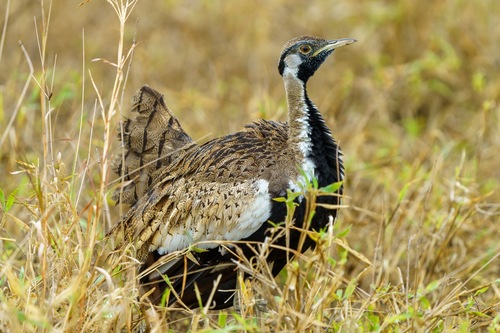
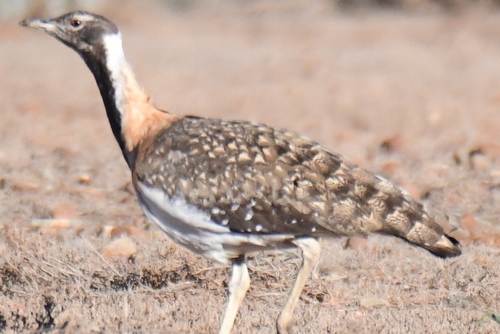
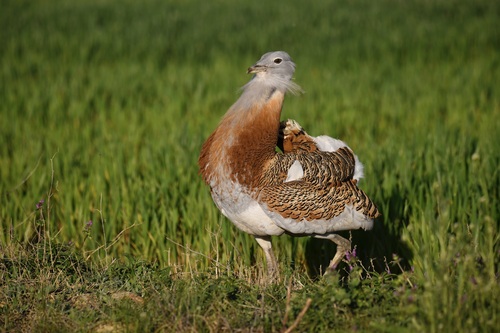
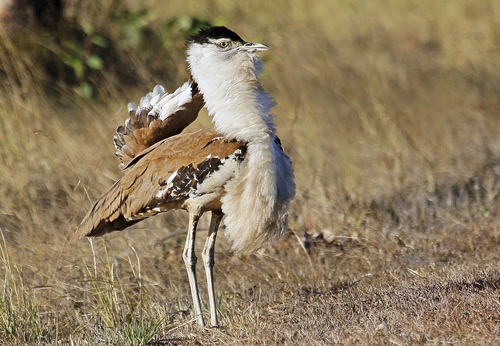
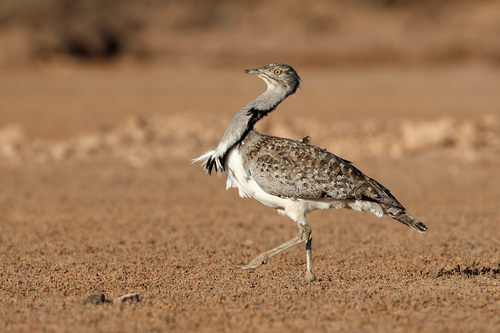
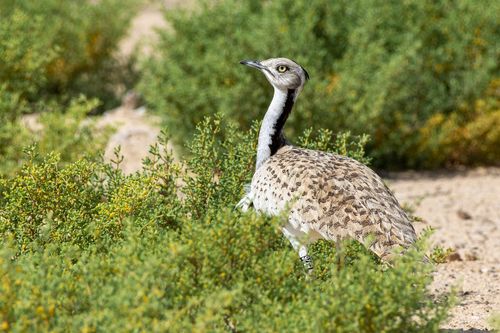
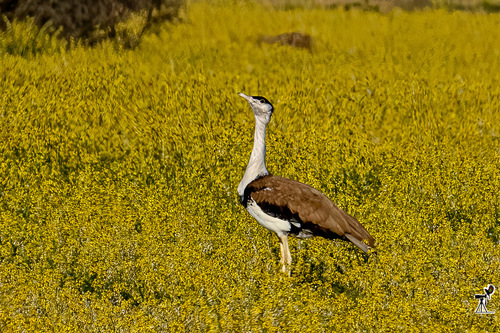
The great Indian bustard, scientifically known as Ardeotis nigriceps (Vigors, 1831), is a large ground bird that stands about one meter tall. It is easily recognizable by its black cap, which contrasts with its pale head and neck. The body is brownish with a black patch spotted with white. Males are deep sandy buff in color and develop a black breast band during the breeding season. Their black, crested crown is puffed up during displays. Females are smaller than males, have non-pure white heads and necks, and their breast band is either rudimentary, broken, or absent. Among bustards, this species is only smaller than the Kori bustard and the great bustard, and it is the largest land bird in its native range. It has a somewhat long neck and quite long legs, with females typically being considerably smaller, as is common in most bustard species. Males have a well-developed gular pouch that is inflated when calling during displays, helping produce deep resonant calls. Abnormally leucistic or near-albino great Indian bustards have been reported. The great Indian bustard was formerly widespread across India and Pakistan. Historically, in India, it was found in Punjab, Haryana, Uttar Pradesh, Madhya Pradesh, Chhattisgarh, Odisha, Andhra Pradesh, Rajasthan, Gujarat, Maharashtra, Karnataka, and Tamil Nadu. Today, it is restricted to isolated pockets in Andhra Pradesh, Gujarat, Karnataka, Maharashtra, Madhya Pradesh, and Rajasthan, which it shares with Pakistan. Current populations exist in the Indian states of Rajasthan, Karnataka, Maharashtra, Madhya Pradesh, and Gujarat. Desert National Park near Jaisalmer and coastal grasslands in the Abdasa and Mandvi talukas of Kutch District, Gujarat support some populations. Ghatigaon and Karera sanctuaries in Madhya Pradesh once held sizeable populations. Other sanctuaries with the species include Kutch Bustard Sanctuary in Naliya, Kutch, Karera Wildlife Sanctuary in Shivpuri district, Great Indian Bustard Sanctuary near Nannaj, and it has also been sighted near Solapur, in Shrigonda taluka of Ahmednagar district, near Nagpur, and near Warora in Chandrapur district in Maharashtra, as well as at Rollapadu Wildlife Sanctuary near Kurnool in Andhra Pradesh. A September 2013 survey detected a few birds in the Cholistan Desert in Pakistan. The great Indian bustard inhabits arid and semi-arid grasslands, open country with thorn scrub, and tall grass interspersed with cultivation. It avoids irrigated areas. Its major breeding areas are in central and western India and eastern Pakistan. Dry semi-desert regions in parts of Rajasthan have been transformed by irrigation canals into intensively farmed areas. The great Indian bustard is omnivorous. It prefers insects, mainly Orthoptera, but also eats beetles including Mylabris species. It also consumes grass seeds, berries (largely from the genera Ziziphus and Eruca), rodents, and reptiles; in Rajasthan, it hunts Indian spiny-tailed lizards Uromastyx hardwickii. In cultivated areas, it feeds on crops such as exposed groundnut, millets, and legume pods. It drinks water if available, sometimes sitting down to drink or suck water and then raising its head at an angle. When threatened, hens are reported to carry young chicks under their wing. Young birds have been recorded to dust-bathe frequently. Males are polygamous. During the breeding season, they are solitary, but they congregate into small flocks in winter. It is thought to use a mating system termed an 'exploded or dispersed lek'. Great Indian bustards make local movements that are not well understood; flocks disperse after the monsoon. Breeding occurs between March and September, during which males display their inflated fluffy white feathers. Territorial fights between males may involve strutting next to each other, leaping against each other with legs in contact, and landing to lock the opponent's head under their neck. During courtship display, the male inflates the gular sac that opens under the tongue, creating a large wobbly bag that hangs down from the neck. The tail is held cocked up over the body, and the male also raises and folds it on its back. The male periodically produces a resonant deep, booming call that can be heard for nearly 500 meters. The female lays a single egg in an unlined scrape on the ground. Only females are involved in incubation and caring for the young. The eggs are at risk of destruction from other animals, particularly ungulates and crows. Females may use a distraction display that involves flying zigzag with dangling legs.