About Ardeotis kori (Burchell, 1822)
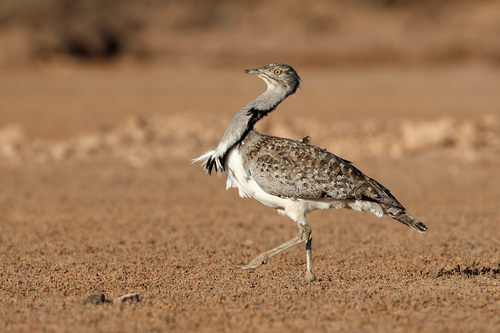
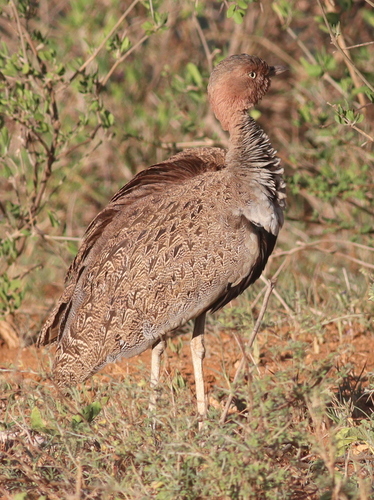
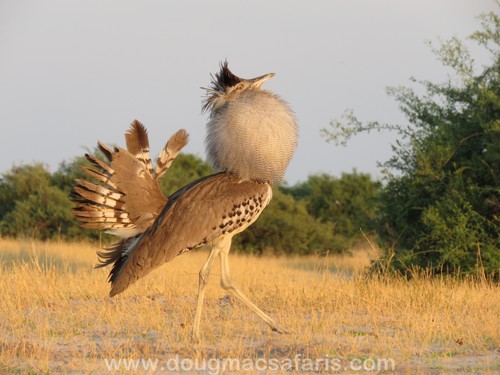
The kori bustard (Ardeotis kori) has cryptic coloration, with plumage that is mostly grey and brown and finely patterned with black and white. Its upper parts and neck are vermiculated black and greyish-buff, while the ventral plumage has bolder coloring in white, black, and buff. The crest on its head is blackish, with less black present on the female's crest. A white eye stripe runs above the eye, and the chin, throat, and neck are whitish with thin, fine black barring. A black collar at the base of the hind-neck extends onto the sides of the breast. The feathers around the neck are loose, creating the appearance of a thicker neck than the bird actually has. The belly is white, and the tail has broad bands of brownish-gray and white. The bird's feathers contain light-sensitive porphyrins, which give the feather bases a pinkish tinge—this is especially noticeable when feathers are shed suddenly. The kori bustard has a large head, relatively long legs, a pale yellow eye, and a light greenish horn-colored bill that is relatively long, straight, and rather flattened at the base. Its legs are yellowish, and its feet have three forward-facing toes. Females have similar plumage to males but are much smaller: their linear measurements are about 20–30% smaller, and they often weigh 2–3 times less than males. Females also have visibly thinner legs and a slimmer neck. Juveniles look similar to females, but are browner with more spotting on the mantle, and have shorter crests and neck plumes. Male juveniles are larger than females and can reach the same overall size as adult males, but are less bulky, with a thinner neck, shorter head crest, paler eyes, and a darker mantle. The kori bustard is found across southern Africa, except in densely wooded areas. It is common in Botswana and Namibia, with its range extending into southern Angola and marginally into southwestern Zambia. In Zimbabwe, it is generally sparse but locally common, particularly on the central plateau. Its distribution range extends along the Limpopo River valley into southern Mozambique and the eastern lowveld of South Africa. In South Africa, it is infrequent to rare in the Free State, North West and Northern Cape Provinces, and extends south into the interior of the Western and Eastern Cape Provinces. Kori bustards are absent from the coastal lowlands along the south and east of South Africa, and from high mountainous areas. This species is common in Tanzania at Ngorongoro National Park, Kitulo National Park and Serengeti National Park. A geographically disjunct population also lives in the deserts and savanna of northeastern Africa, where the species ranges from extreme southeast South Sudan, northern Somalia, and Ethiopia through all of Kenya (except coastal regions), Tanzania and Uganda. Kenya may hold the largest kori bustard population of any country, and the species can be nearly abundant in the country's North Eastern Province. Kori bustards are usually residential within their range, with some random, nomadic movement that follows rainfall. This species occurs in open grassy areas, often with sandy soil (especially Kalahari sands) and short grass, usually near cover provided by isolated clumps of trees or bushes. It can be found in plains, arid plateaus, highveld grassland, arid scrub, lightly wooded savanna, open dry bushveld, and semi-desert. Where this species occurs, annual rainfall is quite low, between 100 and 600 mm (3.9 and 23.6 in). Breeding habitat is savanna with sparse grass cover and scattered trees and shrubs; when nesting, kori bustards sometimes use hilly areas. They follow fires or herds of foraging ungulates to feed on various foods found in short grasses. They may also be found in cultivated areas, especially wheat fields with a few scattered trees. This bustard is not found in well-wooded and forested areas, as it requires large amounts of open space to take off. In arid grassland areas, it is found along dry watercourses, where patches of trees provide shade during the heat of the day.