About Ardeotis australis (J.E.Gray, 1829)
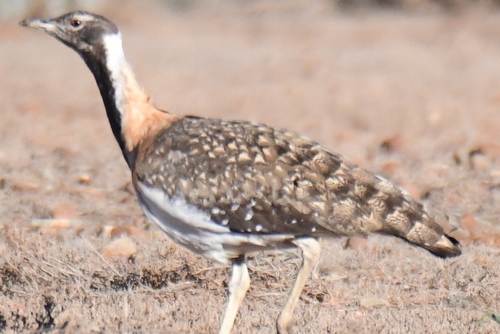
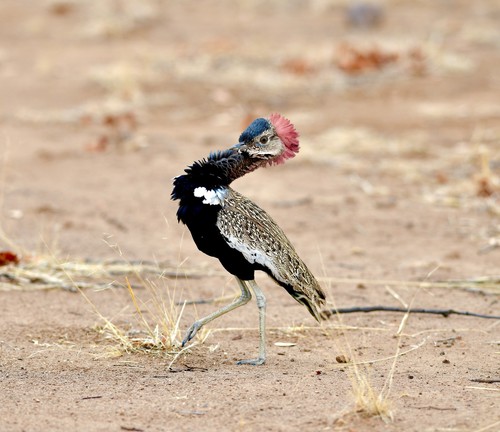
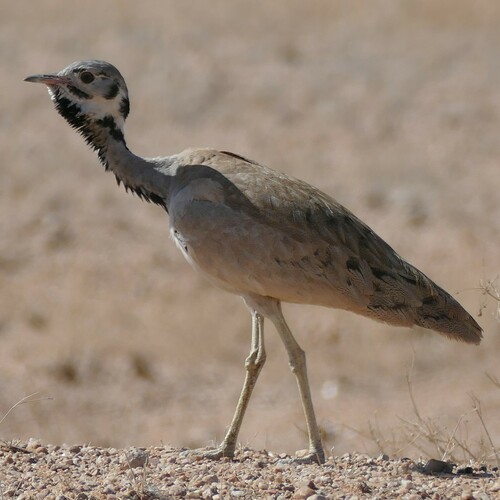
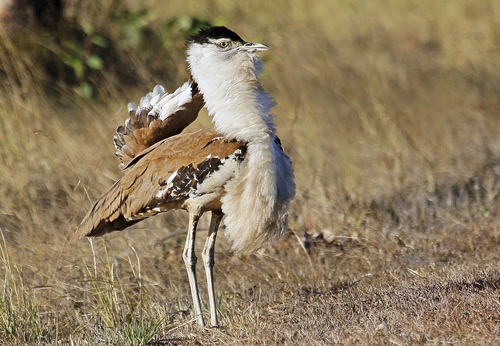
Ardeotis australis is the only Australian species of the Ardeotis genus, which is found across African, Indian, and Australasian regions. This is a large terrestrial bustard that shares similar form and behavior to an American turkey. It can be easily identified by its large size, long legs, and the habit of slowly walking across open plains. The species has a black crown and nape, a long pale grey front neck, and brown plumage covering its wings and upper body. While the sexes have similar appearance, females are smaller than males in height, wingspan, and weight. The abdomen is white, and a black feather band separates the abdomen from the light grey neck. The wing coverts have patchy black and white patterning that is visible at rest, and especially during flight. The iris is white, the beak ranges in color from whitish to brown, and the long legs are yellow to cream in color. Males can reach up to 1.2 m (47 in) tall with a 2.3 m (7.5 ft) wingspan, with an average weight of 6.3 kg (14 lb) ranging from 4.3 to 12.76 kg (9.5 to 28.1 lb). Females are noticeably smaller, reaching 80 cm (31 in) tall with a 1.8 m (5.9 ft) wingspan; their average weight is 3.2 kg (7.1 lb), ranging from 2.4 to 6.35 kg (5.3 to 14.0 lb), and they share the same coloration as males. The largest recorded male, from Victoria, weighed 14.5 kg (32 lb). There are multiple historical records of varying weights from different regions: Tom Carter recorded a 16 lb (presumed male) in western Australia; E. F. Boehm recorded a 16–18 lb range for specimens in South Australia, with some specimens exceeding this at 28 lb; an unwell adult weighed 9 lb when shot by Carter at Broomehill; a healthy but small specimen weighed 7½ lb when captured and weighed by Dominic Serventy and Hubert Whittell at Bridgetown in 1949. Although Ardeotis australis is the largest extant flying land bird in Australia, it is the smallest species in the Ardeotis genus. Regarding distribution and habitat, this species has a wide distribution across most of the Australian continent, and occasionally extends into southern parts of Papua New Guinea and Indonesia. Its range in southeast Australia has contracted, and it no longer occurs in areas where it was once found. Studies tracking the birds via satellite tagging and community surveys show that local populations in wetter regions are more permanent and localized, while populations in more arid regions have larger ranges. The birds can become locally abundant after land clearing or during grasshopper outbreaks. The strongest local region fidelity is reported in high rainfall areas of northern and northwestern Australia. The species favours open grasslands (sometimes with scattered trees), spinifex plains, and low shrublands. This bustard will enter denser vegetation after fire, and is also seen on artificial cleared areas such as golf courses and farmland. Historically, in Southwest Australia, its range included the dunes and alluvial flats of the Swan Coastal Plain as far south as Busselton, and inland areas that later became the Wheatbelt. Vagrants were seen in other areas associated with the higher rainfall forest of the southwest region, but the species naturally avoids forests and densely vegetated areas. Anecdotal reports from local residents state that the species avoided human habitation and pastoral activities, and that over-hunting or land clearing (rather than foxes) caused the local disappearance of the species. Historically, the species occurred year-round in southwest Australia, and was sometimes found in large flocks.