About Ardeola bacchus (Bonaparte, 1855)
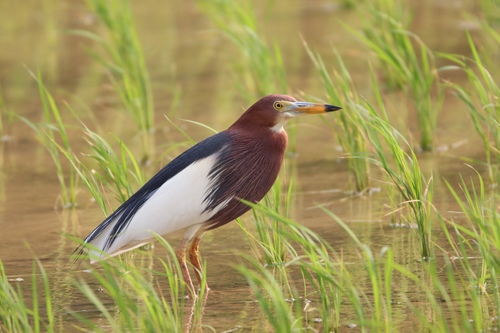
The Chinese pond heron (Ardeola bacchus) is typically 47 cm (19 in) long. It has white wings, a yellow bill with a black tip, and yellow eyes and legs. During the breeding season, its overall plumage is a mix of red, blue, and white; outside of breeding season, it is greyish-brown flecked with white. This heron occurs in shallow fresh and saltwater wetlands and ponds across China and adjacent temperate and subtropical East Asia. It is essentially a lowland bird, and its native range is bounded by subarctic regions to the north, and mountain ranges to the west and south. The species is known to sometimes wander beyond its usual range as a vagrant. On April 8, 1995, one individual in breeding plumage was sighted on a river at Bonzon near Gangaw, just inside Chin State, Burma, west of the species' normal range. A stray individual that stopped over on Saint Paul Island, Alaska from August 4 to 9, 1997 marked the first recorded occurrence of this species in North America. The Chinese pond heron feeds on insects, fish, and crustaceans. It often nests in mixed-species heronries, and lays a clutch of 3 to 6 blue-green eggs per brood. It is fairly common, and is not classified as a threatened species by the IUCN.