About Ardea humbloti Milne-Edwards & A.Grandidier, 1885
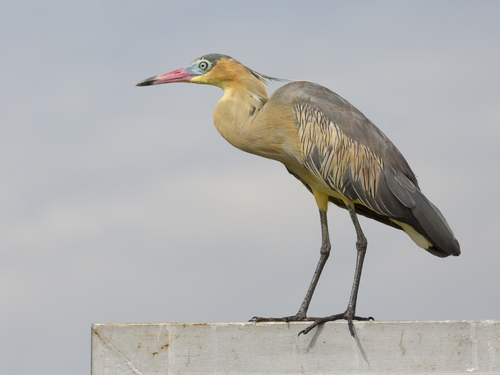
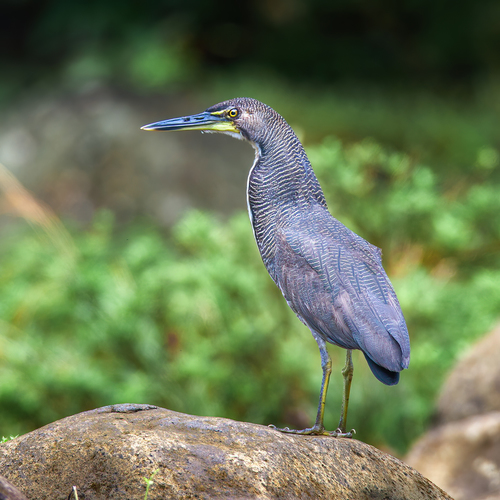
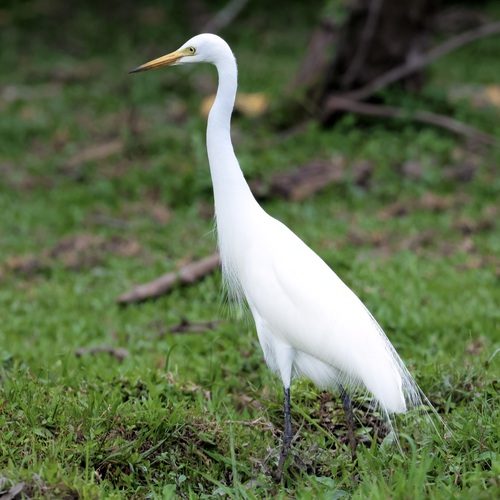
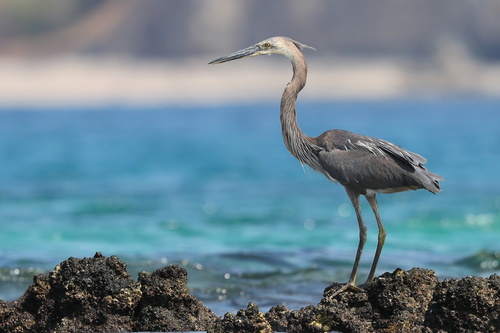
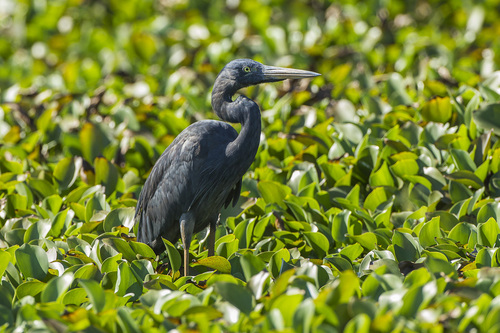
Humblot's heron (Ardea humbloti Milne-Edwards & A.Grandidier, 1885) has uniform dark gray plumage across its body, with darker feathers on its forehead and chin. Elongated feathers on its nape form a crest. It has a large pale bill, pale eyes, and pale legs. This species measures 92–100 cm (3.02–3.28 ft) in height, and ranges in body weight from 1–1.6 kg (2.2–3.5 lb). Its bill length is between 13–14.93 cm (5.12–5.88 in), while bill depth ranges from 2.45–2.69 cm (0.96–1.06 in).
Humblot's heron is endemic to the island of Madagascar, where it is most common in the coastal lowlands of southern, western, and northern parts of the island. Small populations also occur on the neighboring islands of Comoros and Mayotte. There is one recorded and accepted observation of this heron in mainland Africa, at a game reserve in Tanzania. In 2006, the total population of Humblot's heron in Madagascar was estimated at 1,000 to 3,000 individuals.
This heron lives in fresh, brackish, or saltwater wetlands. It prefers tidal areas, but also occupies lakes, rivers, mangroves, and estuaries. It is most often found at low elevations, but has been recorded as high as 1,500 m (4,900 ft) above sea level. It does not migrate, but is capable of dispersing over long distances, which is demonstrated by its occurrence in mainland Africa.
Little detailed information is available about Humblot's heron's breeding cycle. Nesting has been observed year-round. Nests are usually built on the ground, surrounded by dense aquatic vegetation, but they may also be placed in trees 5–12 m (16–39 ft) tall. On Mayotte, this heron has been observed nesting in mangroves. Humblot's heron builds its nests primarily from sticks and reeds, and the nest is approximately 50–70 cm (20–28 in) in diameter. Its eggs are blue, and the typical clutch size is 3 eggs. Both parent birds take turns incubating the eggs.