About Ardea herodias Linnaeus, 1758
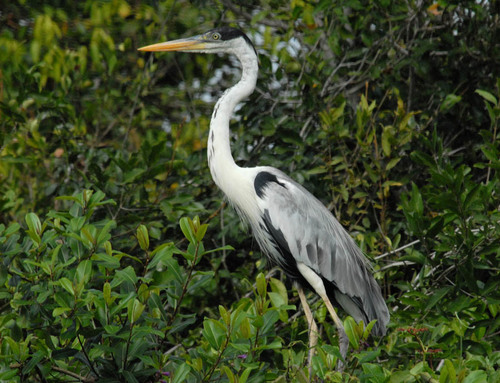
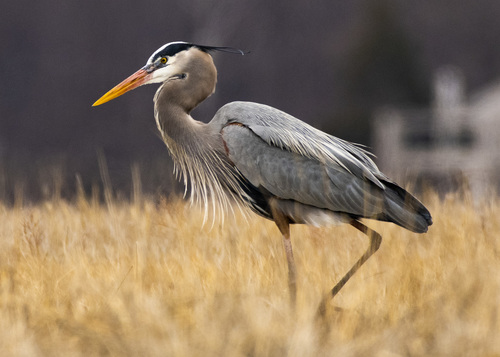
The great blue heron (Ardea herodias Linnaeus, 1758) is the largest heron native to North America. Among all living heron species, only the goliath heron (Ardea goliath) and the white-bellied heron (Ardea insignis) grow larger than the great blue heron. This species shows a small amount of sexual dimorphism: males are slightly larger than females, but the two sexes cannot be easily told apart by external appearance otherwise. The great blue heron has a head-to-tail length of 91–137 cm (36–54 in), a wingspan of 167–201 cm (66–79 in), a height of 115–138 cm (45–54 in), and a total weight of 1.82–3.6 kg (4.0–7.9 lb). In British Columbia, adult males averaged 2.48 kg (5.5 lb), while adult females averaged 2.11 kg (4.7 lb). In Nova Scotia and New England, adult great blue herons of both sexes averaged 2.23 kg (4.9 lb), and in Oregon, both sexes averaged 2.09 kg (4.6 lb). Overall, great blue herons are roughly twice as heavy as great egrets (Ardea alba), though they are only slightly taller than great egrets. They weigh only about half as much as a large goliath heron. Distinctive features of great blue herons include slaty flight feathers, which are gray with a faint azure blue tint, red-brown thighs, and paired red-brown and black stripes running up the flanks. Their neck is rusty-gray, with black and white streaking running down the front. Their head is paler in color, with an almost white face, and a pair of black or slate plumes that run from just above the eye to the back of the head. The feathers on the lower neck are long and plume-like. Great blue herons also grow plumes on the lower back at the start of the breeding season. Their bill is dull yellowish, turning orange briefly at the start of the breeding season. Their lower legs are gray, also taking on an orangey tint at the start of the breeding season. Immature great blue herons are duller in overall color, with a dull blackish-gray crown, only weakly defined flank patterning, no plumes, and a dull gray-yellow bill. Standard measurements for the species are as follows: wing chord 43–49.2 cm (16.9–19.4 in), tail 15.2–19.5 cm (6.0–7.7 in), culmen 12.3–15.2 cm (4.8–6.0 in), and tarsus 15.7–21 cm (6.2–8.3 in). The heron's stride is around 22 cm (8.7 in), and it walks almost in a straight line. Two of its three front toes are generally positioned closer together. In foot tracks, the front toes and the back toe often show the small talons. Subspecies of great blue heron differ only slightly from one another in size and plumage tone. The exception is A. h. occidentalis, which is native to South Florida. This subspecies has a distinct white morph called the great white heron, which should not be confused with the great egret, which was once commonly called great white heron. The great white heron differs from other great blue herons in bill shape, head plume length, and a complete lack of pigment in its plumage. It averages somewhat larger than the sympatric race A. h. wardi and may be the largest subspecies in the great blue heron species. In a survey of A. h. occidentalis in Florida, males averaged 3.02 kg (6.7 lb) and females averaged 2.57 kg (5.7 lb), with a total weight range of 2.0 to 3.4 kg (4.4 to 7.5 lb) for both sexes. The great white heron is found mainly near salt water, and was long considered a separate species. Birds intermediate between the normal great blue heron morph and the white morph are called Würdemann's heron; these birds resemble a typical great blue heron with a white head. The theory that great white herons are a separate species (A. occidentalis) distinct from the great blue heron has recently received some support from David Sibley. In terms of distribution and habitat, the great blue heron occurs across most of North America, reaching as far north as Alaska and the southern Canadian provinces in summer. In winter, its range extends south through Florida, Mexico, and the Caribbean to far northwestern South America; it is regularly found in Colombia and Venezuela, and is an accidental visitor elsewhere on the continent. Birds breeding east of the Rocky Mountains in the northern part of the species' range are migratory, and winter in coastal areas of the Southern United States, Central America, or northern South America. Great blue herons are year-round residents in areas from the Southern United States southward, and along the lower Pacific coast of North America. However, the species is hardy enough that individual birds often stay through cold northern winters, as long as waters that contain fish remain unfrozen. This condition is most often met in flowing waters such as streams, creeks, and rivers. The great blue heron can adapt to nearly any wetland habitat within its range. It can be found in large numbers in freshwater and saltwater marshes, mangrove swamps, flooded meadows, lake edges, and shorelines. It is quite adaptable, and can even be seen in heavily developed areas as long as these areas hold bodies of water that contain fish. Great blue herons rarely travel far from bodies of water, but are occasionally spotted flying over upland areas. They typically nest in trees or bushes near the edge of water, often on islands to reduce the risk of predation, or in partially isolated spots. The species has been recorded as a vagrant in England, Greenland, Hawaii, and the Azores. The great white heron is unique to South Florida, including the Great White Heron National Wildlife Refuge in the Florida Keys.