About Ardea cocoi Linnaeus, 1766
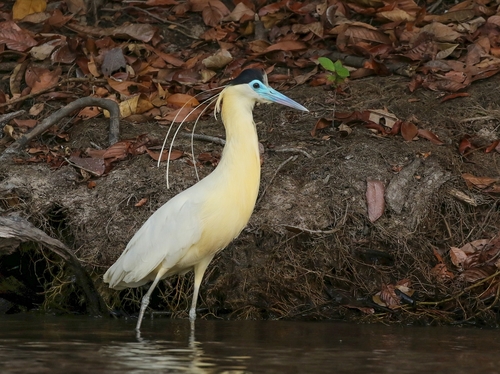
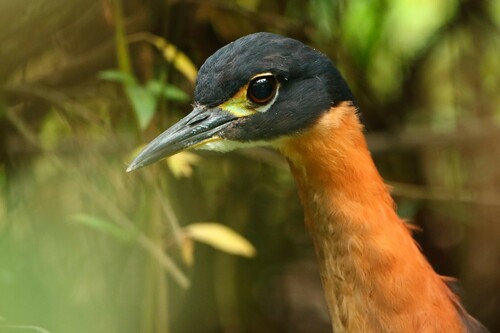
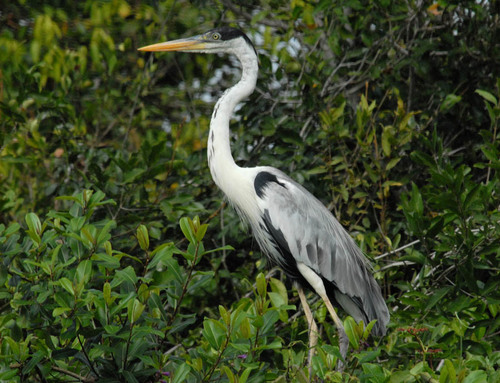
The cocoi heron (Ardea cocoi) is the largest heron species native to South America. It measures 95–130 cm (37.5–51 in) in total length, with regional size variation; southern individuals are likely the largest. Adult individuals of both sexes weigh between 1.14 and 3.2 kg (2.5 to 7 lb). Recorded measurements for adult birds are: wing length 421–455 mm (16.5–18 in), tail length 161–173 mm (6.5–7 in), culmen from the base 128.5–148.7 mm (5–6 in), and tarsus 179–192 mm (7–7.5 in). Its size is similar to the great blue heron, its North American counterpart, though the great blue heron averages slightly larger on average. The sexes are identical in both body size and coloration. Adult birds have grey backs and upper wings, with white S-shaped necks, thighs, under-tail wing coverts, and scapulars. Black streaks are present on the neck and upper breast. The forehead and crown are black, and this black coloration extends down to the eye area and up into a pointed crest that hangs down the nape. Additional black streaks appear on the neck, and black patches are located on the sides of the lower breast and abdomen. Legs have been recorded as black, brownish-grey, or dark green. The iris is usually yellow, and the bill is dull yellow. The bare skin of the orbital region is pale greenish. Some breeding cocoi herons observed in Argentina have bright yellow bills with a red tinge at the base, and dusky pink legs. In flight, its large wings make it a slow but sturdy and graceful flyer. Its call is a deep croak. Overall, the cocoi heron is similar in appearance to the grey heron, but the cocoi heron has slightly darker coloration, a longer neck, and a longer crest. Juvenile cocoi herons have ash grey underparts streaked with buff. Their necks and upper body surfaces are pale brownish, with a faint ash grey tinge on the neck. Compared to adults, the juvenile crown is duller, and the under-tail coverts have dusky streaking. Juveniles also lack the long plumes and occipital crest that are typical of adult birds. Even downy chicks, while paler in overall color, already show the species-typical contrast between a dark head and pale neck seen in adults. The cocoi heron occurs across most of South America, excluding the Andes and some parts of Argentina. It is native to Argentina, Panama, Suriname, Colombia, Venezuela, Bolivia, Brazil, Chile, Ecuador, French Guiana, Guyana, Paraguay, Peru, and Uruguay. Overall, the species has a notably wide range, extending from Central America to the mainland shores of the Strait of Magellan, though it is rarely found further south than Argentina’s Chubut province. It has an estimated extent of occurrence of 20,600,000 km². It inhabits the wetter regions of the Chaco, and occurs as a vagrant in the Falkland Islands, Saint Helena, Ascension Island, and Tristan da Cunha. It is a regular non-breeding visitor to Trinidad and Tobago. Its habitat includes almost any body of water or wetland located away from dense forest, including lake shores, swamps, rivers, and estuaries. Gallery forest, grassland, and beaches are also recorded as suitable feeding grounds. Pastures appear to be disfavored, likely because these habitats support a large proportion of insects, which are less preferred as prey than fish and mammals. In the Falkland Islands, vagrant individuals are found around small streams. One study along the Paraná river found that water with aquatic vegetation was the most preferred habitat, followed by open water, with beaches having the lowest preference. This heron is found at elevations up to 2550 m above sea level.