About Ardea cinerea Linnaeus, 1758
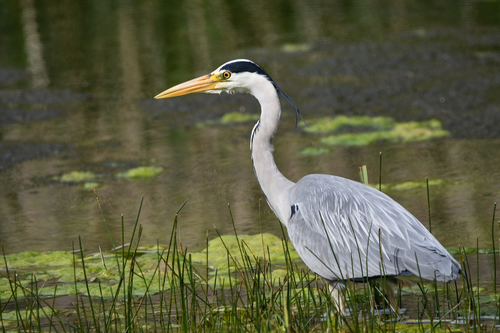
Ardea cinerea, commonly known as the grey heron, is a large bird. It reaches up to 100 cm (40 in) in standing height, 84–102 cm (33–40 in) in total length, and has a wingspan of 155–195 cm (61–77 in). Its body weight ranges from 1.02–2.08 kg (2 lb 4 oz – 4 lb 9+1⁄4 oz). Its upper plumage is mostly ashy-grey, while the underparts are greyish-white with some black markings on the flanks. Adult grey herons have a white head and neck, with a broad black supercilium that ends in a slender, dangling crest, plus bluish-black streaks on the front of the neck. The scapular feathers and feathers at the base of the neck are somewhat elongated. Immature birds do not have the dark head stripe, are generally duller in appearance than adults, have a grey head and neck, and a small, dark grey crest. The long, straight, powerful beak is pinkish-yellow, and is brighter in color during the breeding season for adults. The iris is yellow, and the legs are brown and very long. The grey heron’s main call is a loud croaking "fraaank", but a variety of guttural and raucous vocalizations can be heard at breeding colonies. Males use an advertisement call to encourage females to join them at the nest, and both sexes use various greeting calls after a pair bond is established. A loud, harsh "schaah" is used by males to drive other birds away from the nest area, and a soft "gogogo" expresses anxiety, such as when a predator is nearby or a human passes the colony. Chicks produce loud chattering or ticking noises. The grey heron has an extensive range across most of the Palearctic realm. The range of the nominate subspecies A. c. cinerea extends to 70° N in Norway and 66°N in Sweden, and its northerly limit sits around 60°N across the rest of Europe and Asia, eastward as far as the Ural Mountains. To the south, its range reaches northern Spain, France, central Italy, the Balkans, the Caucasus, Iraq, Iran, India, the Maldives and Myanmar (Burma). It is also present in Africa south of the Sahara Desert, the Canary Islands, Morocco, Algeria, Tunisia, and many Mediterranean Islands. The subspecies A. c. jouyi replaces A. c. cinerea in eastern Siberia, Mongolia, eastern China, Hainan, Japan, and Taiwan. The subspecies A. c. firasa is found in Madagascar and the Aldabra Islands, while the subspecies A. c. monicae is restricted to Mauritania and offshore islands. Across most of its range, the grey heron is resident, but birds from more northerly parts of Europe migrate southward; some remain in Central and Southern Europe, while others travel further to Africa south of the Sahara Desert. The grey heron is a known vagrant in the Caribbean, Bermuda, Iceland, Greenland, the Aleutian Islands, and Newfoundland, with a few confirmed sightings in other parts of North America including Nova Scotia and Nantucket. In South America, most sightings are from Brazil, especially in Fernando de Noronha, and there is also an old recorded sighting from Colombia. Within its range, the grey heron can be found in any location with suitable watery habitat that provides enough food. The water body must either be shallow enough, or have a shelving margin, to allow the bird to wade. Though it is most common in lowlands, it also occurs in mountain tarns, lakes, reservoirs, rivers, marshes, ponds, ditches, flooded areas, coastal lagoons, estuaries, and the seashore. It sometimes forages away from water in pastures, and has been recorded in desert areas hunting for beetles and lizards. Breeding colonies are usually located near feeding areas, but may exceptionally be up to eight kilometres (five miles) away, and individual birds sometimes forage as much as 20 km (12 mi) from their nesting site.