About Ardea alba Linnaeus, 1758
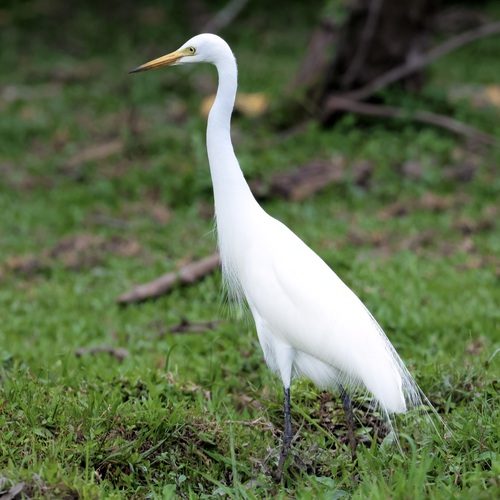
The great egret (Ardea alba Linnaeus, 1758) is a large all-white-plumage heron. It stands up to 1 m (3 ft 3 in) tall, has a total length of 80 to 104 cm (31 to 41 in), a wingspan of 131 to 170 cm (52 to 67 in), and a body mass ranging from 700 to 1,500 g (25 to 53 oz), with an average mass of around 1,000 g (35 oz). This makes it only slightly smaller than the great blue or grey heron (A. cinerea). Aside from size, great egrets can be told apart from other white egrets by their yellow bill and black legs and feet, though the bill may darken and lower legs lighten during the breeding season. Breeding plumage includes delicate ornamental feathers growing on the bird's back. Males and females have identical appearance, and juveniles look the same as nonbreeding adults. Great egrets can be distinguished from intermediate egrets (Ardea intermedia) by their gape: the great egret's gape extends well past the back of the eye, while the intermediate egret's gape ends just behind the eye. Great egrets fly slowly with their neck retracted, a trait characteristic of herons and bitterns that separates this group from storks, cranes, ibises, and spoonbills, which extend their necks during flight. When walking, great egrets hold their neck extended and their wings held close to the body. Great egrets are not typically vocal; they produce a low, hoarse croak when disturbed, and at breeding colonies they often give a loud croaking cuk cuk cuk and higher-pitched squawks. Due to its wide distribution across most of the Americas, as well as Africa, Europe and Asia, the great egret shares its habitat with many other similar species, including the little egret (Egretta garzetta), intermediate egret (Ardea intermedia), Chinese egret (Egretta eulophotes), and the western reef heron (Egretta gularis). In the Americas, the snowy egret (Egretta thula), a medium-sized heron that shares the same habitat as the great egret, is one such similar species. Snowy egrets are easily distinguished from great egrets: snowy egrets are noticeably smaller, have a more slender black bill and yellow feet, while great egrets have a yellow bill and black feet. In North America, another species easily confused with the great egret is the white morph of the great blue heron (Ardea herodias), which is slightly larger and has a thicker bill than the great egret. The great egret is generally a very successful species with a large and expanding range, found worldwide in temperate and tropical habitats. It is common across the Sun Belt of the United States and in the Neotropics. Historically, it was a rare visitor to the Nordic countries. The first recorded breeding of great egrets was in Sweden in 2012, and in Denmark in 2014. In 2018, a pair of great egrets nested in Finland for the first time, raising four young in a grey heron colony in Porvoo. Great egrets breed in colonies in trees located close to large lakes with reed beds or other extensive wetlands, preferring to nest at a height of 3.0–12.2 m (10–40 ft). They begin breeding at 2–3 years of age, forming new monogamous pairs each breeding season; it is unknown if these pair bonds continue into subsequent seasons. The male selects the nest area, starts building the nest, then attracts a female. The nest is constructed from sticks and lined with plant material, and can reach up to 3 feet across. Females lay up to six bluish green eggs per clutch. Both sexes incubate the eggs over an incubation period of 23–26 days. Both parents feed the young by regurgitation, and the young are able to fly 6–7 weeks after hatching.