About Arcuatula senhousia (W.H.Benson, 1842)
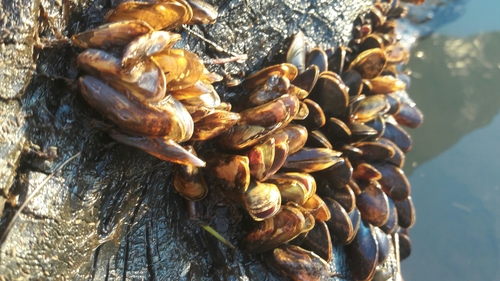
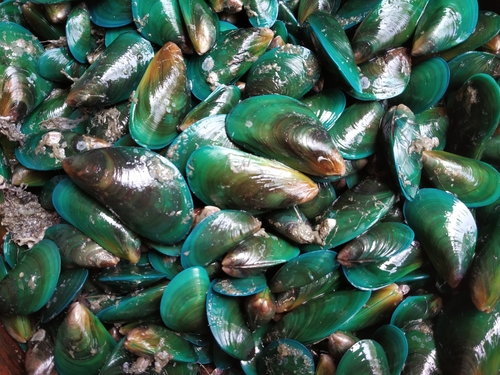
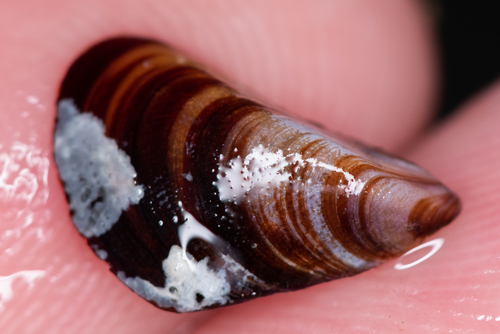
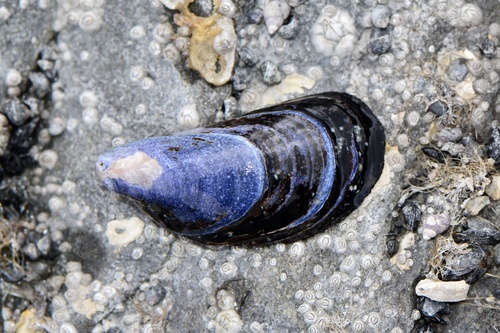
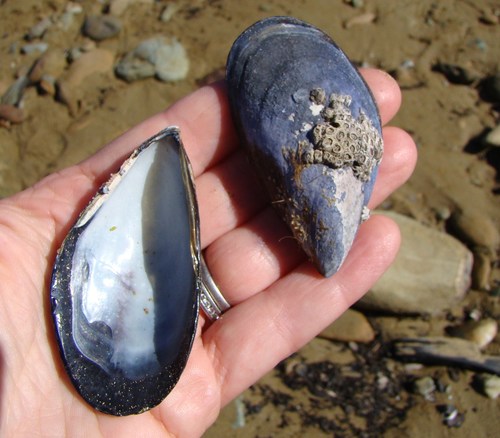
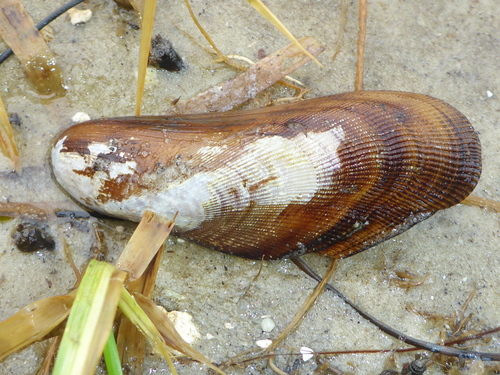
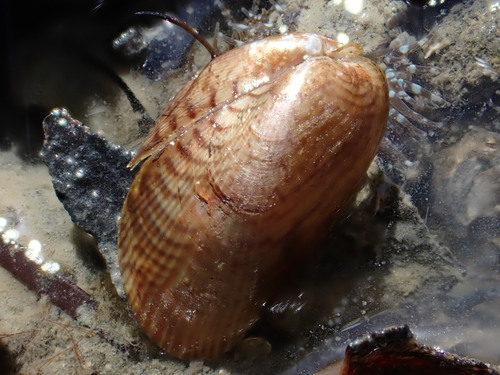
Arcuatula senhousia can be distinguished from other mussels by its relatively small size, inflated shape, and the greenish colour of its outer periostracal layer. Its shell has radiating reddish lines on the posterior surfaces, small internal teeth on the dorsal edge posterior to the ligament, and small ribs anterior to the umbones. This species can grow up to 30 mm (1+1⁄8 in) in length. It is known for relatively fast growth, and has a maximum lifetime of about two years. Arcuatula senhousia is native to the Western Pacific Ocean, and inhabits coastal areas from Siberia and the Kuril Islands south to Singapore. It has become an invasive species in California, the Mediterranean, Australia, and New Zealand. It was introduced to the West Coast of the United States in the early 20th century via shipments of Japanese oysters. In 1983, large specimens of the species were collected in the Swan River estuary in Western Australia. This mussel has been present in Waitemata Harbour, Auckland, since the 1970s, and became established by 1984. Specimens have also been reported in the Tamar estuary in Tasmania. It is thought to have invaded these locations through a variety of pathways: transportation on ship hulls, in ship water-intake chambers and ducts, as planktonic larvae carried in the ballast water of bulk-cargo vessels, in association with intentionally introduced oysters, and via Lessepsian migration through the Suez Canal. Commonly called the Asian date mussel, this species is generally found in sheltered mud or other soft substrates up to 20 m (66 ft) below the water surface. In its native range of China and Japan, it occurs in intertidal zones at densities up to 2500 per m². As an invasive species in Australia, it is found between 0.5 to 4.0 m (1+1⁄2 to 13 ft) below the water surface at slightly higher densities. Along the West Coast of North America, the species generally reaches densities of 5,000 to 10,000 per m², and has been recorded at densities up to 150,000 per m² in Mission Bay, San Diego, California. The mussel is most abundant in summer and early autumn. In the Swan River estuary in Western Australia, the mussel population has a high mortality rate in late autumn and early winter, which may result from decreased water salinity caused by increased rainfall.