About Arctonoe vittata (Grube, 1855)
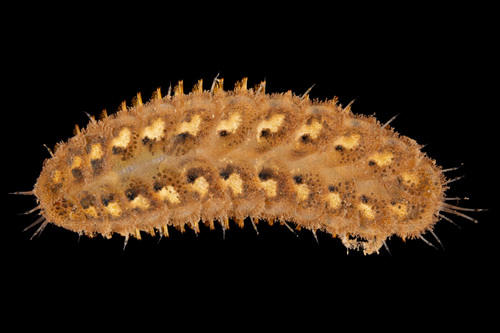
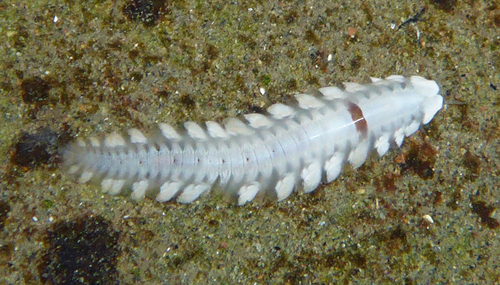
This species, Arctonoe vittata, has at least thirty pairs of elytra — scale-like modified dorsal cirri — that cover most of its body. These elytra are located on alternate segments, do not meet along the back, and leave the central body line exposed. The body is pale yellowish, marked with a few faint transverse bands, and has a distinct dark stripe across its 7th and 8th segments. It can reach a total length of 8 to 10 cm (3 to 4 inches), though most individuals are shorter than this. It can be told apart from the closely similar Arctonoe pulchra by its lack of a dark spot on each elytron.
Arctonoe vittata is native to the eastern Pacific Ocean. Its geographic range stretches from the Bering Strait south to Ecuador, and extends west as far as Japan. It occurs across a depth range from the middle shore down to approximately 275 m (902 ft).
This scale worm forms a commensal symbiotic relationship with a variety of marine host species. It commonly lives on the gills and pallial groove of the gumboot chiton, in the ambulacral groove of the leather star Dermasterias imbricata, and in the gill groove of the keyhole limpet Diodora aspera. In Diodora aspera, the worm can grow to a size that is very large relative to its host. When the host limpet is attacked by a predatory starfish like Pisaster ochraceus, the scale worm defends its host by biting the starfish's tube feet, and usually succeeds in driving the predator away. Other recorded hosts include multiple starfish species: Henricia leviuscula, Luidia foliata, Pteraster tesselatus, Solaster stimpsoni, and Solaster dawsoni; the northern abalone Haliotis kamtschatkana; and two terebellid worm species: Thelepus crispus and Neoamphitrite robusta.
The worm appears to recognize its host species via a chemical cue dissolved in water. If it becomes separated from its symbiotic host, it will attempt to return to its original host, or locate a new host of the same species. Arctonoe vittata is carnivorous, but does not eat its host. Instead, it is carried by its host to new feeding areas, where it feeds on the heads of polychaete tubeworms, or any other suitable prey the host encounters during its movements. The species is an efficient walker, but a poor swimmer.