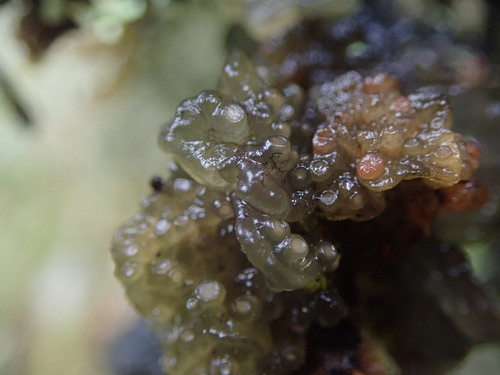
About Arctomia fascicularis (L.) Otálora & Wedin
The lichen body (thallus) of Arctomia fascicularis forms small, rounded cushions up to around 1.5 cm across. The thallus is crustose to small-foliose, and becomes very swollen and pulpy when hydrated, reaching up to 10 mm thick. Its surface is coarsely nodulose-wrinkled and only indistinctly lobed. When lobes are present, they are short, flattened, closely appressed and often overlapping, with tiny secondary lobules that grow from the wrinkles. In its dry state, the upper surface is dark olive-green to brown-black; it changes to grey-green to olivaceous when wet, and is usually strongly ridged. Vegetative propagules are completely absent: this species does not produce isidia (outgrowths) or soredia (powdery patches) that many other lichens use for asexual dispersal. Disc-like fruiting bodies called apothecia develop from the secondary lobules. While apothecia are not always abundant, when they do occur they can be numerous and conspicuous, often covering the entire surface of the thallus. The apothecial discs are 0.8–2 mm across, usually flat, the same color as the thallus, and typically bordered by a thick, somewhat wrinkled rim made of thallus tissue called a thalline margin. The spore-bearing asci (spore sacs) usually hold eight spores, though they sometimes contain six. The ascospores measure 50–95 × 4.5–5 micrometres, and are divided by 9–16 cross-walls called septa. They are vermiform, or worm-like, and lie helically twisted inside the ascus. They often taper at one or both ends and do not have a surrounding gelatinous sheath. Arctomia fascicularis (previously called Gabura fascicularis) is a widely distributed epiphytic cyanolichen with a fragmented Holarctic range. It grows in oceanic and sub-oceanic regions of Europe, and has been recorded in adjacent parts of North Africa and Asia. It is also present in the Southern Hemisphere, documented in Australasia including Australia and New Zealand, as part of its cosmopolitan distribution. This lichen grows primarily on the bark of old broad-leaved trees, especially trees with relatively base-rich bark. In Europe, it has been found on mature elm (Ulmus) and ash (Fraxinus) trees, and occasionally on hazel (Corylus). It often grows over mosses that carpet bark or rock, and has even been recorded growing among mosses on calcareous rock outcrops. In the humid montane forests of Australasia, Arctomia fascicularis lives in very wet, shaded microhabitats on the lower parts of trees, such as understory branches and trunk buttresses. Across its entire range, it prefers moist, shaded sites; in Britain, it "appears to favour moist, shady" woodland habitats. As a cyanolichen, it contains a filamentous cyanobacterial photobiont from the genus Nostoc, which allows it to fix atmospheric nitrogen. Occurrences of this lichen are typically scattered and localized, which reflects its requirement for persistently humid conditions and undisturbed, mature substrates. The species was once more common, but has declined in many areas due to the loss of mature host trees (for example, elm populations severely reduced by disease) and environmental factors such as acid rain. This decline has led to the species being considered rare or threatened in parts of its range; for example, it is listed as a near-threatened species in Britain.

