About Arctomecon humilis Coville
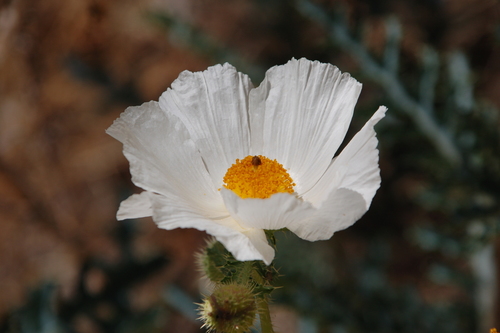
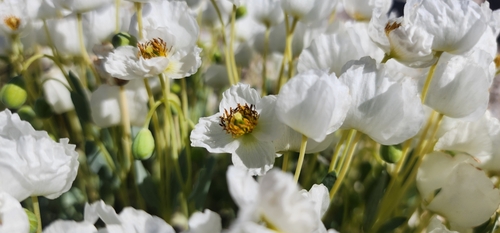
Arctomecon humilis Coville, commonly called the dwarf bear-poppy, gets its name from the resemblance its leaves bear to a bear paw. Its sage-green leaves are covered in small, soft hairs, with three ridges at the tip of each leaf that can be rounded or pointed. Each of these ridges holds a larger, sharper protruding hair, and the ridges are smaller and more rounded than the ridges found higher up on the plant’s stems. The plant’s stems are light yellow-green, growing 2 to 9 cm (0.79 to 3.54 in) tall, and hold the flowers above the plant’s leaf layer. Dwarf bear-poppies grow in individual clusters; when including stems and flowers, these clusters can reach up to 25.4 centimeters (10.0 inches) in total height. Each cluster can produce around 20 to 30 flowers, while the largest plants can produce up to 400 flowers. The flowers often cover the entire top of the plant. Each dwarf bear-poppy flower has four round white petals surrounding yellow stamens and a green pistil at its center. Unopened flower buds hang down while waiting to bloom. This species is native to southwestern Utah, near St. George, where it grows on areas of the Moenkopi Formation, a widespread southwestern United States geologic formation defined by its mineral-rich, erosion-prone badland soil that is high in gypsum. The dwarf bear-poppy requires this specific soil type to grow. It also needs biological soil crust made up of microscopic plants and fungi, which aids the poppy’s growth, supports carbon and nitrogen cycling, and is more resistant to erosion than non-crusted soil. These biological soil crusts take hundreds of years to form, and are easily damaged by off-road vehicle use and construction activity. The dwarf bear-poppy inhabits hilly, unvegetated high-elevation areas, growing at elevations between roughly 853 and 914 meters (2,799 to 2,999 ft). Across the poppy’s limited range, annual precipitation varies, but the average annual precipitation is 2 cm (0.79 in). Precipitation is the species’ most critical growth requirement, followed by local geology and soil content. The dwarf bear-poppy’s range is restricted by its specific habitat needs. Today it only grows in undeveloped areas around St. George, Utah, within Washington County, confined to a half-circle boundary surrounding the city. It was first discovered in 1874, when it once grew extensively across southwestern Utah. In 1960, construction of the I-15 highway split the species’ population in half, and populations continued to decline as regional urbanization increased. This decline is driven by human development and created barriers to pollen transfer. While a large amount of land is theoretically suitable for the species, human activity limits its current range, and the plant now occupies all viable habitat that remains available to it.