About Arctocephalus pusillus (Schreber, 1775)
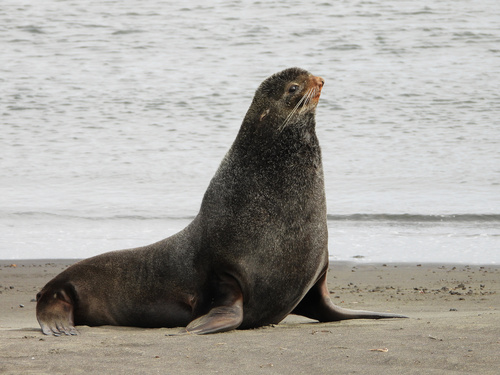
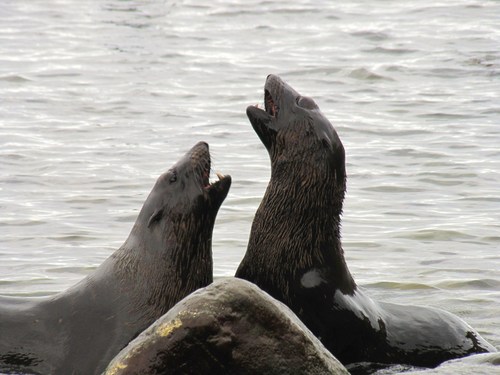
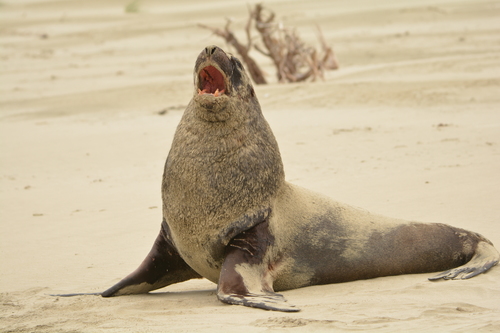
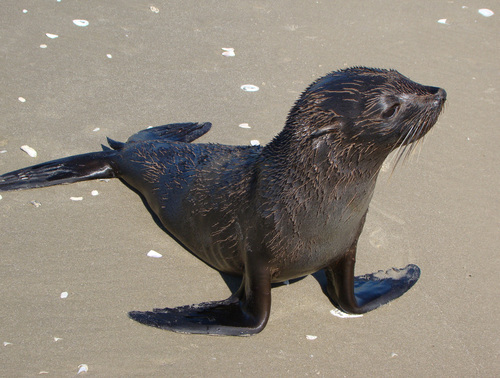
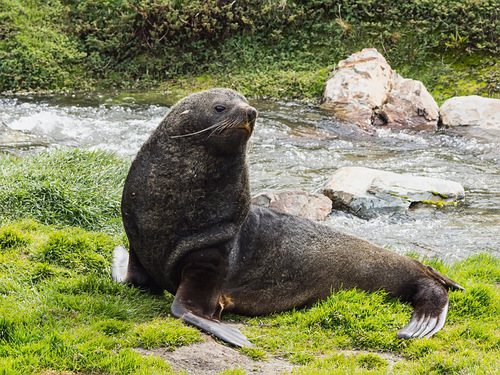
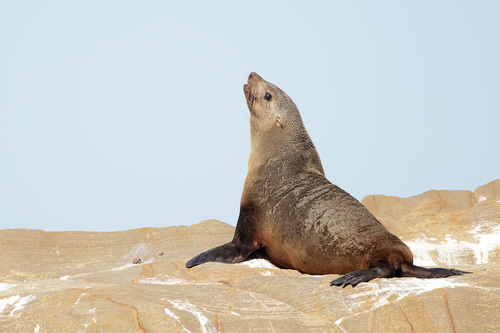
Arctocephalus pusillus, commonly known as the brown fur seal, is the largest and most robust species of fur seal. This species has a large, broad head with a pointed snout that may be flat or slightly upturned. It has external ear flaps called pinnae, and long whiskers (vibrissae) that can grow past the pinnae, particularly in adult males. The fore-flippers are covered in sparse hairs over roughly three-quarters of their length. The hind-flippers are short relative to the species' large body, with short, fleshy tips on the digits. Size and weight vary by subspecies: the Southern African subspecies is slightly larger on average than the Australian subspecies. For the Southern African subspecies (A. p. pusillus), males average 2.3 m (7.5 ft) in length and weigh 200–300 kg (440–660 lb), while females are smaller, averaging 1.8 m (5.9 ft) in length and typically weighing 120 kg (260 lb). For the Australian subspecies (A. p. doriferus), males measure 2.0–2.2 m (6.6–7.2 ft) in length and weigh 190–280 kg (420–620 lb), while females measure 1.2–1.8 m (3.9–5.9 ft) in length and weigh 36–110 kilograms (79–243 lb). Adult male Cape fur seals (the Southern African subspecies) range from dark gray to brown, with a darker mane of short, coarse hairs and a lighter belly. Adult females are light brown to gray, with a light throat and darker back and belly. The fore-flippers of all brown fur seals are dark brown to black. Pups are born black, and molt to gray with a pale throat within 3–5 months. The skull of the Southern African subspecies has a larger crest between the mastoid process and the jugular process of the exoccipital. The Southern African (African) subspecies inhabits the southern and southwestern coast of Africa, ranging from Cape Cross, Namibia to around the Cape of Good Hope, and extends to Black Rocks near Port Elizabeth in the Eastern Cape province. The Australian subspecies lives in the Bass Strait, on four islands off Victoria in southeastern Australia, and five islands off Tasmania. Brown fur seals prefer to haul out and breed on rocky outcrops, small islands, rock ledges, exposed reefs, and rocky, pebble, or boulder beaches. However, some larger colonies can be found on sandy beaches, such as those in South Africa. Fur seals spend most of the year at sea, but rarely travel more than 160 km from land, a distance that is not common. The diet of the African subspecies is up to 70% fish, 20% squid, and 2% crab. They also eat other crustaceans, other cephalopods, and sometimes seabirds. In rare instances, they have been documented attacking and eating sharks. A recent incident off Cape Point, South Africa observed a large male seal attacking and killing five blue sharks between 1.0 and 1.4 m long; observers concluded the seal likely killed the sharks to eat the fish-rich contents of their stomachs and their livers as an energy source. The Australian subspecies mostly eats squid, octopus, fish, and lobsters. Brown fur seals dive for their food: the African subspecies can dive as deep as 204 m (669 ft) for up to 7.5 minutes, while the Australian subspecies generally feeds at shallower depths, with an average dive depth of 120 m (394 ft) and a maximum recorded depth of 200 m (656 ft). The main predators of brown fur seals are great white sharks and orcas; vagrant southern elephant seals also occasionally prey on them. For the African subspecies, land-based predators (which primarily target pups) include black-backed jackals, brown hyenas, and occasionally lions on the Skeleton Coast in Namibia. Additionally, seagulls and other seabirds are known to peck out the eyes of baby seals, especially sick or injured individuals, to disable them before feeding on their flesh. In False Bay, seals use several defensive strategies in shark-infested waters: swimming in large groups and harassing nearby sharks, using low porpoising to increase subsurface vigilance, darting in different directions to create confusion when attacked, using their agility to stay out of a shark's reach, and swimming near the shark's dorsal fin to stay clear of its jaws when pursued.