About Arctocephalus gazella (Peters, 1875)
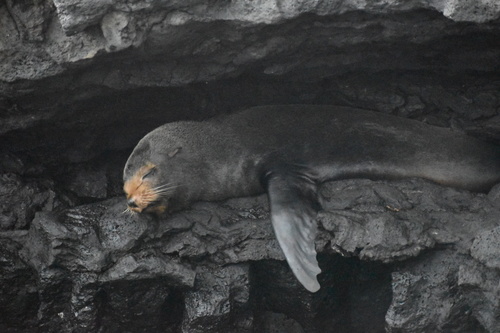
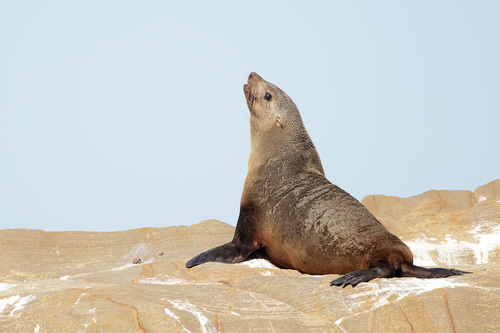
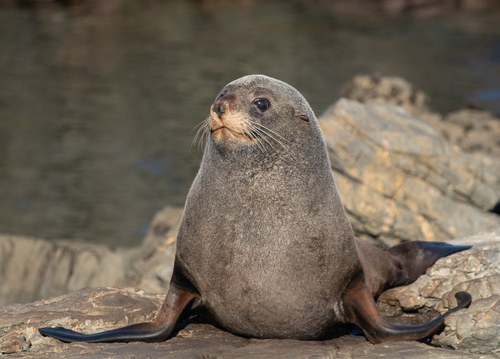
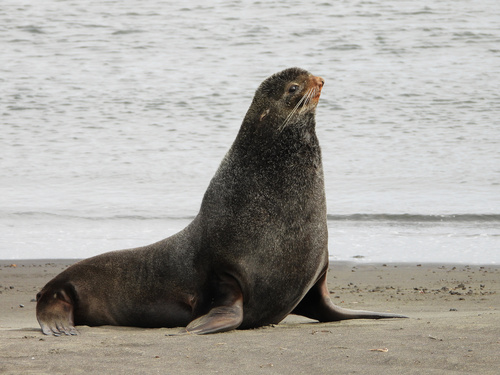
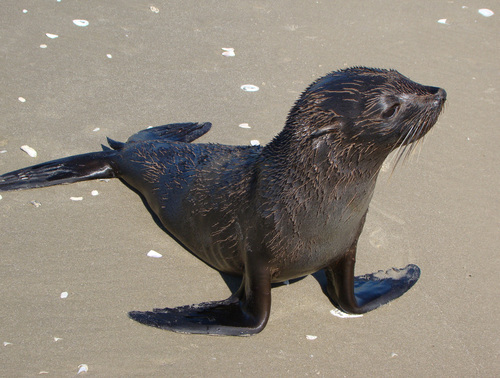
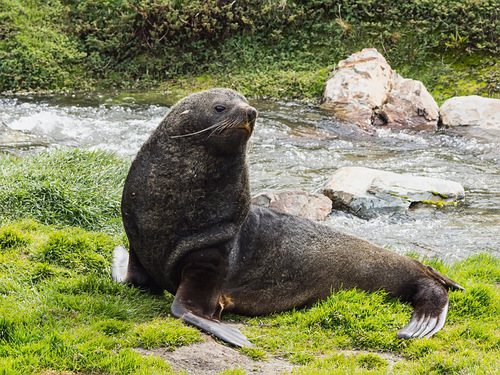
Arctocephalus gazella, the Antarctic fur seal, is a midsized pinniped. Compared to other members of its family, it has a relatively long neck and pointed muzzle. Its nose does not extend far past the mouth, and it has long, prominent external ears that are naked at the tip. Adults have very long vibrissae; these are especially long in males, reaching 35 to 50 cm. Fore flippers make up about one-third of the seal’s total length, while hind flippers make up slightly more than one-fourth. Adult males are dark brown in color, while females and juveniles tend to be paler, almost grey, with lighter undersides. Color patterns are highly variable, and scientists have reported hybridization between Subantarctic and Antarctic fur seals. Pups are dark brown, almost black, when born, though a very small number of partially leucistic Antarctic fur seals have been found. Males are substantially larger than females: males grow up to 2 m (6.5 ft) long with a mean weight of 133 kg (293 lb), while females reach 1.4 m (4.6 ft) with a mean weight of 34 kg (74.9 lb). At birth, the mean standard length of pups is 67.4 cm (range 58–66 cm); newborn males have a mean mass of 5.9 kg (range 4.9–6.6 kg), and newborn females have a mean mass of 5.4 kg (range 4.8–5.9 kg). Antarctic fur seals can live up to 20 years, with the maximum observed lifespan for a female being 24 years. Antarctic fur seals are believed to be the most abundant species of fur seal. The largest congregation of the species is on South Georgia in the southern Atlantic Ocean, which holds approximately 95% of the global population. The current best estimate of the South Georgia population is between 4.5 and 6.2 million animals. Bouvet Island has the second largest population, with 46,834 animals. There are regional differences in population trends: some colonies, such as those on the Kerguelen Islands and McDonald Islands, are increasing in size; some colonies, such as those on Macquarie Island and the Heard Islands, are stable; and some colonies, such as that on Bouvet Island, are decreasing in size. Antarctic fur seals have a circumpolar distribution, and breed between 61° S and the Antarctic Convergence. Breeding colonies are found at South Georgia and the South Sandwich Islands, South Orkney Islands, South Shetland Islands, and Bouvet Island in the Southern Atlantic Ocean; Marion Island, Crozet Islands, Kerguelen, and Heard Island in the Southern Indian Ocean; and Macquarie Island in the Southern Pacific Ocean. During winter, Antarctic fur seals range widely from the Antarctic continent to the Falkland Islands and southern Argentina, reaching as far as Mar del Plata and Gough Island.