About Arctocephalus forsteri (Lesson, 1828)
Scientific name: Arctocephalus forsteri (Lesson, 1828)
Description: Adult males reach a maximum recorded weight of 160 kg (350 lb), with an average weight of 126 kg (278 lb) and a maximum length of 2 m (6 ft 7 in). Adult females average 30 to 50 kg (66–110 lbs) and can grow up to 1.5 m (4 ft 11 in) long. Newborn pups average 3.3–3.9 kg (7.3–8.6 lbs) in weight and 40–55 cm (1.3–1.8 ft) in length. At 290 days old, young males weigh about 14.1 kg (31 lb), and young females weigh about 12.6 kg (28 lb).
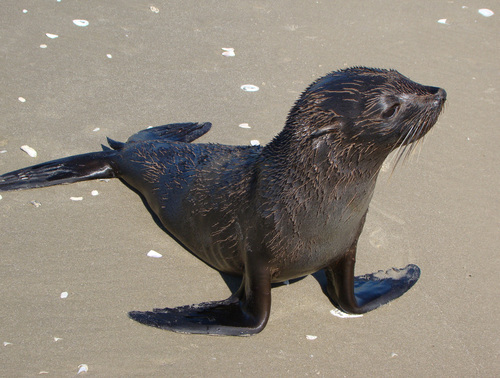
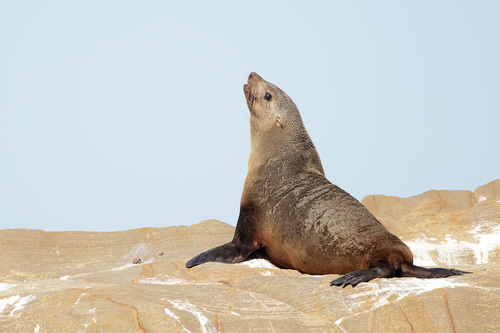
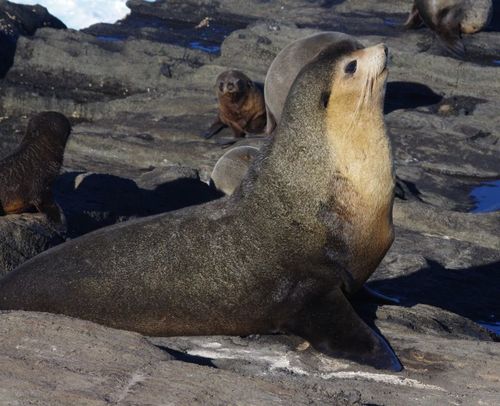
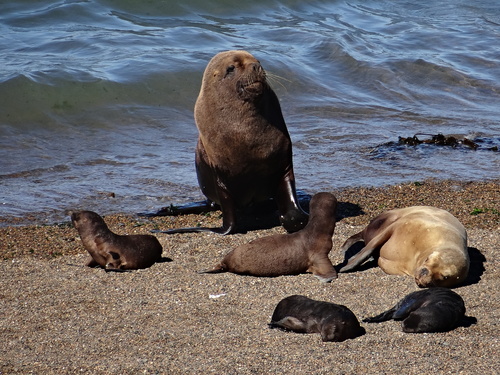
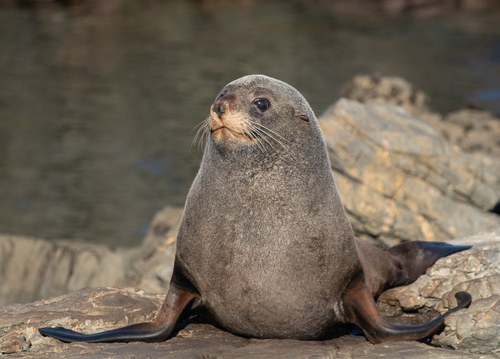
Like all other otariids, Arctocephalus forsteri has external ear flaps and hind flippers that rotate forward, traits that visibly distinguish it from true seals. It has a pointed nose and long pale whiskers. As with other fur seals, this species has two layers of fur. Its coat is grey-brown on the back, and lighter in color on the belly. Some individuals have white tips on their longer upper hairs, which can give their coat a silver-like appearance. So-called "Upland Seals" once found on Antipodes Islands and Macquarie Island have been classified by some scientists as a distinct thicker-furred subspecies, but it remains unclear whether these populations were genetically distinct.
Distribution: This species occurs in Australia and New Zealand. In Australia, it lives in coastal waters and on offshore islands of southern Australia, ranging from the south-west corner of Western Australia to just east of Kangaroo Island in South Australia, and is also found in southern Tasmania and subantarctic Macquarie Island. Small new populations are currently forming in Bass Strait, and in coastal waters of Victoria and New South Wales as far north as the mid-north coast of New South Wales.
Before human arrival in New Zealand, this species bred around the entire New Zealand mainland and all of New Zealand's subantarctic islands. Today, there are established, expanding colonies around the entire South Island, on Stewart Island, and on all New Zealand subantarctic islands. New breeding colonies have also recently become established on the North Island.
Reproduction: Females reach sexual maturity between 4 and 6 years old, while males reach sexual maturity between 8 and 10 years old. This species is polygynous. Males claim and guard territories in late October, before females arrive at breeding grounds. Females typically mate only once per year; mating usually occurs eight days after giving birth, and lasts an average of 13 minutes. Females experience delayed implantation of the fertilized egg: the embryo does not implant on the uterine wall for 3 months after fertilization. Total gestation lasts 9 months.
Females become more aggressive near the time of birth, and prefer not to be approached immediately after giving birth. They continue reproducing until death, which occurs at an average age of 14 to 17 years. Females first arrive at breeding shores between November and January, just a few days before giving birth, and remain close to the birth site for up to ten days. As labor approaches, they become very restless and irritable. Labor can last up to five hours: females lie down, toss their head upward, strain forward on their fore flippers, lift their hind quarters, or move side to side, then slowly lower their head, repeating this cycle until birth is complete.
In one study of birth timing, measured from when the pup first becomes visible, head-first deliveries averaged 2 minutes, while tail-first deliveries averaged 6.5 minutes. Immediately after birth, the mother frequently sniffs her newborn pup to learn its scent, which helps her identify it after she returns from foraging trips at sea. Pups are fairly mature at birth, and start suckling within 60 minutes, for an initial period of about 7 minutes. Suckling sessions can eventually exceed 33 minutes in length. After birth, mothers may leave their pups to go swimming anywhere from 45 minutes to 3 days later, and leave on longer foraging trips after 6 to 12 days. Even on longer trips, mothers generally do not leave their pups for more than 2 days at a time.
When pups are about 21 days old, they gather into small groups called pods while their mothers are away foraging. When females return from trips, they only nurse their own pups, and are hostile to unrelated pups that attempt to suckle from them. Over the course of lactation, females gradually increase the length of their foraging trips. Mothers of male pups make longer foraging trips on average than mothers of female pups during lactation. Growth patterns for male and female pups are broadly similar across cohorts, but males grow faster and are weaned at a heavier weight in some years. Total lactation lasts approximately 300 days. Pups begin eating solid food just before weaning, and are typically weaned around September, after which they disperse.
Pup mortality stems from both natural factors and human activity. The leading natural cause of pup death is starvation, followed by suffocation in the amnion, stillbirth, trampling, drowning, and predation. Human-related causes of mortality include stress from pup handling, tagging, and general human presence in breeding areas.