About Arctictis binturong (Raffles, 1821)
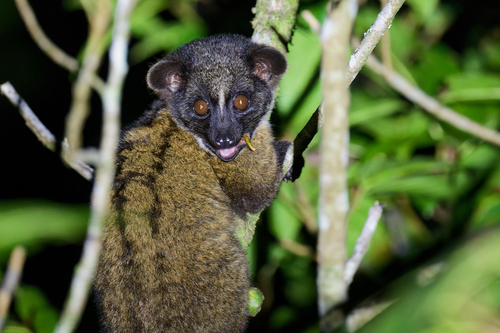
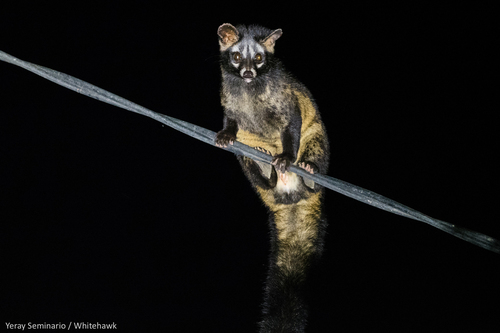
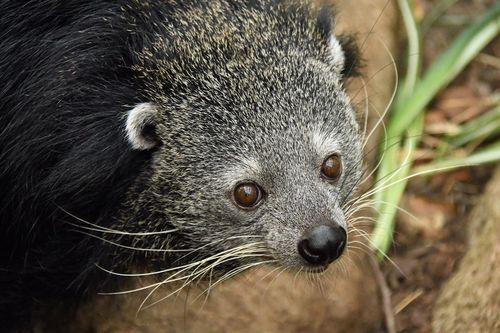
Arctictis binturong, commonly called the binturong, is long and heavy with short, stout legs. It has a thick coat of coarse black hair. Its bushy, prehensile tail is thick at the base, gradually tapers, and curls inward at the tip. The muzzle is short and pointed, slightly upturned at the nose, covered in bristly hairs that are brown at the tips; these hairs lengthen as they spread out, forming a distinct radiated circle around the face. Its eyes are large, black, and prominent. The ears are short and rounded, edged with white, and end in tufts of black hair. Each jaw holds six short, rounded incisors, two long, sharp canines, and six molars on each side. The hair on its legs is short and has a yellowish tinge. Its feet are five-toed, with large strong claws; the soles are bare, and the species is plantigrade, meaning the entire foot length contacts the ground. The hind feet are longer than the fore feet. In overall build, the binturong is very similar to Paradoxurus and Paguma, but is more massive in the tail, legs, and feet. It also differs in scent gland structure, and has a larger rhinarium that is more convex, with a median groove that is much narrower above the philtrum. The binturong's coat contour hairs are much longer and coarser, and the long hairs covering the entire back of the ears project past the tip to form a clear tuft. The anterior bursa flap of the ears is more widely and less deeply notched. The tail is more muscular, especially at the base, and matches the body's color, but is usually paler on the underside near the base. Binturong body hairs are often partially whitish or buff, creating a speckled look to the fur; in some individuals the coat is so pale that the whole body is mostly straw-colored or grey. Young binturongs are often paler than adults, but the head is always tightly speckled with grey or buff. The long mystacial vibrissae are noticeably white, and there is a white rim on the top of the otherwise black ear. The glandular area of the body is whitish. The tail is almost as long as the combined head and body length. Wild binturong head and body length ranges from 71 to 84 cm (28 to 33 in), while tail length ranges from 66 to 69 cm (26 to 27 in). Some captive binturongs measured 75 to 90 cm (30 to 35 in) in head and body length, with a tail 71 cm (2 ft 4 in) long. The mean weight of captive adult females is 21.9 kg (48 lb), with a range of 11 to 32 kg (24 to 71 lb). Captive binturongs typically weigh more than wild individuals. In one dataset, 12 captive female binturongs had a mean weight of 24.4 kg (54 lb), while 22 captive males had a mean weight of 19.3 kg (43 lb). One study estimated the mean weight of wild females at 10.5 kg (23 lb). However, seven wild male binturongs in Thailand had a mean weight of 13.3 kg (29 lb), while one wild female in the same area weighed a similar 13.5 kg (30 lb). One published estimate puts the mean body mass of all wild binturongs at 15 kg (33 lb). Both sexes have scent glands: females have them on either side of the vulva, and males have them between the scrotum and penis. The musk glands produce an odor similar to popcorn or corn chips, which the Malaysian Jahai people call "ltpɨt". This odor likely comes from the volatile compound 2-acetyl-1-pyrroline found in binturong urine, the same compound produced during high-temperature Maillard reactions. Unlike most other carnivorans, male binturongs do not have a baculum. The binturong's range extends from India, Nepal, Bangladesh, Bhutan, Myanmar, Thailand, and Malaysia, through Laos, Cambodia, Vietnam, and Yunnan, China, to Sumatra, Kalimantan, and Java in Indonesia, and Palawan in the Philippines. It lives only in tall forest. In Assam, India, it is common in foothills and hills with dense tree cover, but less common in forested plains. It has been recorded in Manas National Park, Dulung and Kakoi Reserved Forests in Lakhimpur district, and the hill forests of Karbi Anglong, North Cachar Hills, Cachar, and Hailakandi Districts; it was also recorded in Kaziranga National Park in 2024. In Myanmar, binturongs have been photographed on the ground in Tanintharyi Nature Reserve at 60 m (200 ft) elevation in the Hukaung Valley, at 220–280 m (720–920 ft) in the Rakhine Yoma Elephant Reserve, at 580 m (1,900 ft), and at three other sites up to 1,190 m (3,900 ft) elevation. In Thailand's Khao Yai National Park, multiple individuals have been observed feeding in a fig tree and on a vine. In Laos, they have been observed living in extensive evergreen forest. In Malaysia, binturongs have been recorded in secondary forest surrounding a palm estate that was logged in the 1970s. On Palawan, it lives in primary and secondary lowland forest, including grassland-forest mosaic from sea level up to 400 m (1,300 ft). The binturong is active both during the day and at night. Three sightings in Pakke Tiger Reserve occurred during the day. Camera traps in Myanmar captured thirteen binturongs: one around dusk, seven at night, and five in full daylight. All photographs showed single individuals, and all were taken on the ground. Because binturongs are not very agile, they likely must descend to the ground fairly often when moving between trees. Five radio-collared binturongs in the Phu Khieo Wildlife Sanctuary showed arrhythmic activity patterns dominated by crepuscular and nocturnal habits, with activity peaks in the early morning and late evening. Activity drops from midday to late afternoon. In the dry season, they move between 25 m (82 ft) and 2,698 m (8,852 ft) per day, and increase daily movement to 4,143 m (13,593 ft) in the wet season. Male home ranges vary between 0.9 and 6.1 km2 (0.35 and 2.36 sq mi); two males had slightly larger ranges in the wet season. Male ranges overlap between 30 and 70%. The average home range of a radio-collared female in Khao Yai National Park was estimated at 4 km2 (1.5 sq mi), while male home ranges there ranged from 4.5 to 20.5 km2 (1.7 to 7.9 sq mi). The binturong is primarily arboreal. Mammalogist Pocock observed the behavior of several captive binturongs at the London Zoological Gardens: when resting, they lay curled up with their heads tucked under their tails. They rarely leaped, but climbed skillfully (if slowly), moving with equal ease and confidence along the top of branches or upside down under branches. Their prehensile tail was always ready to help with climbing. They descended vertical cage bars head first, gripping the bars between their paws and using the prehensile tail to slow their descent. When irritated, they growled fiercely. When moving, they periodically make a series of low grunts or a hissing sound produced by expelling air through partially opened lips. The binturong uses its tail to communicate. It moves gently, clinging to branches and stopping often, frequently using its tail to maintain balance. It performs distinct comfort behaviors including fur grooming, shaking and licking its hair, and scratching; shaking is the most characteristic of these comfort behaviors. On average, females reach sexual maturation at 30.4 months old, and males reach sexual maturation at 27.7 months old. The binturong's estrous cycle lasts 18 to 187 days, with an average of 82.5 days. Gestation lasts 84 to 99 days. Litter size in captivity ranges from one to six young, with an average of two young per birth. Newborn binturongs weigh between 280 and 340 g (9.9 and 12.0 oz). Females remain fertile until 15 years of age.