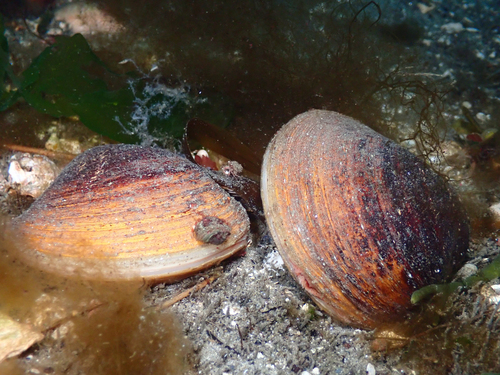
About Arctica islandica (Linnaeus, 1767)
The ocean quahog (Arctica islandica) is an edible species of marine bivalve mollusk that belongs to the family Arcticidae. This species is native to the North Atlantic Ocean and is harvested commercially as food. It has many alternative common names, including Icelandic cyprine, mahogany clam, mahogany quahog, black quahog, and black clam. The typical Arctica islandica looks similar to the common quahog, but the ocean quahog has a rounder shell, its periostracum is usually black, and the pallial line on the interior of its shell has no indentation called a sinus. Unlike the common quahog, which lives in intertidal areas and can be collected by clam digging, Arctica islandica lives subtidally and can only be collected by dredging. They can grow to a shell height exceeding 50 millimeters, or two inches. One individual specimen was reported to have lived 507 years, making it the longest-lived non-clonal metazoan with an accurately confirmed age. Arctica islandica has a slower growth rate than other clam species. Development from embryo to larvae takes an average of 4 days after fertilization. On average, this species reaches maturity at 5.8 years of age. After reaching maturity, somatic maintenance costs begin to decrease. Dynamic Energy Models predict that Arctica islandica's extreme longevity comes from lowered somatic maintenance costs and low aging acceleration. For populations in cold regions, growth rate is likely slowed further because growth only occurs during the summer. This slow life history results in exceptional longevity, most famously for the specimen nicknamed Ming the clam, which had a recorded age of 507 years. Arctica islandica is the longest-lived non-colonial metazoan species with an authenticated lifespan. It remains unknown how much longer Ming would have lived if it had not been collected alive during a 2006 research expedition. This species' extreme longevity and incremental shell growth have proven very useful in the field of sclerochronology, the study of periodic physical and chemical features in the hard accreted tissues of growing animals. It is especially valuable for reconstructing paleoclimates. In 1868, a 374-year-old live specimen collected near Iceland was studied. Analysis of its growth rate and oxygen isotope data showed that it recorded highly variable growth during the Little Ice Age peak around 1550–1620, mild climate conditions near the end of the Little Ice Age around 1765–1780, and even the 1815 volcanic eruption of Mount Tambora. One study of specimens aged 4 to 192 years found that antioxidant enzyme activity declined rapidly during the first 25 years of life, a period that includes growth and sexual maturity, but remained stable for over 150 years after this early decline. While more detailed research is still needed, Arctica islandica appears to be an example of a species with negligible senescence. In contrast to the very long-lived populations found in relatively deep, cold parts of the species' range, more southern populations that experience larger seasonal variations in salinity and temperature typically have much shorter lifespans. For example, Arctica islandica from the German Bay of Kiel usually only reach around 30 years of age, while those from the German Bight reach about 150 years. Like other clam species, Arctica islandica is a filter feeder. Its feeding activity appears to be regulated by light levels, which act as a proxy for food availability. At the northern extreme of the species' distribution, this means feeding is concentrated over eight months of the year, while clams only feed for a few days each month during the remaining four months.

