About Archosargus probatocephalus (Walbaum, 1792)
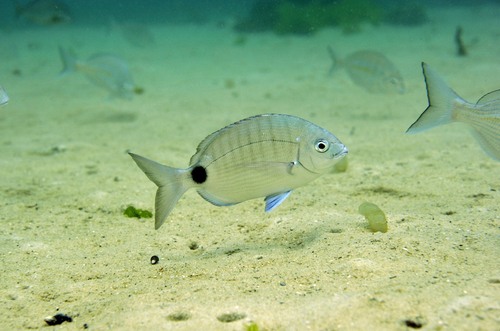
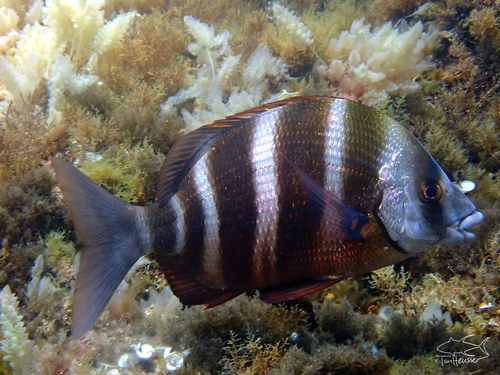
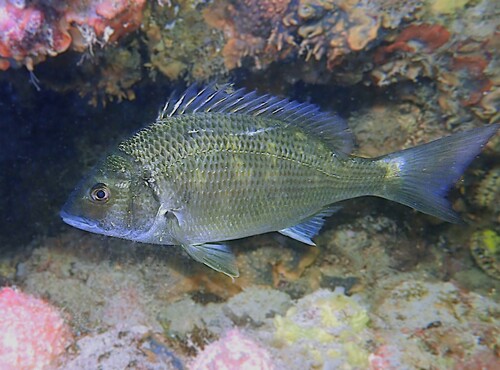
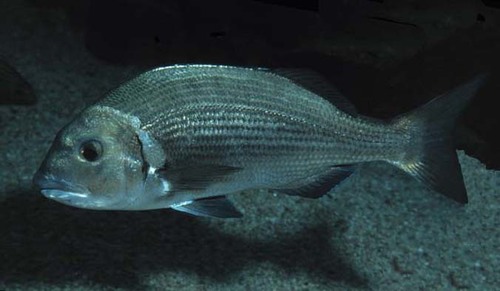
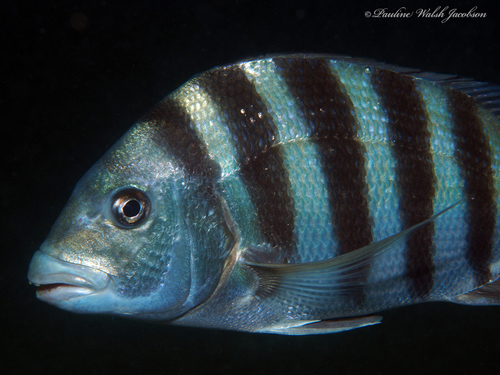
Archosargus probatocephalus, first formally described by Walbaum in 1792, has an oval, deep, laterally compressed body paired with a small blunt head. Both the dorsal and ventral profiles of its head are convex. It has moderately sized eyes, a small horizontal mouth, and its preorbital bone overlaps the rear of the maxilla. The teeth at the front of its jaw are broad and flattened, and the sides of the upper jaw hold three rows of molar-like teeth. The margin of the preoperculum is completely smooth, with no serrations or spines. Its long, low dorsal fin is supported by 12 spines, where the front spine points forward and may be embedded, plus 11 soft rays. The anal fin has 3 spines, with the second spine being particularly robust, and 9 or 10 soft rays. The pectoral fin is long, distinctly longer than the pelvic fins, and extends to the level of the anal fin's middle spine. The caudal fin is forked. Adult Archosargus probatocephalus are silvery to greenish-yellow, with an olive tint on the upper body. Five or six dark vertical bars run along their flanks, and these bars fade as the fish ages. The caudal and pectoral fins are greenish, while the dorsal, anal, and pelvic fins are dark. This species reaches a maximum published total length of 91 cm (36 inches), though a length of 35 cm (14 inches) is more typical. Archosargus probatocephalus is distributed in the Western Atlantic Ocean, ranging from Nova Scotia south to Rio Grande do Sul, Brazil, and its range includes the Gulf of Mexico and the Caribbean Sea. It mainly inhabits coastal waters near rock pilings, jetties, mangrove roots, and piers, and is also found in tidal creeks. It is euryhaline and prefers brackish waters. It seeks out warmer areas around springs and river discharges, and will occasionally enter freshwater during the winter.