About Architectonica nobilis Röding, 1798
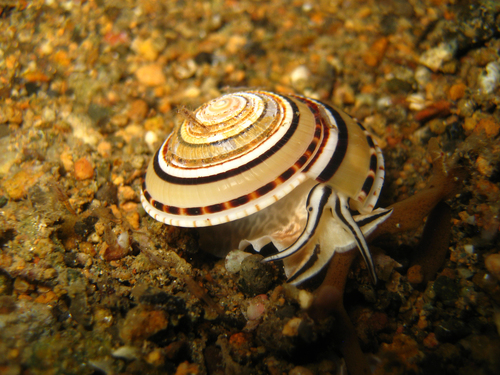
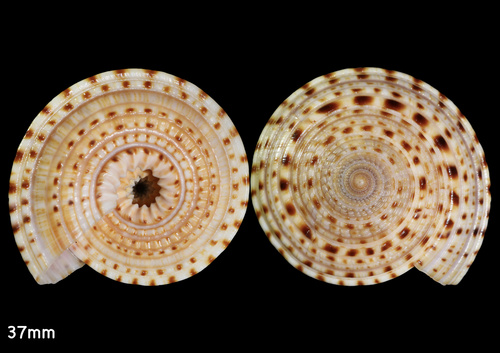
Architectonica nobilis Röding, 1798 has been previously described under two different synonyms, originally documented in Latin. From the original description of Solarium quadriceps: the shell is orbicular-discoidal, with numerous flattened whorls encircled by four rows of varying width. The cords hold quadrate, flattened, closely spaced tubercles; the lower and upper cords are larger and colored red. The shell base is swollen, and its median area has radiating folds. The umbilicus is wide open, surrounded by large brown crenations, while the narrow umbilical area is smooth. From the original description of Solarium ordinarium: the shell is orbicular-conoidal, depressed, and has a moderate umbilicus. It is whitish or lilac-tinted, and marked with red punctures. It has 5 whorls that are barely slightly convex, encircled by five oblique granose ridges. The body whorl has a sharp angle at its periphery, is generally lilaceous, and is concentrically grooved and girdled. The girdle surrounding the umbilicus is the largest and strongly crenated, and all other girdles are also more or less crenulated or have sub-quadrately shaped granules. The aperture is trapeziform, and has two channels at the columella. The overall shell has a whitish-yellow ground color. A series of red-brown spots appear in the zone just below the suture. The color pattern is finished by paler spots spread across both the spiral cords and interspaces, above and below the shell base. This is a marine species with a wide distribution. It occurs on sand in shallow waters off the coasts of North America, Central America, South America, and Spain.