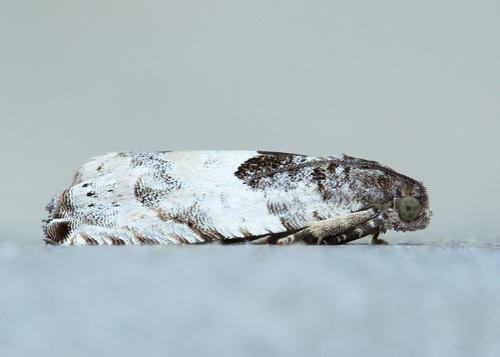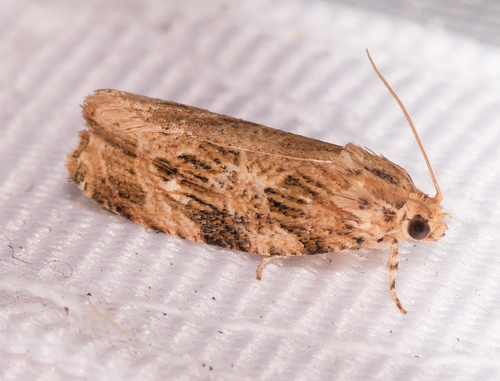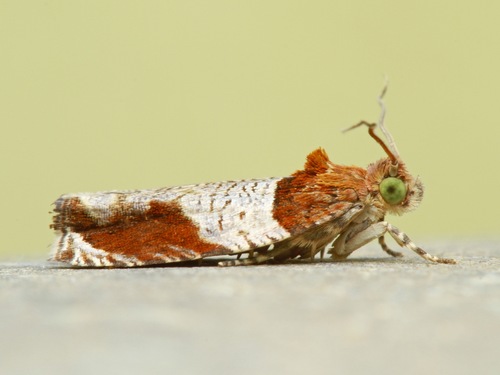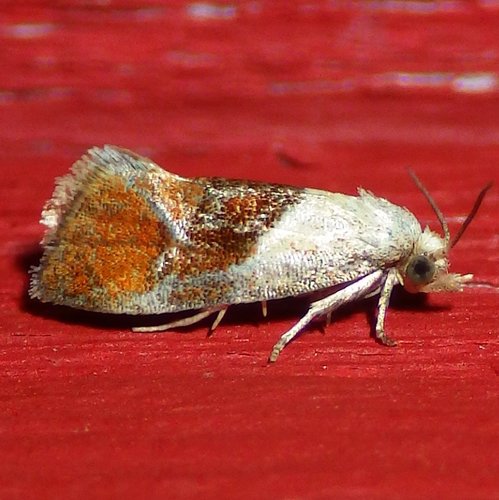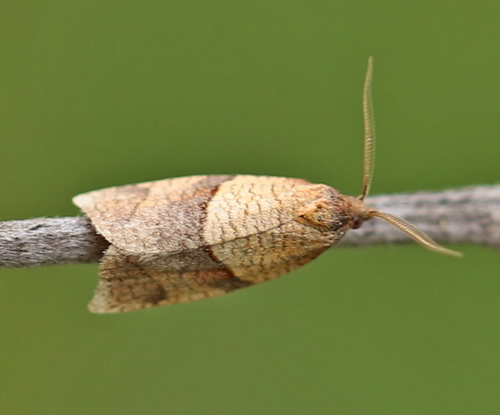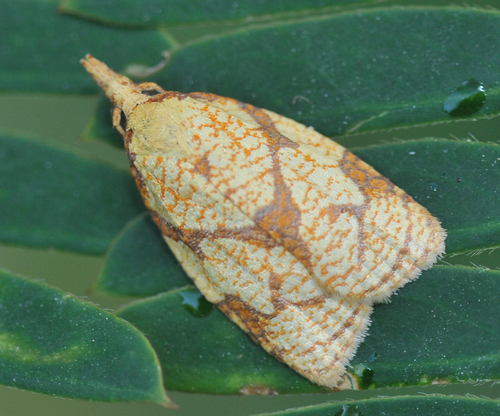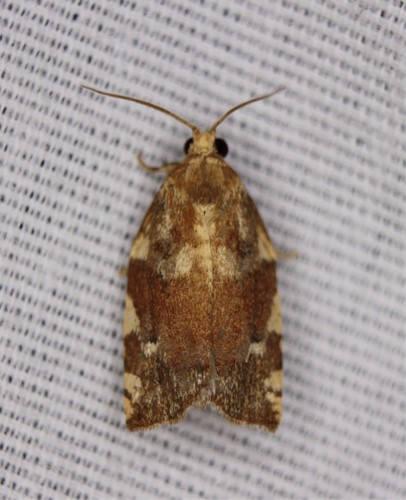
About Archips semiferanus (Walker, 1863)
Archips semiferanus, commonly known as the oak leafroller moth, follows an annual life cycle. In most regions, adult females lay clutches of 40 to 50 eggs each in July. Females cover these egg masses with hairs from their own body, depositing them at the base of large branches and on rough bark patches of tree trunks and limbs. The flat, oval egg masses are white-gray, and measure approximately 4.8 millimetres (0.19 in) across. Eggs overwinter and hatch the following spring. Larvae (caterpillars) emerge in April, and first feed on oak tree buds and the young leaves growing inside these buds. When fully mature, larvae are 25 to 29 millimetres (0.98 to 1.14 in) long. Their bodies may be yellow-green or darker green shades, and they have distinct identifying features: pale legs, and a head that is either solid black or marked with a dark eye patch or dark bar. Larvae feed and reside inside rolled or folded leaves until they are ready to pupate in mid-June. Pupation occurs inside cocoons located within the rolled leaves or in bark crevices. After one to two weeks in the pupal stage, adult moths emerge in late June or early July. Adults mate and lay eggs to begin the next generation, and the species produces only one generation per year. In Texas, where spring arrives earlier, all life cycle stages occur earlier than in other parts of the range. Eggs are laid in May and hatch the following mid-March, and pupae in Texas are additionally found on branch tips and on weeds near host trees. Oak leafroller larvae can be dislodged from trees and dangle below them on silk threads. While the larvae cannot harm humans, people in Texas generally avoid walking under oak trees to avoid encountering them. Archips semiferanus is native to the eastern United States and adjacent parts of southeastern Canada. It has been recorded in the U.S. states of Connecticut, Massachusetts, New York, Pennsylvania, Texas, Virginia, and West Virginia, and may have been introduced to the United Kingdom. These moths feed on all types of oak trees, but infestations are especially common on northern red oak, scarlet oak, and mountain and ridge-top species such as chestnut oak and white oak. Occasional feeding has also been recorded on witchhazel and apple trees, and other oak pest species such as Croesia semipurpurana and other oak leaftiers often feed on the same infested trees. Young larvae eat leaf buds, which can either destroy developing leaves or cause leaves to grow with numerous holes. This severely drains the tree’s food reserves; older larvae can then consume nearly all remaining leaves, fully defoliating the tree. When a tree is defoliated for two or more consecutive years, extensive tree mortality can occur. Dead wood in affected trees is then attacked by fungi such as shoestring root fungus and wood borers like the twolined chestnut borer. Tiadaghton State Forest in north central Pennsylvania was particularly severely impacted by outbreaks. In the late 1960s and early 1970s, oak leafrollers defoliated over 1,045,000 acres (423,000 ha) of oak forest in Pennsylvania. By 1975, the Pennsylvania Bureau of Forestry reported that the value of lost oak timber from the outbreak exceeded $100,000,000. Hikers in the Quehanna Wild Area of northern Pennsylvania were warned about increased fire risk from large numbers of dead oak trees left by infestations on the Allegheny Plateau. As of 2001, recent outbreaks had been recorded in Cambria, Cameron, Clearfield, Clinton, and Warren counties in Pennsylvania. The pesticide DDT was used to control oak leafroller outbreaks until it was banned in the United States in 1972. In 1974, the United States Forest Service tested four alternative insecticides on oak leafroller larvae, and found that less than 1 microgram of each tested insecticide (bioethanomethrin, mexacarbate, phoxim, and pyrethrins) caused 90 percent mortality. Natural predators of the larvae include parasitic wasps and bird species such as mockingbirds. The sex pheromones of this species have also been the subject of scientific study.