About Archips cerasivorana (Fitch, 1856)
This species is scientifically named Archips cerasivorana (Fitch, 1856).
Larval morphology: larvae can be distinguished by their specific coloration. Early instars are yellowish-green, with black legs, head, prothoracic shield, and anal shield. Later instars are bright orange, with the same contrasting dark sclerotization, plus sparse, moderately long pale setae. Last instar larvae measure 19–26 mm in length, and have a yellow to dark yellowish-green abdomen. The head, prothoracic shield, thoracic legs, and anal shield are dark brown to black. An anal comb is not present. Larvae of Archips rileyana are very similar in appearance to larvae of A. cerasivorana.
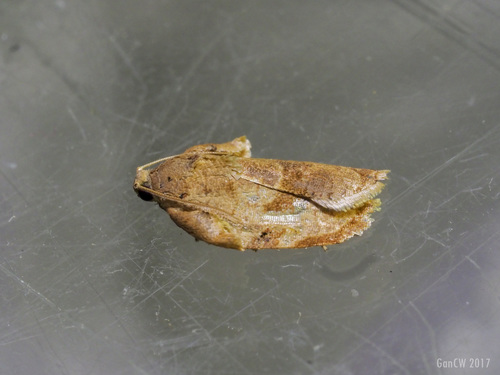
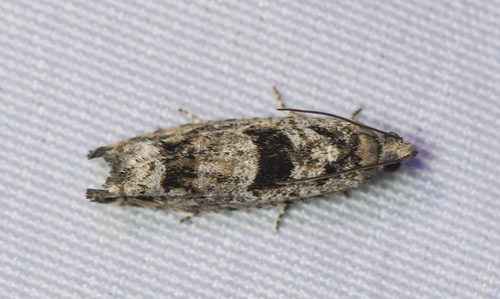
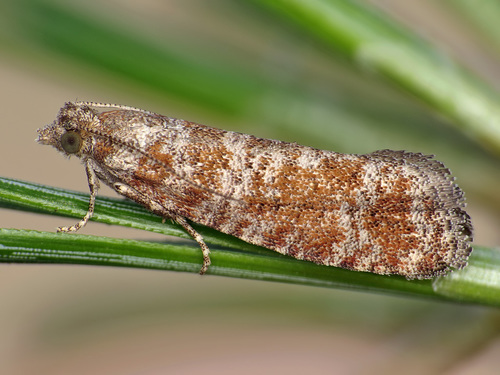
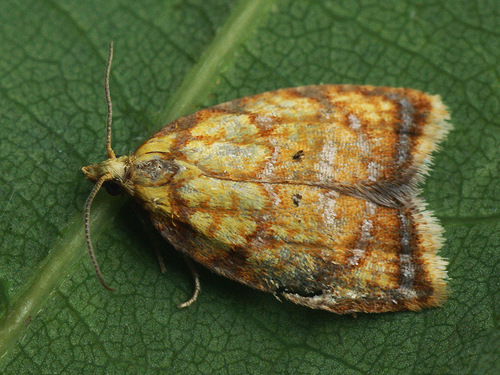
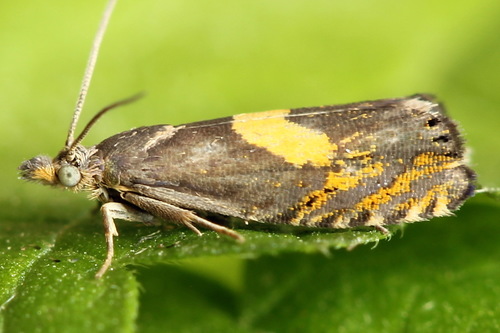
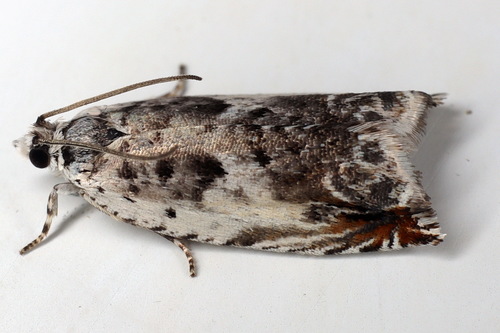
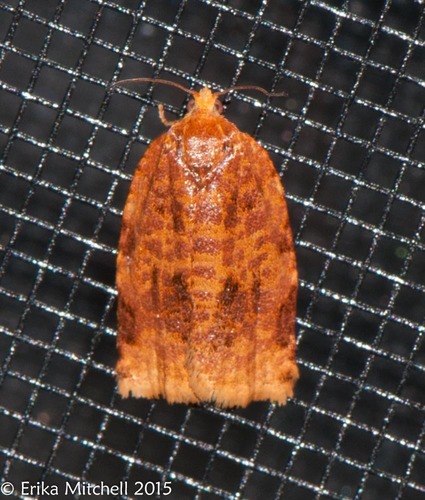
Adult morphology: forewing length ranges from 7.5–9.5 mm in adult males, and 9.0–12.0 mm in adult females. Adults are easily identified by their orange forewings marked with many silvery bars. Forewing color ranges from bright orange to yellow, and often bears faint purplish markings. Males have a forewing costal fold. Distinct brown squared blotches run along the costa in the median and postmedian areas, alongside variable smaller brown markings through the middle of the wing in the antemedian and median areas. Most of the body and the hindwings are also orange. The total wingspan measures 20–25 mm, and the hindwings are yellow with orange shading.
Distribution: this moth is found across multiple regions of North America, ranging from Alaska through Canada to the United States. Within the United States, it occurs as far east as New England, as far south as North Carolina, and as far west as California, Utah, and Colorado.
Life cycle and behavior: this species has one generation per year. Females lay egg masses containing 25 to 200 eggs at the base of shoots, often close to the ground. Females strongly prefer chokecherry as a host. Eggs overwinter, and first instar larvae hatch in May. Adult moths can be found from early July to mid-September. Unlike many other tortricids, A. cerasivorana larvae are social, and feed inside silken nests built on the terminals of host plants. These webs form around the host's terminal shoots, and may sometimes cover entire plants. Pupation takes place inside individual cells within the silk shelter. Adults are not very active during the day, and can be found resting on foliage. At night, adults are known to be attracted to light. A typical nest holds between 30 and 200 larvae, and can grow up to 30 inches in diameter. The colony expands the nest when it needs more food, and all feeding happens under the protection of the nest. Early instar larvae skeletonize leaves, while later instar larvae consume entire leaves. Pupation occurs inside chambers built from frass and silk within the nest. Before adult emergence, pupae work their way to the outer surface of the silk nest, where the adult moth finally ecloses.