About Archilochus alexandri (Bourcier & Mulsant, 1846)
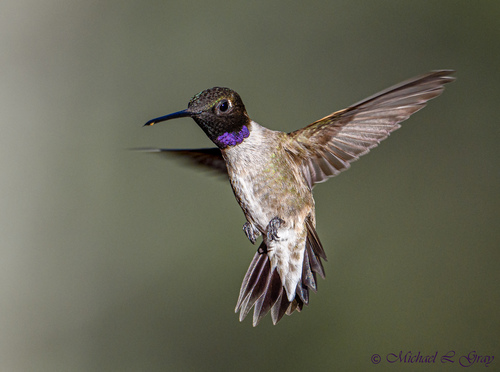
The black-chinned hummingbird (Archilochus alexandri (Bourcier & Mulsant, 1846)) measures 8.25 cm (3.25 in) in total length. Adult individuals have metallic green upper plumage, white underparts, and green flanks. Their bill is long, straight, and slender. Adult males have a black face and chin, a glossy purple gorget, and a dark forked tail. Adult females have a dark rounded tail with white tips and lack a throat patch. Juvenile plumage is similar to that of adult females, but has buff margins on the dorsal feathers. Juvenile males may also have purple feathers on their throats. Unlike adults, juveniles do not have a forked tail. Newly hatched young are born almost featherless, but grow a full set of feathers within three weeks of hatching. After migrating to their winter range, juveniles begin molting their feathers in November, and grow a complete new set of feathers before they reach one year of age. Similar species that are related to the black-chinned hummingbird include the broad-tailed hummingbird, rufous hummingbird, calliope hummingbird, Allen's hummingbird, lucifer hummingbird, Anna's hummingbird, and Costa's hummingbird. Black-chinned hummingbirds are distributed across most of the western United States, ranging north into Canada in Alberta and British Columbia, east to Oklahoma, and south as far as Mexico. They occupy mountains, woodlands, orchards, meadows, and chaparral habitats. Their breeding habitat consists of open, semiarid areas, usually located near water, in the western United States, northern Mexico, and southern British Columbia. They may also live in moist environments including orchards, shaded canyons, and riparian woods. Males and females of this species use different habitats from each other for their breeding territories.